interview
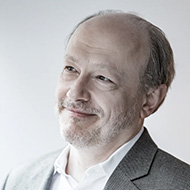
Interview with Marc-André Hamelin
July 31, 2026
“I consider composing an indispensable tool for performing musicians.”…


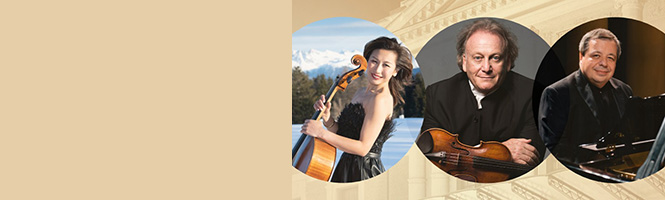


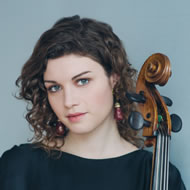
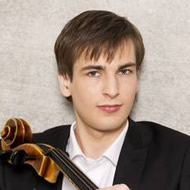
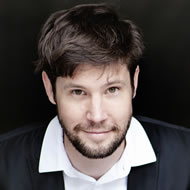
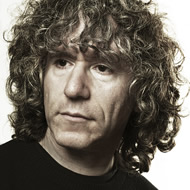
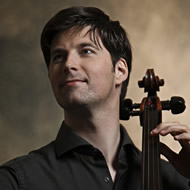
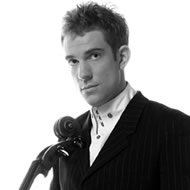
Born in Munich and raised in Spain, Sebastian Klinger received his first cello lessons at the age of six. He later studied with Heinrich Schiff in Salzburg and Vienna, and with Boris Pergamenschikow in Berlin. After receiving numerous national and international awards at various competitions and foundations, he won the German Music Competition in 2001. This was followed by debuts at major German festivals in Schleswig-Holstein, Rheingau, Mecklenburg-Vorpommern, and Ludwigsburg, as well as several recitals at the Concertgebouw Amsterdam. In 2002, at the initiative of the Cologne Philharmonic, he was invited to perform as part of the Rising Stars Series (European Concert Hall Organization), which ultimately led him to the most important music centers in Europe and the USA (Carnegie Hall, New York; Wigmore Hall, London; Palais des Beaux-Arts, Brussels; Konserthus, Stockholm; Konzerthaus, Vienna, among others). Sebastian Klinger now performs as a soloist and chamber musician throughout Europe, Asia, and the United States.
Classicpoint.net: You were born in Munich but grew up in Gran Canaria until you were 11. How did that shape you?
The years on the island were, of course, very formative. The people there, the language, the subtropical climate (with the incomparable Canarian light), the unique flora and fauna – and, of course, the sea – have been very familiar to me ever since. Back in the early 1980s, it was still the time before the digital revolution. Moving to such a place as a family was a real adventure back then – perhaps even more so than today, when all digital information sources are always available to us in our globalized world. We lived inland in a wonderful house with a huge garden. When my brother and I weren't at school, you could almost always find us outside, exploring the area around the house, building something, collecting things, reading, or playing with our dog. I also remember many fantastic island tours with family and friends, where we experienced the incredible richness of color and contrast in the local nature. We regularly went to the seaside, among other things to learn windsurfing at the Dunkerbeck family's surf school, but we also took advantage of the local cultural program with its unforgettable concerts. And that's how I started playing the cello there, and my first teacher became the principal cellist of the local orchestra.
Do you remember your first performance with the cello?
Of course, that was there too, at a school concert where I was allowed to perform Vivaldi's E minor sonata. I was incredibly nervous just before my performance and didn't want to go on stage. But after my mother, who accompanied me on the piano, persuaded me, I played after all – and I still remember exactly how wonderful it felt to finally play the piece in a concert setting for an audience.
What ultimately led you to want to make the cello your profession?
All my first cello records and CDs were by Slava or Yo-Yo Ma. I listened to them over and over again for years and soon knew: what they were doing is what I wanted to do in my life. And surprisingly, I've remained relatively straightforward along the way.
while studying at Heinrich Schiff's place Christian Poltéra . Can you tell us a few anecdotes from that time?
Ha, there are quite a few! I remember, for example, a very funny cloak-and-dagger operation where, during an apartment clearance, we had to dispose of a large, old mattress that had been sitting on the balcony for months, completely waterlogged and totally moldy, and it took us ages. I'd rather not reveal where we disposed of it! Or how we repeatedly tested the acceleration and top speed of Heinrich Schiff's car on the speed-limited Austrian motorways. If we had been caught back then, it certainly would have been newsworthy enough for the local newspaper…
Despite launching your solo career with the Bavarian Radio Symphony Orchestra in 2004, you took on the position of principal cellist. Didn't that limit your career?
That depends entirely on how you define "career." For me, pursuing a career in the sense of "only solo" was never the primary focus. When I received the call asking if I'd be interested in auditioning for the Bavarian Radio Symphony Orchestra, I was simply intrigued — partly because I had very little experience playing in a symphony orchestra up to that point. I never saw the point in committing myself too strictly to a particular genre or ensemble. I'm therefore grateful to have been able to enjoy a good mix of orchestral, chamber music, and solo work for so many years now. And, of course, teaching came along a while ago!
Compared to 20 years ago, there are now a large number of first-class solo cellists on the market. Why are there suddenly so many?
I think it has a lot to do with the pedagogical work of great teachers: In Central Europe, Heinrich Schiff, Boris Pergamenschikow, and David Geringas come to mind. All three had outstanding cello classes for many years and, through their work, raised the bar for cello playing, taking it to entirely new levels. Fantastic cellists emerged from these classes, and many of them are now professors themselves. This is how the standard of playing continues to rise. In addition, there are now a multitude of new sources of information, such as audio/video music streaming services and social networks, as well as masterclasses all over the world. Furthermore, there are now excellent elite academies and far more competitions than before – all things that foster competition and further raise the standard.
What is your opinion on the development of contemporary composers?
I'm no expert. But I think there are phenomenal contemporary composers and so many worthwhile pieces for the cello alone. Unfortunately, far too little of it is still performed in concert halls.
What does your career plan look like, what are your hopes for the future?
Sometimes I'd like to find a better balance between family, performing concerts, and teaching. But actually, I don't really want anything drastically different – ideally, a continuation of my current life at a high musical level. Fortunately, you can learn at any age, as long as you don't stop working on yourself and connect with the best colleagues.
What should change in the classical music market? Where do you see opportunities and risks?
I don't want to join in the general 'music market bashing' too much. The term 'market' implies that money has to be made. However, I do sometimes wonder whether all aspects that don't directly involve making and listening to music have become far too important and dominant. I have a very positive view of the young generation of musicians and also of the overall quality of classical music. As I've already said, the standard across the board has never been as high as it is today.
What are your interests besides music?
Art, politics, the environment, sports…
I have a few hobbies too… but at the moment I spend most of my time away from the cello with my family – we have four little daughters, so there isn't much room for anything else.
Interview by Florian Schär | Classicpoint.net | August 1, 2019
September 25, 2026 - Roland Glassl (viola), Sebastian Klinger (cello), Mandelring Quartet;
September 27, 2026 - Sebastian Klinger (cello), Kiel Philharmonic Orchestra;
November 28, 2026 - Sebastian Klinger (cello), Vorarlberg Symphony Orchestra, Marzena Diakun (conductor)


























































Do you want to attract more visitors to your concerts?
Find out more about the possibilities this portal offers.
With a concert search subscription, you will receive an email for your selected cantons/federal states as soon as a new concert is listed there. You can unsubscribe from the service at any time.
