

interview
Interview with Julia Lezhneva
August 31, 2026
“Analytical work allows for emotional freedom, while emotional discoveries…”




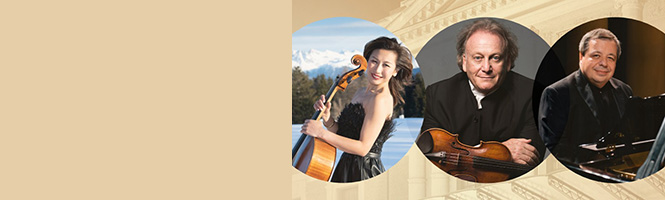


Violinist and violist Isabelle van Keulen is one of the most sought-after artists of her generation. Raised in the Netherlands, she is now a regular guest on major stages and at important festivals. Since autumn 2012, she has taught at the Lucerne School of Music.
Classicpoint.ch: You are both a violinist and a violist. What do you particularly like about these two instruments?
The wonderful thing is that I don't have to choose between the two! The violin always gets to sing (play the 'first' violin!), whereas the viola, especially in chamber music, gets to define the tone more. As the middle voice, you can mediate between high and low, you can shape the connection between the other voices. You also benefit greatly in terms of sound technique when you master both instruments. You learn a great deal about tone production on the viola, which in turn makes the violin sound 'richer'.
You once said that you consciously avoid playing certain major classical works that don't appeal to you. Which pieces are those?
It's always dangerous to tread on the slippery slope one is tempted to: naming favorites (or, conversely, non-favorites). There are phases in life when you've played certain pieces so often that you need a break. This has less to do with the pieces themselves than with your own situation! And usually, you rediscover such compositions in a different light because you've grown personally and can engage with them anew.
You are very committed to contemporary music. What is it about new music that appeals to you?
As all-round musicians, we are obligated to engage with the entire musical tradition and its various styles. This means, for example, that one must see Mozart within the tradition of Haydn and Bach. From this, Beethoven's ideas, Schubert, and so on developed, right up to the present day. We live now, and I feel personally called to play contemporary works as much as those composed in the past. Of course, there are sometimes modern works that may not survive forever, but which are nevertheless interesting because they represent a zeitgeist.
How do you motivate yourself when you have to play an extremely difficult contemporary piece, one that requires a lot of practice time, and you know perfectly well that you will hardly ever perform it again?
You must never approach work with the awareness that you will only play a piece once: it can always be planned again. Besides, I also see learning these demanding works as a kind of sport. Precisely because they are so difficult, you can also do a lot of 'gymnastics' and develop great dexterity. That's less boring than always playing the same exercises! Furthermore, I believe that studying contemporary literature also keeps the mind fit.
You have just taken up a lectureship at the Lucerne University of Music. What are your expectations?
I've reached a point where I'm happy to pass on the experience I've gained over the last almost 30 years to young, talented people. I expect my students to be curious, open-minded, and willing to work independently, and of course, disciplined. I also believe that joy is an essential part of making music, and I will place great emphasis on stylistic awareness and the ability to communicate with the audience. I will also try to provide my students with a well-rounded education so that they become musicians rather than 'just' violinists!
You joined the Leopold String Trio in 2009. Did you consciously seek out this ensemble, or did it simply happen?
It happened. My two colleagues asked me in 2007. The trio repertoire isn't particularly large, but it is quite refined, except that, apart from a few pieces, such as those by Taneyev, the entire Romantic period is more or less absent. We will soon be performing Michael Tippett's Triple Concerto. That's a whole new dimension of playing trio music! The trio instrumentation is very delicate. This is evident, not least, in the fact that all composers have tried to write for at least four voices. Furthermore, the three instruments are very distinct and each has its own individual sound. The great challenge is trying to find a way to blend them together!
You've been playing with pianist Ronald Brautigam for over 20 years. Does your interpretation of pieces you play repeatedly change?
The collaboration with Ronald Brautigam has naturally become very established over the past 22 years. We certainly have pieces in our extensive repertoire that we always return to. These include, for example, the Beethoven sonatas. Perhaps they have evolved over the years in the sense that Ronald has focused heavily on the fortepiano in recent years, which has also influenced my sound and interpretation. Nevertheless, we have always tried to play as naturally and close to the source as possible, without engaging with music for show or with false motives. Fortunately, we haven't grown apart over the years, but have both remained very true to the music.
Do you have any projects planned for the future?
For about a year now, I've been actively engaged with tangos, especially those of Piazzolla, a passion I've had since childhood. I've founded a quartet with Christian Gerber (bandoneon), Ulrike Payer (piano), and Rüdiger Ludwig (double bass). We'll be having a wonderful tour next summer with concerts at the Schleswig-Holstein and Rheingau festivals, as well as in Amsterdam. By then, our first tango CD will also be recorded.
What do you do in your free time when you're not making music?
A healthy mind in a healthy body: I exercise regularly and also really enjoy gardening, as it's almost meditative. Otherwise, I like to cook and read a lot.
Interview by Florian Schär | Classicpoint.ch | December 3, 2012
© Photo: Marco Borggreve
September 25, 2026 - Isabelle van Keulen (viola), Van Baerle Trio
; February 21, 2027 - Deutsche Kammerakademie Neuss, Isabelle van Keulen (violin & conductor);
May 1, 2027 - Stretta Concerts: Masterpieces of Chamber Music
, 2027 - Christian Poltéra (cello), Ronald Brautigam (piano), Deutsche Kammerakademie Neuss, Isabelle van Keulen (violin & conductor)
; June 25, 2027 - Markus Becker (piano), NDR Radiophilharmonie, Isabelle van Keulen (conductor);
June 27, 2027 - Isabelle van Keulen (violin), Johannes Strake (violin), Oliver Kipp (violin), Theresia Stadlhofer (violin), Anna Lewis (viola), Carlos Campos Medina (viola), Nikolai Schneider (Cello), Rüdiger Ludwig (Double Bass)



























































Do you want to attract more visitors to your concerts?
Find out more about the possibilities this portal offers.
With a concert search subscription, you will receive an email for your selected cantons/federal states as soon as a new concert is listed there. You can unsubscribe from the service at any time.
