
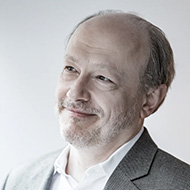
interview
Interview with Marc-André Hamelin
July 31, 2026
“I consider composing an indispensable tool for performing musicians.”…




Andreas Staier studied piano and harpsichord in Hanover and Amsterdam and was the harpsichordist of the ensemble Musica Antiqua Köln for three years. In 1986, he began his solo career as a harpsichordist and pianist. He has established himself as one of the most influential interpreters in his field, offering intellectually and emotionally fresh perspectives on composers from Haydn to Schumann, while simultaneously exploring great works beyond the standard repertoire.
Classicpoint.ch: What kind of grand piano do you play, and how does your instrument differ from a standard grand?
I play on different instruments. It always depends on where the concerts are taking place. For example, I can't bring my own grand piano to concerts in Switzerland because the regulations for ivory are very complicated, and the import costs would even exceed the purchase price. The difference to a modern grand is that the case is much lighter, the strings are much thinner with less tension, etc. I could list the differences in detail, but that's probably not very interesting. I'll try to address the aspects of musical relevance. If you look at the literature, you can say that composers wrote for the instruments they knew. There's little reason to assume that composers were better at composing than instrument makers were at building instruments. You can see significant differences, especially in the calculations for the pedal markings, since a modern grand piano sustains the sound much longer, which can lead to chaos more quickly and therefore requires a different approach. The older grand piano articulates better and more clearly. This is because the hammers were covered with leather back then, not felt like modern grand pianos. Take, for example, a grand piano from 1820s Vienna, an already Romantic instrument with certain registers that give the sound a whispering, moonlit quality, something modern grand pianos simply lack. Furthermore, Viennese grand pianos of this period sometimes have guitar stops and six or seven pedals, which are primarily used in four-hand repertoire. At that time, instruments were produced according to customer orders and vary considerably.
Do you prefer playing an original historical grand piano or do you prefer newly built ones?
Unlike a violin, a piano has a complex mechanism. If a grand piano doesn't function properly, however beautiful it may be, then unfortunately it's unusable. Therefore, an original must be in very good condition; otherwise, one must find a good copy. The problem is also that individual parts often cannot be repaired. If a grand piano still has its original strings, it's almost impossible to replace individual strings, as the resulting sound would simply deviate too much from the original. The leather of the hammers also changes over time, regardless of whether the piano is played or not; it becomes harder.
Can you, with your eyes closed, hear the difference between an original and a good copy purely by ear, without playing the piano yourself?
That's a very difficult question to answer, because pianos were far less standardized in the past than they are today. A modern Bechstein doesn't differ significantly from a Steinway or Yamaha. When copies of very well-preserved instruments are made today, they certainly sound different, though not necessarily better or worse.
In the 18th century, besides the fortepiano, there was also the clavichord and the harpsichord. What qualities do you particularly like about these instruments in comparison?
For me, it's difficult to consider the tonal qualities of individual instruments independently of the repertoire. A Viennese grand piano is so closely associated with a Schubertian aesthetic for me. It's also interesting that Schubert wasn't a great pianist, yet he wrote for the instrument better than, for example, Beethoven. Certain facets of 17th/18th-century French harpsichord literature... The music of the 19th and 20th centuries is so intimately suited to the harpsichord that the essential elements—rhythm, phrasing, the treatment of the high, middle, and low registers, and how a composition is orchestrated—are all lost on a modern grand piano. This is because the modern grand piano is, to put it negatively, less colorful, and to put it positively, more balanced. The more pianistic a piece of music is, the more is lost. Take Couperin or Chopin, for example. There's simply an incredible amount lost. With music that is conceived in a more "abstract" way, the difference is smaller, even if the music isn't necessarily older. For example, there are some truly wonderful recordings of the Well-Tempered Clavier.
Do you sometimes get annoyed when you hear interpretations of Bach, Mozart, or Haydn that don't take any historical aspects into account at all?
Of course, there are colleagues who play in such a way that it's relatively unimportant. But there are also colleagues who have a completely different aesthetic and are simultaneously such great musicians that conversations with them are incredibly interesting. I've often chatted with Alfred Brendel, for example, and even had some very amusing arguments, as well as with Andrés Schiff. But these musicians are also interested in historically informed performance practice. They simply draw different conclusions. Such conversations are very valuable to me personally. Because you learn far more from the literary sources about how not to do something than how to do it. It's interesting to compare these sources with the first recordings by students of Chopin or Liszt. You see, for example, that Brahms used far more arpeggiation than indicated in the scores, and that this isn't mentioned in the sources at all, because it was simply understood at the time. This also humbles me, because if we go back in time, there are unfortunately no recordings by students of Bach, etc. In that sense, we'll never know how Bach played. I'm sure that if a recording of Bach were to surface, modern pianists would be just as surprised as the proponents of historically informed performance practice.
Are there any "no-gos" for you when interpreting historical works?
Of course there are, absolutely. But they're relatively difficult to define. Perhaps an example: the question of tempo. Even before the metronome was invented, there were pendulums of varying lengths for setting the tempo, especially for dances in France, that is, for the codified ballet dances. If someone plays a dance at a tempo that is too far removed from the original, everything rearranges itself. The piece objectively becomes different because the relationship between the details and the whole changes. Generally speaking, the intermediate tempos are given far too little consideration today. As soon as Allegro is indicated, a tempo that is much too fast is often chosen, and when Andante is specified, a tempo that is much too slow is often selected.
How do you explain the phenomenon of "historically informed performance practice"? Why did the desire for historically informed performance practice only arise today and not much earlier?
The First World War marks a turning point. Until then, there were many pianists who simply played within a certain tradition. Let's say, for example, students of Clara Schumann or Karol Mikuli. They played only select repertoire, and they played it correctly, so to speak, because they had absorbed it with their mother's milk. At some point, these traditions broke down. Furthermore, we have to look at the developments of the 20th century. With the New Objectivity movement, the initial aim was to suppress strong emotions and simply follow the rules. Then came the idea of Urtext editions, and after that, there was a certain stage where the prevailing belief was that if we play the notes exactly, then we are authentic. The next stage involved people like Harnoncourt, who asked: What do we do in a case like Italian Baroque music, where so little is written down, where so much ornamentation and rubato were expected of the player? Then came the questions: What is not written down but is part of the musical language of a certain era?
Which treatises or writings on historical performance practice would you recommend to a piano student as a beginner?
As essential reading, I recommend Carl Cerny's "The Great Piano School." Furthermore, YouTube offers a vast archive of old films. For example, research recordings of students of Chopin's pupil Karol Mikuli. Compare the recordings very carefully with the scores and listen for what the musician is playing that isn't written in the music: where does he arpeggiate, where does he slow down, what is the dynamic range, etc. For earlier works, you have to read and study the treatises and writings.
Interview by Florian Schär | Classicpoint.ch | March 2, 2015
Photo: Josep Molina
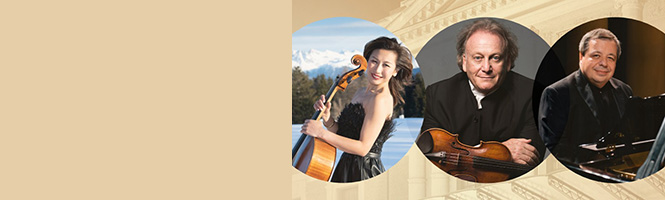
April 10, 2027 - Daniel Sepec (violin), Roel Dieltiens (cello), Andreas Staier (piano)





























































Do you want to attract more visitors to your concerts?
Find out more about the possibilities this portal offers.
With a concert search subscription, you will receive an email for your selected cantons/federal states as soon as a new concert is listed there. You can unsubscribe from the service at any time.
