interview
Interview with Marc-André Hamelin
July 31, 2026
“I consider composing an indispensable tool for performing musicians.”…




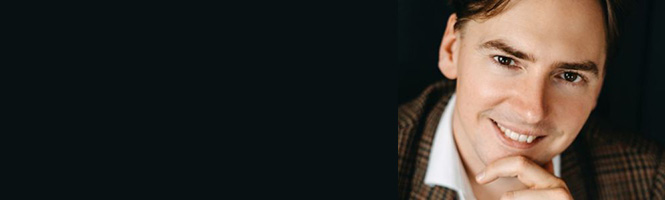


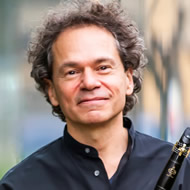
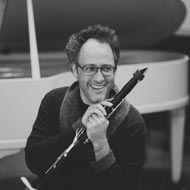
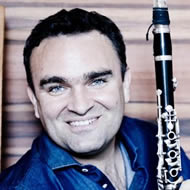
For Alexander Bader, the clarinet was the "reward" for passing the entrance exam as a junior student in piano at the Berlin University of the Arts. The silvery shimmer on the black wood and the soft, warm sound fascinated him from the start, and so he studied this instrument alongside his main subject at the Berlin University of the Arts. His most influential teachers were Manfred Preis and Peter Rieckhoff. After completing his orchestral diploma, he transferred to Wolfgang Meyer's soloist class at the Karlsruhe University of Music and, in 1990, while still completing his final exams, became a member of the Deutsche Kammerphilharmonie Bremen. In 2002, he became principal clarinetist at the Komische Oper Berlin; he also performed regularly with, among others, the Bavarian State Opera in Munich and the Munich Philharmonic. In 2006, Alexander Bader became a member of the Berlin Philharmonic. Since 1994, the clarinetist has also dedicated himself to historical performance practice on original instruments and regularly performs with ensembles such as Concentus Musicus Wien, the Balthasar Neumann Ensemble, and the Academy for Ancient Music Berlin. Alexander Bader has been a member of the Scharoun Ensemble Berlin since the 2006/2007 season.
Did you first study and graduate from piano studies, and only then clarinet?
As a child, I played the piano; it was a great love. Then, at 11, I became a junior student at the Berlin University of the Arts, and as a reward, I was allowed to choose a second instrument. I chose the clarinet more or less by chance. At first, I neglected it, as the piano offered me more. Then I finished high school, and the question arose of what to study. I decided on the clarinet. Ultimately, it was a cost-cutting measure by the university that forced me to take the entrance exam. After passing, I was able to study piano and clarinet simultaneously. However, it was also difficult to study both at the same time, and eventually, the piano slipped from being my main subject to just a hobby.
Were there any other students who studied simultaneously?
Well, I know people who studied mathematics alongside music. But studying two instruments as your main subject is very demanding, and I have to admit that my piano studies increasingly took a backseat.
Do you still play the piano?
Yes, with family and the many obligations with the clarinet it naturally became difficult, but now that the children are getting older, I'm getting more and more time for it again.
You are a member of the Berlin Philharmonic, what makes the orchestra stand out for you?
I can tell you that quite clearly. After my experiences in several other orchestras, I was so overwhelmed by the quality of every single musician within the first few weeks. Not just the first violin, but everyone was incredibly good. If someone isn't quite up to par, it's immediately noticeable. That's my greatest motivation. Of course, this also provides mutual training. And if a mistake happens, even someone who's far away will be corrected, because everyone hears everything.
But that also creates quite a lot of pressure, doesn't it?
Yes, of course, it was difficult at the beginning. But thanks to the two probationary years, it becomes clear that you've really made it. You could probably pretend for another year, but in the second year, your true self emerges. You might be able to compensate for everything with a lot of effort and practice for a year, but you can't do that for two years. You simply have to be at that level.
You are also a member of the Scharoun Ensemble. What appeals to you about it?
Next year marks the 40th anniversary of this ensemble, formed by exceptional individuals. The Scharoun Ensemble takes its name from the architect of its home venue: With the Berlin Philharmonie, Hans Scharoun (1893-1972) created a concert hall unique in the world, one that dares to synthesize innovation and a respect for tradition, opening up new avenues of artistic communication – ideals to which the Scharoun Ensemble is also committed. I was already captivated as a student and audience member. And when I joined the orchestra, I was fortunate that my predecessor had just retired and I was asked to take over. We always strive to create something more sustainable, for example, by playing with young people. They then go on to have their own careers, and later you'll find them performing in concerts in New York and other major cities around the world. At the Zermatt Music Festival, we work with the students for two years. That creates a bond.
If you are in Zermatt, do you also have time to go hiking?
Yes, as long as you're not a morning person. Usually you get one half-day off, but then you have to get up at 4 a.m. We also do an organized hike; every Sunday after the first week, we go out with the students. There's also a group of students who race each morning to hike to the Edelweiss Hut.
They also dedicate themselves to historical performance practice; how did that come about?
It all started during my studies. I was advised to learn something other than just the exam material. An instrument was handed to me, and I simply began. Sure, it was a bit shaky at first, but it also helped me with modern instruments. You play much more like a singer, learning how to control your breath. I quickly received many requests for performances because the scene was still small. It was also unusual for someone from the modern era to venture into this field. When my second child arrived, I took a step back. You're hardly ever home; you're always rehearsing first, and then there are the numerous concerts and tours. After my fourth child, I decided to retire completely. I sold all my historical instruments. That way, I wasn't tempted to return. I was glad to have closed that chapter, at least temporarily.
What about solo performances?
That's not something we do as often anymore. Maybe one or two gigs a year. But this year is special in Zermatt because we have a harp with us and were still trying to decide what to play. I suggested Copland's Concerto for Clarinet and Strings, since I'd just played it anyway, and we agreed on it.
If you could ask a deceased composer one last question, who would you choose and what would you ask?
I would choose Mozart, but I don't think I'd need to ask him anything, since he would speak for himself. Mozart is so unique and so moving to me. Is he even still human? Because this simplicity is so extraordinary, and I wonder how a human being can create such a moving simplicity.
Do you have any interests outside of music?
I'm a passionate paraglider and hang glider pilot. I got my license in 1989, but that took a backseat with family life. And sure, there are dangers, but I find horseback riding more dangerous. Three years ago, I took up paragliding with my older sons. It's very easy; you carry everything in your backpack and can just take off whenever you want.
Interview by Florian Schär | Classicpoint.net | July 20, 2021




























































Do you want to attract more visitors to your concerts?
Find out more about the possibilities this portal offers.
With a concert search subscription, you will receive an email for your selected cantons/federal states as soon as a new concert is listed there. You can unsubscribe from the service at any time.
