
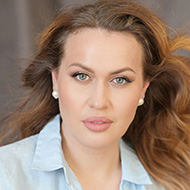
interview
Interview with Elena Stikhina
June 1, 2026
“The Zurich Opera House has a very special meaning for me.” Elena Stikhina is…


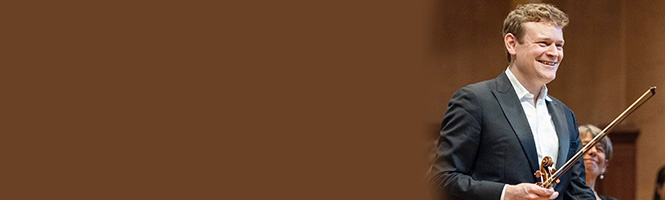


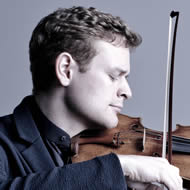
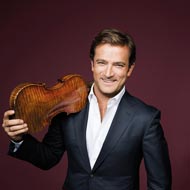
Michael Barenboim began playing the piano at the age of four. When his family moved to Berlin in 1992, he switched to the violin. Barenboim was taught by Abraham Jaffe and studied with Axel Wilczok at the Rostock University of Music and Theatre. Since 2000, Michael Barenboim has been a member of the West-Eastern Divan Orchestra and its concertmaster since 2003. He has performed with the orchestra in venues including the Royal Albert Hall in London, the Théâtre du Châtelet in Paris, the Berlin State Opera, the Berlin Philharmonie, the Salzburg Festival, Carnegie Hall in New York, and the Teatro Colón in Buenos Aires.
As a soloist, he has performed with, among others, the Mahler Chamber Orchestra under Pierre Boulez, the Vienna Philharmonic, the Bavarian Radio Symphony Orchestra under Mariss Jansons, the Chicago Symphony Orchestra, the Munich Philharmonic under Lorin Maazel, the NDR Symphony Orchestra and – as part of the Summa Cum Laude Festival – with the Filasteen Young Musicians Orchestra.
Barenboim has been the dean of the Barenboim-Said Academy in Berlin since 2020. He also teaches there as a professor.
You are the dean of the Barenboim-Said Academy. What makes this academy different from traditional music academies?
There are two aspects that distinguish us from other music academies: firstly, due to our history and close connection with the West-Eastern Divan Orchestra, we have a strong focus on the Middle East and North Africa; about 75% of our students come from these regions.
Secondly, we have integrated a humanities component into the curriculum. This means that all students must take courses in philosophy, literature, and history in addition to their music subjects. The workload is, of course, designed to allow sufficient time for practice and rehearsal, but it is very important to us to train true artists. This includes thinking outside the box and being more than just a specialist in instrumental performance.
You yourself once studied philosophy. Which of the big questions still occupy you today?
First of all, I would have been very happy at our academy, of course. As it was, I had to abandon my philosophy studies after two years to concentrate on music.
Fortunately, I retained the ability to think critically, and also the ability to ask the right questions of a text (and thus also of a musical score).
There are, of course, many, as you say, "big questions" that occupy me. One of them: what can we know for certain? Socrates already knew that he knew nothing. We live in a world of technological progress, where the internet, in particular, can give us an answer to almost anything immediately. But you can't get a real answer to a truly philosophical question like, for example, "why is there something rather than nothing?" I've actually tried.
Have you found your personal answers to these questions?
If ChatGPT doesn't have an answer, I certainly don't!
You are considered an expert in contemporary music. Do you really enjoy practicing contemporary music as much as the great classical pieces?
I particularly enjoy the variety. When I play a contemporary recital alongside the tour with the Swiss Orchestra, as I am doing now, it's certainly more work, but it's what I find most fulfilling!
As for practicing, one has to admit: it's not always fun – whether the piece is by Mozart or Berio makes no difference. But unfortunately, none of it is possible without practice.
You just performed Hermann Suter's rarely played violin concerto. What was your experience with it?
It was a true discovery for me! It's a beautiful work, in the late Romantic style. It's most similar to Richard Strauss. It's really worth hearing and performing, and I hope it wasn't the last time for me.
Your new album featuring Elgar's Violin Concerto will be released in September. In what way will your recording differ from existing ones on the market?
It's not my intention to do anything fundamentally different. That should never be the primary motivation. With a piece like this, one must always start with the score and develop one's own interpretation; it's also important to know and respect the tradition. After all, there's a recording of this piece conducted by Elgar himself, with the young Menuhin on violin. It's certainly interesting when they do something that isn't in the score.
I've also been fortunate enough to have played other works by Elgar, such as the Piano Quintet and the Violin Sonata. That's important to me because it allows you to recognize musical gestures and ideas that are typical of Elgar. That naturally influences the interpretation. I think the recording is very successful, very expressively played by myself and the orchestra.
Her brother David makes hip-hop music. Are there any joint projects or ideas for the future?
I've occasionally recorded a few bars when he's asked me. But that doesn't happen very often, and that's fine. But if the sound of a live violin was needed, I was there.
I'm deliberately not asking any questions about your father because I can imagine that it can sometimes be annoying. What question would you like to be asked in an interview?
It would be presumptuous to want to dictate the questions when I'm already giving the answers. Of course, some questions come up in almost every interview, but that's just part of the process.
What are your passions besides music?
I enjoy watching and playing snooker, although I haven't had much time for it in recent years. I simply don't have enough. As a result, my playing level is rather poor. If I could, I would play much more often – and probably much better.
What are your hopes for the future regarding your own career?
I've made it a habit not to look too far ahead. I'm fortunate enough to be able to make music on stage; I couldn't wish for anything better.
Interview by Florian Schär | Classicpoint.net | June 1, 2023
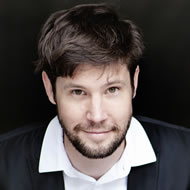
Photo: Neda Navaee



























































Do you want to attract more visitors to your concerts?
Find out more about the possibilities this portal offers.
With a concert search subscription, you will receive an email for your selected cantons/federal states as soon as a new concert is listed there. You can unsubscribe from the service at any time.
