
interview
Interview with Elena Stikhina
June 1, 2026
“The Zurich Opera House has a very special meaning for me.” Elena Stikhina is…




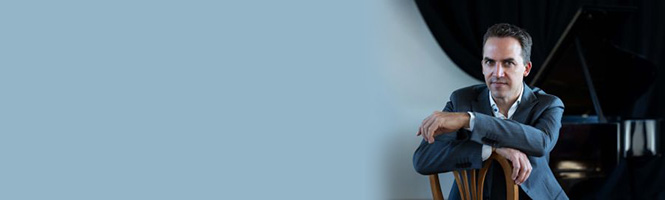


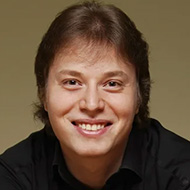
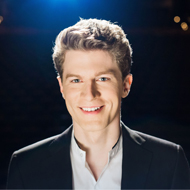
Born in 1992 near Zurich, the Swiss-Canadian pianist Teo Gheorghiu made his concert debut in his hometown at the Tonhalle in 2004. Since then, he has performed worldwide, including in Paris, Tokyo, St. Petersburg, Madrid, New York, and at all of London's major concert halls. He has collaborated with leading orchestras, including the Danish National Symphony Orchestra, the Zurich Chamber Orchestra, the Tchaikovsky Symphony Orchestra, the Royal Philharmonic Orchestra, the Tokyo Symphony Orchestra, the Bilbao Symphony Orchestra, and the Pittsburgh Symphony Orchestra.
Throughout his career, he has collaborated with renowned conductors such as Sir Neville Marriner, Vladimir Fedoseyev, Matthias Pintscher, and Alexander Shelley. Teo has won first prize at the San Marino International Piano Competition and the Franz Liszt International Piano Competition . In 2010, he became the youngest recipient of the prestigious Beethoven Ring at the Beethovenfest Bonn , and in 2017, he was awarded "Best Canadian Artist" at the Concours Musicale International de Montreal. His first CD was released by Deutsche Grammophon in 2009, and he has recorded for Sony ever since.
They are currently focusing on the national musical styles of Romania, Spain, and France. How do these styles differ, and what are their defining characteristics?
There are more connections than differences!
All three musical styles reflect different cultures and their stories, which are geographically specific yet universal in their expressiveness.
In my new album, Duende — my dedication to the culture and nature of Spain — the strong influence of the guitar is palpable, as are the powerful contrasts, intensity, and passion that also characterize flamenco singing. Furthermore, one can hear the cultural influences of North Africa in the harmonies.
Roma have shaped the musical landscape not only in Spain but also in Romania, where flutes, dulcimers, and violins create a whirlwind of emotions. On my next recording, I will try to capture all these colors with works by Bartók and Enescu.
The French musical style is less a classical embodiment of folk music and more an independent movement characterized by increasing harmonic sophistication.
Your parents are from Romania, but you have lived in England and Switzerland. You are now trying to get to know Romania, the land of your roots, on a cultural level. What is your connection to Romania?
Without a doubt, my strongest connection to Romania is through music. Even as a child, Radu Lupu and Dinu Lipatti were two huge role models, and even today I get goosebumps when I listen to 'Taraf de Haidouks'. So far, I've only been to Romania once – to Bucharest for a performance at the George Enescu Festival. I'd like to explore Romanian nature soon.
After your time in London, you now live in Switzerland. Where do you feel more at home?
I feel at home wherever I have a piano and feel comfortable. I spent 16 years in London; it was there that I became a man. The city became a part of me, but towards the end, I felt it wasn't the right place for me anymore – I needed more nature. Now I have more nature in Fribourg, plus the city itself has a special atmosphere – and three airports nearby!
You often go on long bike tours, for example from London to Morocco. You say that you learn a lot about music from these trips?
Music is a reflection of life, and the performer must give it expression. That means that even though making music is the center of my life, I give equal importance to my experiences as a musician. First and foremost, I try to maintain my balance as a person, so that I am in full possession of my strength. In that state, I can then truly give my all – in life as well as on stage.
When I got on my bike in London and cycled towards Morocco, it was an act of searching for balance in my life.
That month without practicing is still by far my longest "dry spell," which also had unexpected consequences shortly afterward: Upon my return, I learned Beethoven's Second Piano Concerto in just two weeks. I had expected more like six weeks, but that creative break had transformed my brain into a parched sponge!
You are also on the lookout for new discoveries in the world of folk music. How exactly do you search for them?
With a great deal of curiosity and passion, I simply keep my eyes open and am immediately captivated by sounds that transport me to the most diverse sonic worlds. Furthermore, the migration of the Roma from India – through North Africa and Europe – to Andalusia has also left its mark on my musical preferences.
You are also interested in politics. What bothers you about today's world?
2020 has shown how deeply culture is placed in political priorities: Culture has to shut down, but people can still waste money in casinos and on Black Friday? This inconsistency does nothing to ease the situation and inflicts serious damage on the entire cultural landscape.
Which deceased composer would you like to meet and talk with? And why?
I had to think about that for a long time, as I already feel a deep connection to my favorite composers through the works they left behind.
I would love to spend time with Beethoven. An exchange isn't necessarily required – ideally, I'd simply like to witness the creative process of Op. 111.
A cosmic piece that deeply moves me every time.
What are your future plans?
In the short term, things are changing almost daily at the moment, so I prefer to live in the moment. Of course, I very much hope that my recital at the Tonhalle Maag (Master Interpreters) and the second piano recital with Alex Ullman at the Elbphilharmonie will take place. In the longer term, the 4-CD project with Claves gives me a concrete perspective in these extraordinary times.
Interview by Florian Schär | Classicpoint.net | January 1, 2021



























































Do you want to attract more visitors to your concerts?
Find out more about the possibilities this portal offers.
With a concert search subscription, you will receive an email for your selected cantons/federal states as soon as a new concert is listed there. You can unsubscribe from the service at any time.
