

interview
Interview with Julia Lezhneva
August 31, 2026
“Analytical work allows for emotional freedom, while emotional discoveries…”


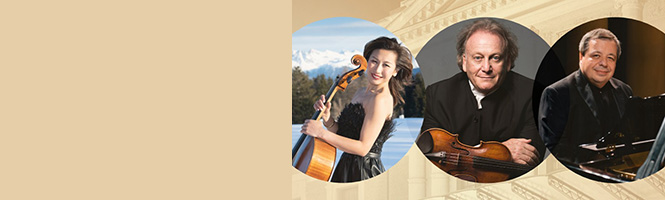




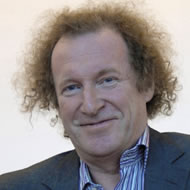
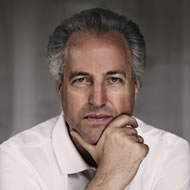
Belgian musician Robert Groslot has made a name for himself as a pianist and, above all, as conductor of the "Night of the Proms." At this mega-event, which has been held annually since 1994 and is themed "The Best of 300 Years of Popular Music," Groslot leads the orchestra "II Novecento," which he founded. Although the "Night" regularly takes him to major cities, the 64-year-old considers himself primarily a composer. Following orchestral and solo works, he recently released his first CD dedicated entirely to chamber music.
Classicpoint.ch: Mr. Groslot, you are primarily known as a pianist, and even more so as a conductor. However, you consider yourself primarily a composer, mainly of orchestral music. Now you have released your first all-chamber music CD, "Chamber Works for Clarinet." What was this "chamber experiment" like for you?
As a pianist, I have always derived great joy from chamber music. Playing with a small group of people—usually good friends and excellent musicians—is always a unique, intense, and irreplaceable experience. Nevertheless, it took me quite some time to turn to chamber music as a composer. Apparently, I first had to satisfy my deeply ingrained need to compose larger works and write 16 orchestral concertos... (laughs)
What chamber compositions have you written in the past, and what experiences have you had with them?
In the last two years, I've composed numerous pieces for traditional chamber music ensembles, for example, a string quartet—it's titled "Matrix in Persian Blue"—and a violin sonata, which seemed completely impossible to me a year ago (laughs). But I've also tried out some new instrumental combinations, such as in "The Phoenician Sailor," a piece for piccolo, English horn, bass trombone, and piano. I see the limitations that the chamber music genre seems to have compared to orchestral music much more as an enrichment than a deficit. Because here, on a smaller scale, entirely new possibilities for experimentation open up. Beethoven's chamber music is much more adventurous than his works for orchestra. And, very importantly: as a composer, you write chamber music for performers you know very well.
How did it come about that the clarinet is at the heart of the CD recording?
All the pieces on the CD "Chamber Works for Clarinet" were written at the request of the clarinetist Vlad Weverbergh. I wrote these works within a relatively short period, and that is probably also the reason why the CD has become stylistically very unified. In "Painted Curves," I wanted to counter the traditional seriousness of the famous great clarinet quintets—for example, by Brahms or Reger—with carefree lightness. "Parfum éphémères," written for the instrumentation of Mozart's "Kegelstatt Trio"—that is, for piano, violin, and viola—consists of five quasi-impressionistic sketches. "Hoquetus, Battaglia & Madrigal" for clarinet and harp naturally refers to medieval techniques, and "Wagner's Moon" is a nocturnal reflection on the Tristan chord.
Her music for clarinet is understandable, accessible, and at the same time very sensual and playful. Are these qualities still "allowed" today?
We mustn't forget that art always arises in two phases: first, from a concept, and second, from its concrete realization. Concepts can be more or less conscious, or even purely intuitive. The development of a concept or idea, however, is inherently sensual, almost by definition, because it must be perceived through the senses. In my opinion, the attempt by some composers to assign music tasks other than purely sensual ones is forced, since music expresses nothing other than itself. For my part, I experience even very complex structures—such as that of my piano concerto—as something emotional and not merely driven by reason.
How does your knowledge of conducting help you in composing?
Conducting masterpieces of the past is an inexhaustible source of information, far more intense than listening. A conductor, so to speak, transforms himself within the piece he is conducting, both mentally and physically. This activity has also encouraged me to notate and arrange my musical ideas and concepts—tempi, nuances, articulations, etc.—as precisely as possible. A concrete example: I rarely write 5/8 time signatures, but always 1/4 + 3/8 or 3/8 + 1/4, so that every musician, including the conductor, immediately knows and plays the correct accentuation without wasting rehearsal time. The British composer Michael Tippett, whose music I love very much, connected his compositional motifs with beams across the bars. This significantly complicates readability. I always try to make the assimilation process as easy as possible for the performer.
Especially in Germany, there are reservations about "composing conductors." What's your take on that?
Prejudices are always foolish and reprehensible. Nevertheless, it's self-evident that musicians like Gustav Mahler, Richard Strauss, and Leonard Bernstein were also important conductors and great composers. Of course, there are good conductors who compose less interestingly and good composers who can't conduct. And there have been, and still are, musicians who have no clue about either (laughs).
The music of the 20th century was—and in some ways still is—characterized by ideological trench warfare. Twelve-tone music, and later serialism, were elevated to dogma; atonality was the order of the day after the Second World War. To what extent is it important for you to take a stand in this context? And why do you write in such a tonal and accessible way?
That was also a major problem for me and one of the reasons why I wrote so little in the 80s and 90s. The expansion of the seven-tone scale after the use of twelve tones is a logical development, deeply intertwined with the nature of music. The strict avoidance of tonality and the exclusive use of serial principles seem to me, in many cases—though not always—forced. The Belgian composer André Laporte, born in 1931, who himself wrote avant-garde works, once said that one cannot continually ignore tonality throughout history. I think the development of music after the First World War is all too understandable and was perhaps even inevitable in this form, partly because of the great tragedies of history, and partly because of the nature of music itself, whose capabilities were misjudged.
How would you describe your own style, your way of composing music?
The musical language I write in feels completely natural to me. I can move within it easily and freely, yet it's also very accessible to an experienced listener. I think my musical language is personal and recognizable. We all know there are many problems in our world, but I think it makes little sense to constantly try to express them through music. Politics and literature are much better suited for that. With my music, I want to express the experience of life itself, the joy I get to experience every night and every day, the many wonders of our existence, and of course, the eternal mystery. Above all, I want to bring a smile back to music.
In which historical and musical tradition do you see yourself? Where do you see your intellectual and artistic roots?
I feel European body and soul, and I also think that many Germanic and Latin influences can be heard in my music—perhaps that's typically Belgian? (laughs). The Anglo-Saxon tradition also plays a major role for me. "Rainfall on Pink City" and, for example, the first and last parts of "Painted Curves" clearly have American roots. My love for large-scale forms—for example, in "The Great Globe," "Black Venus," or in some of my concerts—is undoubtedly Germanic. The bright colors in many compositions, on the other hand, reveal my love for all things Mediterranean. I clearly see myself as continuing a lineage that began with Beethoven and leads through Liszt, Debussy, Stravinsky, Bartók, all the way to Lutosławski and Ligeti, without wanting to compare myself to these masters.
Can, should, or must music take a stand in any way, in other words—and understood in the broadest sense—be political?
Stravinsky was right when he said that music expresses nothing but itself. Of course, many pieces of music remind us of everyday or even political circumstances, especially when texts are sung or set to music. But even these things remain within the realm of association. To deny the primarily purely aesthetic dimension of music is pointless, because then nothing of it remains.
How “subjective” is your music? Does the category of “existential music” or even “confessional work” still have any meaning today?
Every good composer is constantly expressing themselves. In this sense, good music is always existential. It's understandable that artists living under difficult circumstances feel the need to express this in their art. But these extramusical ideas only work through association, not through the music itself. Some composers take themselves so seriously that the result becomes bombastic or even ridiculous. So let's remain humble and use musical language as it is.
What plans and wishes do you have for the future?
I hope to create many more compositions – and in genres I don't even know yet (laughs). Music drama also appeals to me; I'd love to write an opera or make an opera film. I'm not talking about film music – where the sounds always serve a supporting function – but rather a new kind of art film in which the sounds, texts, and film sequences form an organic, dramatic unity. I also have a concrete plan for a large-scale orchestral work that might then become a synthesis of my musical world (laughs).
Interview with Dr. Burkhard Schäfer as a guest author for Classicpoint.ch | October 1, 2015



























































Do you want to attract more visitors to your concerts?
Find out more about the possibilities this portal offers.
With a concert search subscription, you will receive an email for your selected cantons/federal states as soon as a new concert is listed there. You can unsubscribe from the service at any time.
