
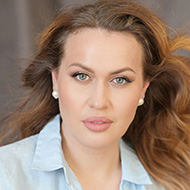
interview
Interview with Elena Stikhina
June 1, 2026
“The Zurich Opera House has a very special meaning for me.” Elena Stikhina is…


Born into a family of musicians, Beatrice Rana performed Bach's Piano Concerto in F minor in a public concert at the age of nine. At 16, she completed her piano and composition studies at the Conservatorio di Musica Nino Rota in Monopoli. She then studied in Hanover with Arie Vardi and in Rome at the Accademia Nazionale di Santa Cecilia. She participated in masterclasses in Italy, France, and the United States with Michel Béroff, Aldo Ciccolini, Andrzej Jasiński, François-Joël Thiollier, and Elisso Wirsaladse.
She has won first prizes at several national and international piano competitions, including the Muzio Clementi Competition, the International Piano Competition of the Republic of San Marino, and the Bang & Olufsen PianoRAMA Competition. In 2010, Rana received the Arturo Benedetti Michelangeli Prize, and in 2011, she won the Montreal International Competition, where she also received all special prizes. In June 2013, Rana was awarded second prize and the audience prize at the prestigious Van Cliburn International Piano Competition.
Beatrice Rana is a soloist in high demand worldwide. She has performed at the Tonhalle Zurich, the Vienna Konzerthaus, London's Wigmore Hall, Walt Disney Concert Hall, the Washington DC Center, Ferrara Musica, the Auditorium du Louvre, and the Lied Center of Kansas. She is also a regular at festivals such as the Verbier Festival, the Radio France Festival, the Portland Piano Festival, the Klavier Festival Ruhr, Toronto Summer Music, and the La Roque d'Anthéron Festival. She has appeared as a guest soloist with various international orchestras, including the Los Angeles Philharmonic Orchestra, the Detroit Symphony Orchestra, the London Philharmonic Orchestra, the Orchestra of the Accademia di Santa Cecilia, the RAI Symphony Orchestra Turin, the Dresden Philharmonic, the Filharmonica della Scala, and the Maggio Musicale, under conductors such as Yannick Nézet-Séguin, Leonard Slatkin, Trevor Pinnock, Susanna Mälkki, Antonio Pappano, Fabio Luisi, and Zubin Mehta.
Beatrice Rana is considered one of Italy's leading pianists.
How did you first encounter the piano and why did you want to learn this instrument?
I began studying piano because both my parents are pianists, so playing was a natural, daily practice for me. For me, approaching the piano was inevitable and not at all unusual, because it was something I knew from home. It was a daily activity.
You were already performing piano concertos as a soloist at the age of nine. When and why did you decide to make it your profession?
Actually, the decision to pursue it professionally was a gradual one, precisely because my parents were already pianists. Fortunately, they didn't pressure me to become a pianist, but as I grew older, it became increasingly clear to me that music was an essential part of my existence, and that I would have loved to make it my profession. The certainty of this came later, with victories at competitions like the one in Montreal, which gave me the opportunity to turn my great love into my career.
Today you live in Rome. Do you perceive audiences differently in different European countries?
Yes, absolutely. I perceive each country very differently. Every nation has its own specific audience, and that's a wonderful thing despite globalization. I must say that every audience in every nation has its own distinct character. For example, the Italian audience is a very, very warm audience, even if it might be a bit more chaotic. The German audience obviously has a great appreciation for the entire German repertoire, which naturally makes up a large part of the repertoire we play. In the United States, the enthusiasm is different again, in the sense that European music is, in a way, new music to them. In Japan, people are very religious, and so on.
Who are your favorite composers and why?
I couldn't say I have favorite composers because I love everything I play and usually decide spontaneously what to play. I can't choose one composer because I feel I would be doing another a disservice.
Do you also improvise when playing the piano?
I would love to be able to improvise on the piano. Unfortunately, it's not a talent I possess. I haven't practiced this skill, although I truly admire people who can improvise because it's something I would like to be able to do.
Are you also interested in other musical styles besides classical music?
Yes, I really like other genres of music as well. For me, music is divided into good music and bad music. There is good classical music, just as in other genres, and there is bad classical music, just as in other genres.
Do you teach?
I don't teach regularly. I give masterclasses now and then. I really enjoy these occasions because I like being in contact with young people. It's a challenge for me because I don't teach regularly. I also learn a lot myself while teaching.
When is a lesson good, as a teacher or a student?
A good lesson is one where a teacher is able to fully develop their student's potential. I was fortunate to have teachers who taught me with this ideal in mind. They explained how I could play better, but they never contradicted my human nature. They never contradicted my nature as a musician, and that is very important to me.
What does music mean to you?
Music is life to me. I express myself much more through music than with words. Essentially, the voice, both mine and that of many other people, is truly a universal language. This form of communication allows people who don't know each other to connect and experience unique and unrepeatable emotions.
Are there any other passions and hobbies besides music?
Yes, I'm a person with diverse interests, but certainly not on the same level as music. Music takes up a lot of my energy and leaves little time for anything else. However, I enjoy reading, going to the cinema, taking walks, or visiting museums.
Interview by Florian Schär | Classicpoint.net | September 20, 2021
06/23/2027 - Mirga Gražinytė-Tyla & Beatrice Rana
06/24/2027 - Mirga Gražinytė-Tyla & Beatrice Rana

































































Do you want to attract more visitors to your concerts?
Find out more about the possibilities this portal offers.
With a concert search subscription, you will receive an email for your selected cantons/federal states as soon as a new concert is listed there. You can unsubscribe from the service at any time.
