interview
Interview with Elena Stikhina
June 1, 2026
“The Zurich Opera House has a very special meaning for me.” Elena Stikhina is…


Anne-Sophie Mutter has been one of the great violin virtuosos of our time for 35 years. Born in Rheinfelden, Baden, the violinist began her international career in 1976 at the Lucerne Festival. A year later, she appeared as a soloist at the Salzburg Whitsun Concerts under the direction of Herbert von Karajan. Since then, Anne-Sophie Mutter has performed worldwide in all the major music centers.
Classicpoint.ch: What are your earliest memories of playing the violin?
My first impression came from an LP recording of Menuhin's Beethoven Concerto. My earliest memory of actively playing the violin is actually my first lesson, which must have been sometime in 1968/69. It felt spontaneously symbiotic, as if the violin had always been on my shoulder.
You originally studied at the Winterthur Conservatory in Switzerland and experienced the start of your international career at the Lucerne Festival. What memories do you have of your time studying there, and what is your relationship with Switzerland today?
My relationship with Switzerland couldn't be stronger, as I had the privilege of studying at the Winterthur Conservatory with the wonderful Aida Stucki from the age of nine. Incidentally, Alemannic – my mother tongue – is very closely related to Swiss German. Furthermore, my debut in 1976 at what was then the Lucerne International Music Festival played a significant role in my international career.
I always enjoy returning to Switzerland, especially to the Lucerne Festival.
You made your debut at the age of 13 under the direction of Herbert von Karajan. Were there moments in your youth when you would have gladly traded the pressure of expectations and fame for a carefree childhood?
Neither during my teenage years nor in retrospect did I have the impression of having experienced a troubled youth. I was completely absorbed by music, and being able to perform with Herbert von Karajan and other great musicians was my everything and thus the central focus of my formative years.
You have established your own foundation to promote top young musical talent. Do you believe all your scholarship recipients have the potential for a world-class career? What ultimately determines their breakthrough?
My focus in promoting top young musical talent is not necessarily on a world-class career. Beyond the passionate search for talent with an insatiable thirst for knowledge and passionate personal views on musical literature, my primary focus is on introducing young musicians to the humanistic side of a musician's life, encouraging them to build bridges with and through music, and to engage in social activism, for example, through benefit concerts.
You yourself often play at benefit concerts for institutions that address the medical and social problems of our time. Which projects/institutions are closest to your heart?
All the projects I have supported wholeheartedly, with all my heart and soul, and through concerts, are especially close to my heart. But it is particularly the needs of children, the elderly, and people with disabilities that repeatedly move me, concern me, and compel me to take action.
Besides Lynn Harrell, Aida Stucki, your long-time teacher, is a key decision-maker in your foundation. How strongly has Aida Stucki influenced you, and what do you particularly value about her?
There is nothing about Aida Stucki that I don't value. She is an extraordinary woman, musician, mother, and educator. I was profoundly and lastingly influenced by her from an early age. Her remarkable ability to guide talents individually and with admirable, patient rigor over a long period, ultimately bringing them to their full potential, is particularly noteworthy.
In 2006, to mark Mozart's 250th birthday, you made extensive recordings of Mozart's works for violin. What significance does Mozart hold for you as a composer compared to other great composers?
Mozart, with his many wonderful chamber music works as well as violin concertos, occupies a special place in every violinist's repertoire. This is not only due to the unusual diversity and sheer number of his works, but also because of their singular purity of expression and the genius of his musical development.
What is your stance on authentic versus historically informed performance practice?
I am against dogma in art. An authentic performance practice is impossible, but the attempt to approximate the sound and phrasing of the time is certainly possible and thus a very important part of analysis and interpretation today.
You have been on stage for 35 years. What were the most important impulses or events that influenced your playing during this time?
No one lives in a vacuum, and no artist should live in one. Personal experiences have repeatedly had a lasting impact on my violin playing, enriching it, and sometimes even shaking me, such as the loss of my husband, the father of my children, and the wonderful gift of the birth of our two children.
You are also deeply engaged with contemporary music. Several composers have written works for you, including Krzysztof Penderecki, Wolfgang Rihm, and Sofia Gubaidulina. When did you first become seriously involved with contemporary music?
Contemporary music is another important source of inspiration, as are the visual arts and simply life itself with its diverse and truly wonderful moments. I've been involved with contemporary music since the world premiere of Witold Lutosławski's "Chain II" on January 31, 1986. And the last few weeks and months have been filled with studying new works by Wolfgang Rihm and Penderecki, as well as a violin concerto by Sebastian Currier, which will have its world premiere in New York this summer. It's an exciting, frustrating, and exhausting process, yet also a profoundly fulfilling engagement with a new musical language and, finally, with a counterpart—the living composer who is available to answer questions.
You once said you wanted to retire at 45. Thankfully, that didn't come to pass. Do you plan to leave the stage anytime soon?
There's really only one answer to that question. It was John Lennon who said, "Life is what happens to you while you're busy making other plans," and so my last hour on stage will eventually strike as well.
What are your plans for the future? Are there any projects you absolutely want to realize? I
have many plans for the future, but I trust in God and therefore hope that the most important project, my greatest wish, will come true: to see happy and healthy children grow up to fulfill their calling.
Interview by Florian Schär | Classicpoint.ch | April 24, 2011
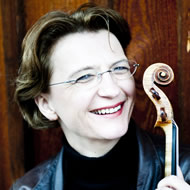
© Photo: Harald Hoffmann / DG
August 23, 2026 - Summer Festival: In Conversation - Anne-Sophie Mutter
August 23, 2026 - Summer Festival: Classical Music for Everyone - 40 min 2
August 25, 2026 - Summer Festival: Lucerne Festival Orchestra 6
September 3, 2026 - Summer Festival: Debut Elias David Moncado
September 4, 2026 - Summer Festival: Pittsburgh Symphony Orchestra 2



























































Do you want to attract more visitors to your concerts?
Find out more about the possibilities this portal offers.
With a concert search subscription, you will receive an email for your selected cantons/federal states as soon as a new concert is listed there. You can unsubscribe from the service at any time.
