
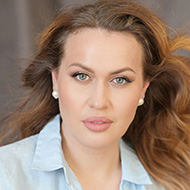
interview
Interview with Elena Stikhina
June 1, 2026
“The Zurich Opera House has a very special meaning for me.” Elena Stikhina is…


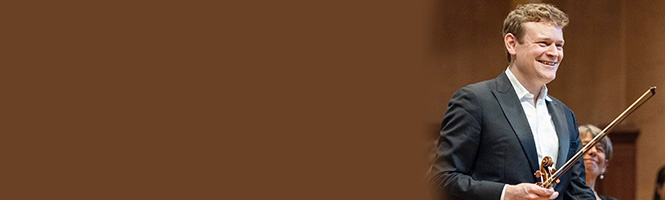


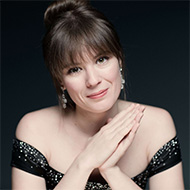
Sophie Pacini (born 1991 in Munich) is a German-Italian pianist who ranks among the most outstanding musicians of her generation. She received exceptional support from a young age and gave her first concert at eight. She studied with Pavel Gililov, among others, and quickly developed an international concert career.
Pacini performs regularly in major concert halls in Europe, Asia, and North America and collaborates with renowned orchestras and conductors. She has received numerous awards for her recordings and interpretations—particularly of Romantic works—including the Echo Klassik and the ICMA Award. In addition to her work as a concert pianist, Sophie Pacini is committed to promoting classical music and oversees her own projects that combine art and social engagement.
How did you come to play the piano as a child?
My mother gave my father a piano with her first savings to fulfill his long-held dream of starting to play and taking lessons. I immediately expressed the same curiosity, and at the open house of our local music school, I discovered a grand piano for the first time, or as I affectionately call it, "my black panther," and fell in love with its independent, powerfully subtle elegance. And since I learned that as a student you can only play the grand piano once you're good at the upright piano, it was clear to me that I wanted to become really good quickly so I could sit down at the grand piano as soon as possible. And once I was there, I didn't want to leave. I had found my favorite place.
You launched your own festival, "Nuances," in 2023. What makes this festival special?
"Nuances" is, for me, a celebration of the nuances, of everything that connects people with completely different cultural interests, those who may have never experienced music before, or those who simply want to experience high culture with a view of the Alps, the scent of linden trees, and amidst Bavarian coziness. It's a festival that celebrates the diversity of perception – in music, in literature, in human exchange. We live in a world that often speaks in buzzwords. I wanted to create a space where subtle transitions, delicate nuances, and the unspoken are given a stage. And where contrasts reveal how they are interdependent, creating a harmonious whole.
You don't just perform in the great concert halls of Europe. You also bring your music to places that otherwise rarely encounter classical music, for example, by regularly playing concerts in women's shelters. What led to this, and what are your experiences?
I've always been moved by the idea that music can be healing, comforting, an anchor. Women's shelters are places where people seek new hope, where they need confidence – and playing music there makes their very essence palpable: it gives strength where words cannot take root. These are some of the most moving concerts of my career, because they demonstrate the immediate impact of music's essence and serve as a compass for one's own self. They offer a moment of self-care, self-worth, renewed courage, inner resonance, and a profound connection to the soul. After every concert, each woman always gives me a hug; we've even cooked pasta together, and I feel fulfilled and revitalized, genuinely inspired. There are two sentences in particular that I've taken away from my concerts so far and hold deep in my heart: "You left the place more hopeful and brighter than we had experienced it before." "Please talk about us, tell our story. Please give us a voice." And that is my goal, to fulfill a mission with my audience. The mission is to give back, to tell stories of undeserved bitterness, and to offer a glimpse of a future yet to be discovered. To stand up for other women as a woman and to make a difference. Simply because music is a cloak of warmth for me, and happiness only comes when shared.
Your new CD, "Bittersweet," also originated from such a performance. Can you tell us more about it?
"Bittersweet" is a mirror of life itself: joy and pain, the journey through darkness into light. The idea for the album actually came from one of these concerts at the women's shelter, where I felt: such an embrace through music would be ideal for an album, a to-go source of encouragement, a pocket-sized piano book, a talisman box to keep safe. It's not an escape from reality, but rather an experience of it.
You have been committed for years to introducing classical music to children and young people and want to make classical music accessible to everyone, everywhere, and you develop new concert and broadcast formats for radio and television. What are your experiences with this?
I experience time and again that children have an unprejudiced, almost magical relationship with music. There are no categories like "classical," "pop," or "modern"—there is only wonder. That's precisely what I want to preserve. In my projects, I try to create formats that don't instruct, but invite. Classical music shouldn't be a museum piece; it must breathe, be alive. This succeeds when we don't ask, "Does anyone understand this?" but rather, "Does it touch them?"
You've been performing as a piano duo with Martha Argerich since 2019. What's it like playing with her?
Playing with Martha is like flying—you never know which winds will carry you, but you trust them. She's a musical volcano, full of energy and surprise, and at the same time an incredibly warm-hearted partner. Making music together with her is less a "process" than a lifelong dream, a joyful adventure, and it creates treasures for life. There
's a 50-year age difference between you. Are there also different approaches to works or things you'd like to interpret differently?
Of course, there are differences—shaped by time, experience, and life paths. But these very differences are the treasure. It's not about being right, but about opening up spaces together. Martha brings an immediacy, a timeless curiosity that is unconditionally contagious. And I perhaps bring the desire to absorb and capture all shared and tangible emotions. In the end, we join hands—in the music, which watches over us both, both blissfully and challengingly.
Do you have any further ideas or project wishes for the future?
I continue to pursue my women's shelter mission with vigor, and I'm also committed to other communities and associations that need visibility and a supportive embrace through music. I've become an ambassador for various institutions that have contacted me over the past few months due to the increased attention given to women's shelters, and I'm increasingly involved in German cultural policy, true to the motto: Anyone can complain from the sidelines. Go out, do it, build it. In addition, I continue my active work as an initiator and presenter of new radio formats, and here too I never tire of inspiring everyone with the burgeoning magic of music. And perhaps one day I'll even write a book of short, imaginative pieces from my life, seen through the eyes of a pianist.
What passions do you have besides music?
I enjoy writing, going for walks (preferably only in the woods!), observing people in cafes or while traveling and inventing stories about them, and I recently rejoined the gym. I also love making the people around me laugh and decorating my home according to my mood. Anything that sharpens my perception is a passion for me.
Interview by Florian Schär | Classicpoint.net | December 1, 2025
Image: Vitaliy Bachaco



























































Do you want to attract more visitors to your concerts?
Find out more about the possibilities this portal offers.
With a concert search subscription, you will receive an email for your selected cantons/federal states as soon as a new concert is listed there. You can unsubscribe from the service at any time.
