

interview
Interview with Julia Lezhneva
August 31, 2026
“Analytical work allows for emotional freedom, while emotional discoveries…”








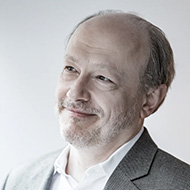
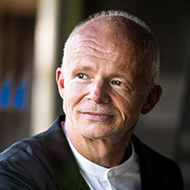
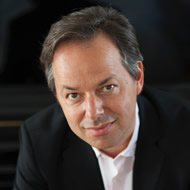
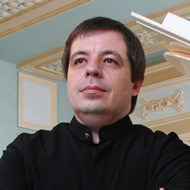
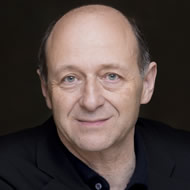
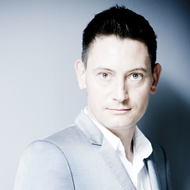
Born in Bonn, Dirk Joeres studied conducting and piano in Berlin, Cologne and London, as well as composition in Paris with Nadia Boulanger, the grande dame of musical modernism.
Dirk Joeres has also successfully conceived new presentation formats for classical music. For example, in 2008 he initiated a new concert format at the Sinfonia's home in Leverkusen: "KlassikSonntag!" (Classical Sunday!). The press called it "a delightful offensive in the field of classical music" (Kölner Stadtanzeiger). The CD/DVD series "Beethoven Today" and the series "Klassik im Kloster Steinfeld" (Classical Music at Steinfeld Monastery) have also established Dirk Joeres as a "born music communicator" (Westdeutscher Rundfunk).
Dirk Joeres' CD recordings received top ratings in the international press; London's Gramophone magazine awarded its 'Critic's Choice Award' to a Brahms recording with the Sinfonia; a Schumann CD with the RPO also received top ratings: "Exemplary 'Rhenish' – a reference recording" (Supersonic award, Pizzicato).
composition with Nadia Boulanger studied. What was your impression of this grande dame of modern music?
As very old and incredibly mentally agile. She represented a bridge to the past (after all, she had studied with Gabriel Fauré at the Paris Conservatoire!), while at the same time she was keenly interested in all developments in 20th-century composition, with her admiration for the music of Igor Stravinsky being a constant.
Do you still compose today, or do you have any compositions planned?
I wrote a few piano pieces during the Corona period, when concerts weren't possible. Incidentally, I believe every performer should at least master the basic rules of composition, for example, being able to write a cadenza for a Mozart concerto. By creating music oneself, one's respect for the achievements of the great composers grows even further, along with the realization that without them, performers would be nothing at all.
What does music mean to you?
I can only echo Friedrich Nietzsche's wonderful words: "Without music, life would be a mistake."
You later established yourself as a conductor as well. How active are you as a pianist today?
I often play in chamber music ensembles together with members of the West German Sinfonia (recently, for example, in the piano quintets by Schumann and Brahms), and occasionally as a soloist.
You are the artistic director of the West German Sinfonia and were a regular guest conductor with the Royal Philharmonic Orchestra in London. Tell us what is important to you in your work as a conductor.
The tasks of a conductor are very diverse, and of course, the artistic work comes first. But psychology also plays a major role: one of the most important tasks of a conductor is to motivate musicians, that is, to convey their own identification with the music being performed. Only someone who is passionate about something themselves can inspire others.
Were there any formative experiences in your career as a pianist and conductor?
I believe that, ideally, one experiences the decisive formative moments even before beginning one's professional life, if one is fortunate enough to find good teachers. One can then build upon these early experiences in one's career.
us a little about the "Dreiklang" format tell?
"Dreiklang" is an interdisciplinary format that brings together representatives from literature, philosophy, and music to explore a topic from different perspectives. Past topics have included, for example, the Romantic era or the dawn of modernity at the beginning of the 20th century.
What is the idea behind the Beethoven Today CD/DVD series?
Beethoven's symphonies, in particular, are in danger of becoming mere cultural artifacts, simply consumed passively. My aim with this CD/DVD series is twofold: firstly, to raise awareness of the message behind the music; secondly, and especially with the help of Beethoven's sketches, to focus attention on the architecture, the "blueprint," of the works. The goal, therefore, is active listening. Because: the more you know, the more you hear.
You are said to have a great talent for communication. What would have become of you if you hadn't chosen music?
I would certainly have gone in a direction that has to do with language in some way. And when I look at its use in politics and the media today, I have to say: Language needs our special care and attention.
What hobbies and interests do you have besides music?
Literature and history.
Interview by Florian Schär | Classicpoint.net | November 1, 2022
Image copyright: Hagen Willsch































































Do you want to attract more visitors to your concerts?
Find out more about the possibilities this portal offers.
With a concert search subscription, you will receive an email for your selected cantons/federal states as soon as a new concert is listed there. You can unsubscribe from the service at any time.
