

interview
Interview with Julia Lezhneva
August 31, 2026
“Analytical work allows for emotional freedom, while emotional discoveries…”







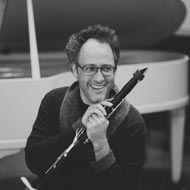
In addition to his work as a freelance oboist in various orchestras, Gotthard Odermatt is also a dedicated chamber musician. He performs as an oboist in ensembles ranging from duos to octets and has played in various chamber music groups, such as the "Banda Classica." He also performs with the two chamber music ensembles he founded: the "Ensemble Armonico" and the "Krommer Wind Ensemble.".
Gotthard Odermatt first gained public recognition as a composer in 2004 with his "Wind Octet in D Major, Op. 15." This work was performed a year later by the Zurich Chamber Orchestra . His "Wind Quintet in E Major, Op. 16" followed in 2006, and "Time and Hour, Op. 17," for mixed choir and harp, in 2009. In 2010, the Decca label released a CD by Albrecht Mayer, principal oboist of the Berlin Philharmonic, and the Academy of St. Martin in the Fields, which included, among other pieces, the first movement, "Été," of the three-part work for solo oboe and orchestra, "Trois Images pour hautbois et orchestre, Op. 18." Further world premieres followed in 2012: at the Tonhalle Zurich, the "Concertino for Oboe d'amore and Strings, Op. 19," also with Albrecht Mayer as soloist, and in the Chamber Music Hall of the Berlin Philharmonie, the "Five Miniatures, Op. 20," for solo bassoon, with Stefan Schweigert, principal bassoonist of the Berlin Philharmonic.
You yourself studied oboe and compose primarily for wind instruments. Is it a crucial difference whether you play an instrument yourself in order to compose, or does that ultimately not play a major role, or is it even a hindrance in some respects?
If you can play the instrument you are composing for, that is naturally an advantage. You know its specific characteristics and can therefore emphasize its strengths and take its difficulties into account. Especially when composing a solo piece, one of my central aims is to present the solo instrument in its most beautiful registers and timbres—in other words, to write "for" and not "against" the instrument.
Of course, it's impossible to master every instrument for which I compose. But that shouldn't be a composer's ambition. Besides the oboe, oboe d'amore, and English horn, I'm fascinated by many other instruments. To better understand string and percussion instruments, I've taken violin and drum lessons and maintain a constant and lively exchange with professional musician colleagues to further my education. For harmonic understanding, polyphonic sensibility, voice leading, and other compositional aspects, playing the piano is arguably the most important skill in composing. I taught myself the basics of the clarinet, bassoon, and saxophone. I even played the latter in a big band once.
My main instrument, the oboe, is considered a difficult instrument to learn. However, I see this as an advantage for composing. It makes me even more sensitive to instrument-specific characteristics.
Do you compose more than you play the oboe these days, or is it the other way around?
Especially now, during this time of coronavirus, like all freelance oboists, I've had very few performances. As a composer, I'm receiving an increasing number of requests, which I'm very pleased about and which reinforces my composing work.
You've already received several commissions from the Berlin Philharmonic and its musicians. How did that come about?
Generally, many different factors play a role in receiving such requests. Besides diligence, perseverance, the proverbial opportune moment, and a bit of luck, cultivating personal contacts is also extremely important. If no one knows that I compose, no one will think to commission a piece from me. If people know me, I have the opportunity to prove myself anew with every work.
My contact with oboist Albrecht Mayer , and thus also with the Berlin Philharmonic Orchestra, originated at the KKL Luzern. Albrecht was very taken with my compositions, which is why I composed numerous pieces for him. A friendship developed at the same time. Through the compositions for Albrecht Mayer, other members of the Berlin Philharmonic also approached me, for whom I wrote compositions for other instruments.
You have recently written a new work commissioned by the principal oboist of the Berlin Philharmonic, Albrecht Mayer. How did this commission come about?
This current composition, released by Deutsche Grammophon, is a special commission. Mozart left behind a fragment of an oboe concerto in F major, K. 293, which comprises only 50 bars; the first 19 bars of the solo part are also preserved. The task was to complete the fragment in Mozart's style.
Albrecht Mayer had already recorded Robert Levin's version for Deutsche Grammophon in 2004. He was accompanied by the Mahler Chamber Orchestra under the direction of Claudio Abbado. Prompted by the desire to have the solo part more "oboist-like," Mayer approached me several years ago with the request to complete this fragment. Initially, I had great respect for the task of completing a work by Mozart in his style, but when he contacted me again in connection with these CD recordings, I had already been considering the idea for quite some time and decided to accept the commission.
What exactly was the commission? Did Albrecht Mayer also have any influence during the composition process?
The commission was to complete the first movement of the Oboe Concerto KV 293 in Mozart's style. After I had finished the composition, Albrecht Mayer suggested several variations, particularly for the oboe part, which I then incorporated into the composition. All the experience he has gained so far as an orchestral musician and soloist, especially with Mozart's music, has greatly impressed me and made our collaboration profound and indescribably enriching.
After completing the composition of the first movement and recording it in Germany with the Deutsche Kammerphilharmonie Bremen, we were both so delighted with the result that we are already considering a second and third movement. This would then give the oboists another complete oboe concerto. I would have to compose these additional movements from scratch. We have searched for fragments I could use as a basis, but haven't found anything yet.
How would you describe the work?
As already mentioned, it was important to Albrecht Mayer that the solo part be tailored to the oboe. Regarding the harmony, structure, proportions, and voice leading, I studied many of Mozart's scores and also looked to his other instrumental concertos, paying particular attention to his wind concertos. His chamber music works, especially the Oboe Quartet KV 370, also served as a model and inspiration for me. Regarding the tonal range and playing techniques, I oriented myself towards the possibilities of the time, both for the oboe and the orchestral instruments. This applies, for example, to the classical horns. The movement is formally structured according to the classical sonata form.
The typical elements of Viennese Classicism are important and useful as a foundation, but I consider it even more important to get a feel for Mozart's "spirit." For this purpose, I traveled to Vienna specifically to visit the composer's remaining places of work and to find inspiration. Composing in Mozart's style was electrifying for me, even intoxicating, and I could practically feel how much joy Mozart must have had in composing. I wanted to incorporate this joy into my own composition.
What is important to you when composing?
When composing, it's important for me to have enough time and peace and quiet so I can be completely present. Then I can fully immerse myself in my music. It's especially pleasant if I manage to take care of as many current tasks as possible beforehand. I also enjoy going out into nature to recharge.
When you look at the latest new compositions by other composers, what do you like and what do you find more challenging?
That's not so easy to answer. The stylistic range of compositions, especially today, is enormous, as is the number of works being composed. I find it exciting when composers break new ground and can realize compelling concepts. Personally, I think the most important thing is that the music touches the heart in some way. That's what's essential for me. If a composition has a purely intellectual approach, it speaks to me primarily "only" in my head. For me, the question of style isn't paramount, whether something comes across as "more modern" or "less modern."
What are your next projects?
I am currently composing a symphonic poem for a large orchestra and a sonata for tuba and piano. A work for a trio with oboe, bassoon, and piano is in the planning stages. Further works for Albrecht Mayer are in preparation, as are additional chamber music pieces.
What are your passions besides music?
I enjoy sports and am a member of a table tennis club, I love being outdoors, and I adore animals. I'm also a science fiction fan. In my free time, I enjoy visiting good restaurants, engaging in stimulating conversations, and traveling, the latter often in connection with music.
Interview by Florian Schär | Classicpoint.net | April 19, 2021






























































Do you want to attract more visitors to your concerts?
Find out more about the possibilities this portal offers.
With a concert search subscription, you will receive an email for your selected cantons/federal states as soon as a new concert is listed there. You can unsubscribe from the service at any time.
