

interview
Interview with Julia Lezhneva
August 31, 2026
“Analytical work allows for emotional freedom, while emotional discoveries…”




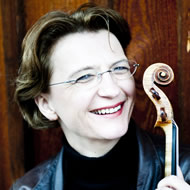
Antje Weithaas is one of the most sought-after soloists and chamber musicians of her generation. She is the artistic director of the Camerata Bern, a professor at the Hanns Eisler School of Music in Berlin, and a co-founder of the Arcanto String Quartet with Daniel Sepec, Tabea Zimmermann , and Jean-Guihen Queyras.
Classicpoint.ch: You completed your musical training at the Hanns Eisler School of Music in Berlin under Werner Scholz. Now you are a professor at the Hanns Eisler School of Music in Berlin. What was your experience of this institution as a student, and how does it feel now as a professor?
That's very difficult for me to compare. I studied at the Hanns Eisler School of Music during the GDR era, in a dictatorial system. I was, of course, constantly aware of the lack of intellectual freedom and the political pressure. Fortunately, however, I had complete musical freedom. In addition to a fantastic education, I received a great deal of support from an early age, also through the school, and was able to "try things out" in concerts and gain important artistic experience. It is, of course, wonderful for me to teach at my "former" university today. The Hanns Eisler School of Music now enjoys an excellent reputation worldwide as a musical training institution; the faculty is international, and the artistic standard is very high. We have a wonderful atmosphere in the string department, and it is simply a pleasure to work with such talented students.
You play an instrument made by Peter Greiner in 2001. Would you trade that violin for a Stradivarius, or does the mystique surrounding old master violins hold no appeal for you?
For me, what's interesting about an instrument isn't its age or the luthier's name, but the quality of its sound. I'm searching, so to speak, for "my vocal cords." Every musician pursues their personal sonic ideal, seeks a wide tonal palette and versatility, and of course, an instrument sound that allows them to express themselves personally and speaks to their soul.
I find all of that in my Peter Greiner violin.
You took over the artistic direction of the Camerata Bern . How did you come to join the Camerata Bern?
It was a matter of chance. A few years ago, I stepped in at short notice as a soloist and conductor for a colleague with the Camerata Bern . I remember a fantastic atmosphere during rehearsals and wonderful concerts. A few months later, I received a call asking if I would be interested in the artistic directorship. You can imagine that I was very surprised, but also very pleased. Nevertheless, I thought about the offer for a long time. After all, the artistic direction of a chamber orchestra was completely new to me. Today, we are in our fourth season together, and I am very happy that the musicians of the Camerata have embarked on this "adventure" with me.
What do you appreciate about this ensemble, where do you see its strengths? I experience the ensemble as far removed from any false routine, always curious and with a great passion for music. Because the Camerata plays without a conductor to whom one could delegate responsibility, a truly chamber music-like approach emerges; each individual contributes and is challenged as a creative musician. This kind of music-making is my ideal, whether in chamber music, as a soloist, or indeed as the director of a chamber ensemble. I believe that by now there is an almost telepathic understanding, a great joy in working and playing together, even during our rehearsals. Very intense, energetic, and spontaneous performances result. What are your visions for the Camerata Bern? We are always looking for exciting programs for our audience in Bern and for our concerts beyond the region and for international tours. Without neglecting the core repertoire for string orchestra from the 18th to the 20th centuries, I would like to continue down the path we have begun of presenting symphonic works, such as Beethoven's symphonies, to the public in a chamber music-like, transparent manner. Since last season, a new focus of the ensemble has been the exploration of Baroque music on new historical instruments. Furthermore, there is a pleasing interest in composing new works for the Camerata Bern
with Tabea ZimmermannYou founded the ARCANTO Quartet in 2002
We had played together for many years in various ensembles, enjoyed it immensely, and were very good friends. So, at some point, it seemed natural to dedicate ourselves together to the incredibly beautiful string quartet repertoire.
All four of you are quite active internationally. How much time do you dedicate to playing as a quartet?
At the moment, we play together for about four weeks a year, which means we plan four periods of concerts and CD recordings spread throughout the year.
How does rehearsal work go? Does someone take the lead, or does everyone spontaneously suggest what they'd like to change?
Of course, everyone contributes their ideas. We're a truly "democratic" quartet and can really "argue" about nuances of musical interpretation. But we often find that we're not that far apart after all.
What's the longest break you've had from playing your violin?
This summer, for example, I finally took a proper four-week break. That hadn't been possible for several years. But my violin and I quickly reconnected and harmonized as usual right from the first concerts.
Interview by Florian Schär | Classicpoint.ch | October 7, 2013
Photo: Marco Borggreve
September 13, 2026 - Antje Weithaas (violin), Noémie Bialobroda (viola), Pauline Sachse (viola), Peter Bruns (cello), Thorsten Johanns (clarinet), Oliver Triendl (piano)
December 9, 2026 - Antje Weithaas & Leo McFall
December 10, 2026 - Antje Weithaas & Leo McFall
January 23, 2027 - CAMERATA BERN | «Distant Light»
January 24, 2027 - CAMERATA BERN | «Distant Light»
10.02.2027 - Antje Weithaas (violin), Dénes Várjon (piano)
27.02.2027 - Antje Weithaas (violin), Konzerthausorchester Berlin, Jonathan Cohen (conductor)
12.06.2027 - Antje Weithaas (violin), Bochumer Symphoniker, Anu Tali (conductor)




























































Do you want to attract more visitors to your concerts?
Find out more about the possibilities this portal offers.
With a concert search subscription, you will receive an email for your selected cantons/federal states as soon as a new concert is listed there. You can unsubscribe from the service at any time.
