interview
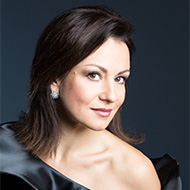
Interview with Elena Stikhina
June 1, 2026
“The Zurich Opera House has a very special meaning for me.” Elena Stikhina is…


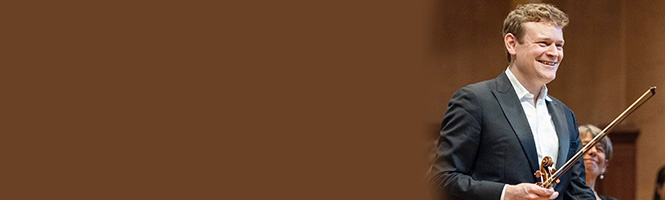


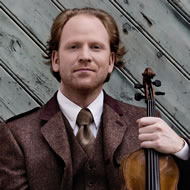
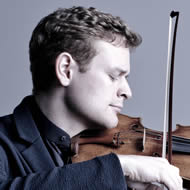
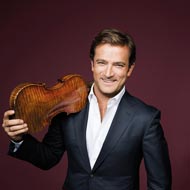
Daniel Hope is one of the most important violinists of his generation. He performed with Yehudi Menuhin at the age of 11. In addition to his solo career, he was also a member of the Beaux Arts Trio. Daniel Hope is also an author and has written two books.
Your mother was one of Yehudi Menuhin's secretaries. As a baby, you were always with him at rehearsals, concerts, and on tours. What was it like for you as a child and teenager to experience Yehudi Menuhin?
I came to live with him when I was six months old. Until I was seven, I spent almost every day with him, especially every summer in Gstaad. Later, at 16, I went on tour with him and played concerts with and under his direction for 10 years: he conducted, I was the soloist, even at his last performance. It was a wonderful time; Menuhin was always warm and approachable. He called himself my musical grandfather. Menuhin was very spontaneous. There was always a Stradivarius or Guarneri in its open case on the table; he never put it away. He would pick it up and play it, without any fuss, as if he were drinking a glass of water. From him, I learned that you have to play every day. He said: “We are like a bird, and can you imagine a bird saying, today I am tired, today I don’t want to fly?”
What does Yehudi Menuhin mean to you as a musician and violinist?
“I now know that there is a God in heaven,” was Albert Einstein’s comment on Yehudi Menuhin’s concert debut, which he gave in Berlin at the age of seven. Bruno Walter, the conductor that evening, called him “the little boy with the big soul.” Although Menuhin has been dead for a long time, I am constantly reminded of him. When I listen to recordings of him, I naturally think of his playing and his unmistakable sound. The intensity of the emotions he conveys to the listener is breathtaking.
Did you have a pivotal experience as a concertgoer of classical music?
I first heard Mendelssohn's Violin Concerto Op. 64 performed by Pichas Zuckermann in London when I was five. From then on, I desperately wanted to play it, but I wasn't nearly technically ready. At boarding school, I was frustrated because I wasn't given enough pieces to practice. One day, I locked myself in the bathroom and secretly practiced the violin concerto. I had borrowed the sheet music from a friend. I was caught and given a dressing-down. My parents were called and thought I had set the school on fire. But when they found out what it was all about, they took me out of school.
Was there a key experience during a concert as a musician?
There is at almost every concert!
You played violin in the Beaux Arts Trio from 2002 to 2008. In your opinion, is there a specific Beaux Arts Trio sound that you had to search for, or did you simply play in this trio the way you always do?
The time with the Beaux Arts Trio was a kind of chamber music specialization. And what could be better than giving 400 concerts and recording three CDs together with the wonderful pianist Menahem Pressler? I perhaps learned more during those years than in my entire life. In every rehearsal, Pressler tried to reinvent the pieces—even if he had already played them thousands of times. There wasn't a single rehearsal of, say, Beethoven's Archduke Trio where he didn't pause for half a minute beforehand. For him, it's always a matter of life and death. He fights for every accent—and holds back so much in the ensemble playing. That's how magical moments are created. The chemistry between Pressler, cellist Antonio Meneses, and myself in the last iteration of the trio was so good that Pressler ultimately wanted us to continue the trio with another pianist. But I couldn't do that. The Beaux Arts Trio is Menahem Pressler.
You are also an author. Your first book, "Familienstücke" (Family Pieces), became a bestseller in Germany. In it, you describe your search for your great-grandparents in Berlin. Both were Jewish converts to Christianity who lived in Berlin, and both of your great-grandfathers were murdered during the Holocaust. When and why did the idea of writing a book about this arise?
In 2007, I received an offer from Rowohlt Publishers to write my biography. I was flattered, but at the same time, I found the request absurd at the beginning of my thirties. So I declined with thanks. A few months later, I was in Berlin and visited my great-grandparents' former home. By chance, I discovered something astonishing: My ancestors suffered one of the typical fates of that time. When the pressure became too great, they agreed to a forced sale of the villa and emigrated to South Africa. The great-grandfather couldn't cope with the journey and died en route. Initially, the house continued to be used by the private Jewish Kaliski School; 39 students later perished in the Holocaust. From 1939 onward, the Reich Foreign Ministry used the premises. The Nazis' main decryption station was established here by Foreign Minister von Ribbentrop himself. Today, the German Foreign Ministry still owns the house, and the German Archaeological Institute operates a guesthouse there. It's both beautiful and sad to be in the house. On one of my first visits, I discovered old pieces of furniture belonging to my ancestors and a family crest. The story struck me as very compelling, so I remembered Rowohlt's offer and picked up the phone. That's how "Family Pieces" came about.
In September 2009, your second book, a concert guide titled "When May I Applaud?", was published. Why and for whom did you want to write this book?
The book examines the so-called rules of classical music and its presentation. It asks why certain rules exist and how they originated. I wrote it because I didn't know enough about it myself. The goal is to get people to concerts by explaining things to them. After almost completely abandoning home music-making and music education in schools, you can no longer simply assume everyone knows these things. At a reading of my first book, someone approached me and said they didn't go to concerts because they didn't know when to applaud. So, I started to delve into the history of applause over five centuries...
You give over 100 concerts a year, record CDs, appear on television, and write books that become bestsellers—how do you manage to juggle it all?
Discipline and a great team.
You are committed to making classical music accessible to as many people as possible. Which projects are particularly close to your heart?
Live Music Now and Rhapsody in School are two outstanding projects that ideally combine music and social engagement, and I regularly participate in them. I also direct two festivals (Mecklenburg-Vorpommern in Germany and Savannah in the USA) – both have large-scale programs for emerging artists or children's concerts.
You don't shy away from collaborating with other musical styles besides classical. What motivates you to realize collaborative projects with pop, rock, folk, or techno?
I'm not particularly interested in techno, but I am interested in all the other genres. I find it exciting and inspiring to talk to musicians, to communicate with them, and to learn from them. The genres don't matter in that respect.
Most classical stars don't want to engage with other types of music. Do you think that's a good thing, or is a change in thinking needed?
Everyone has to find their own path. For me, being a musician means having to listen very carefully.
Do you believe that classical music can touch people more deeply than pop music?
Without a doubt. Pop music is to classical music what champagne is to red wine. Champagne has an immediate effect, goes straight to the bloodstream, is incredibly potent, but only for a short time. The effect of a good red wine, on the other hand, comes slowly, very gradually, but lasts much longer. You quickly forget the taste of champagne, but you can still taste a fine wine the next day, and sometimes you even remember a very good vintage months later.
Interview by Florian Schär | Classicpoint.ch | May 4, 2012
Photo: Harald Hoffmann / DG


























































Do you want to attract more visitors to your concerts?
Find out more about the possibilities this portal offers.
With a concert search subscription, you will receive an email for your selected cantons/federal states as soon as a new concert is listed there. You can unsubscribe from the service at any time.
