

interview
Interview with Julia Lezhneva
August 31, 2026
“Analytical work allows for emotional freedom, while emotional discoveries…”


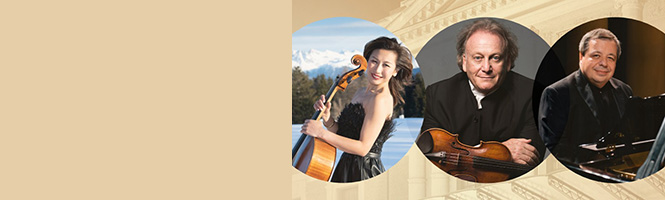




Mischa Maisky is one of the most important cellists of our time. The Latvian-born artist was hailed early on as Rostropovich's future successor. At the age of 22, the world-famous soloist was sent to a Soviet labor camp for 18 months and had to shovel cement for over a year without his cello. His subsequent international career is all the more remarkable.
Classicpoint.ch: When and why did you begin playing the cello?
For the standards of the Soviet Union at that time, I started playing the cello very late. It was the year I quit smoking – I was eight. I was the third child; my sister already played piano, my brother violin. My mother had had enough; she wanted a "normal" child, so I initially went to a regular school, but then I insisted on playing the cello. Why the cello in particular, I don't remember now. There might be some romantic story about how I heard a cello playing from an open window on the street and fell in love with its beautiful sound. But I always have to disappoint people by saying I don't remember it. Perhaps it was simply a practical decision so I could play in a trio with my siblings. That never came to pass, which is why I later dreamed of forming a family trio with my children.
After your father died young, Rostropovich was like a second father to you. How did that come about?
I was, of course, completely obsessed with Rostropovich's personality as a cellist, teacher, and musician. It was my lifelong dream to study with him. When my father died unexpectedly of lung cancer, Rostropovich supported me, even though I wasn't yet his student. After the Tchaikovsky Competition, he took me into his class. We had a close relationship, musically speaking, of course, but also personally, which is perhaps because he always wanted a son (he had two daughters). Shortly before his death, when we spoke at length, he told me I had been like a son to him.
In the middle of your studies at the Moscow Conservatory under Rostropovich, you were arrested. After four months in prison, you had to shovel cement for another 14 months. What happened, and why couldn't Rostropovich help you?
The circumstances were incredibly unfortunate. When I was arrested in the summer of 1970, Rostropovich himself was facing serious problems because he was advocating for the writer Solzhenitsyn; he was already living at Rostropovich's country house at the time. He did what he could, but it was precisely at this point that he began to lose his immense influence. It was fortunate that I got out after 18 months; it could have been much worse.
Did anyone apologize to you later?
I never received an apology. But as difficult as the experience was, it was ultimately beneficial for my development—because even though it meant I never graduated from the Moscow Conservatory, I gained valuable life experience during that time. I always try to see the glass as half full. In this case, at least a quarter full.
How did it feel to play the cello again after that time? Did your experiences find expression in the music?
Yes, of course. Probably unconsciously, but that time shaped me. I didn't play the cello for a total of two years. Those two years felt like 20 years of life experience. When I started again, it wasn't easy, but it wasn't as difficult as one might think. I had a lot of new energy and was happy to be able to start a new life.
After your time with Rostropovich, you studied with Piatigorsky. Why Piatigorsky in particular?
He was a legend, especially in Russia. I met him in 1966 at the Tchaikovsky Competition, where he was on the jury. He was a good friend of Zubin Mehta, whom I knew from Israel. It was Mehta's suggestion, and Rostropovich also recommended only him when I left the Soviet Union. I was incredibly fortunate to have spent those special four months with him, even though he was already very ill. He died of lung cancer shortly afterward, just like my father.
If you had to say in a few sentences what he taught you, what would it be?
That's really difficult to sum up in a few sentences. He was nearing the end of his life, and he knew it. For me, it was the beginning of a new life. He loved speaking Russian, and it was his last chance to share his incredible life experience and knowledge with someone who absorbed everything like a sponge. It was an intense exchange, and I probably spent more time with him in those four months than I did with Rostropovich in four years, because he was always traveling. To say that Piatigorsky was a better teacher than Rostropovich would be as absurd as claiming that Mozart was a better composer than Bach, but one could say that I was a better student. I had a very close relationship with both of them; Piatigorsky became a second father to me in my second life.
You are the only cellist who studied with both Rostropovich and Piatigorsky. How different were the teaching styles of these two great cellists?
They were very different personalities, but interestingly, they had a similar way of teaching. They almost never talked about cello playing itself. They were concerned with music and musical expression, and the main thing I learned from both of them is that the cello (in my case) is nothing more than an instrument. It's a means to help us pursue a goal, namely music. One must constantly remind oneself of this so that music doesn't become a means to demonstrate how well someone has mastered their instrument.
Do you listen to recordings of other cellists and attend concerts as a listener?
Yes, absolutely. I listen to as much music as I can. I listen to other cellists because I believe it's important for developing one's own musical taste, training one's ears, and avoiding falling into a routine. You can learn from every recording and every concert—from the good and interesting things, and from the mistakes of others as well. Music has become my profession, but first and foremost, it's my passion. I love music and enjoy listening to it, so I go to concerts to hear great music and wonderful artists whenever I can.
Please tell us the story of how you came to own your Montagnana cello.
When I arrived from Russia, I didn't have a good instrument. I was delighted when Charles Beare, a luthier from London, provided me with one. In 1973, I made my Carnegie Hall debut on it with the Pittsburgh Symphony Orchestra. After the concert, a gentleman waited until everyone had left and told me that he loved classical music and had thoroughly enjoyed my performance. His uncle was an amateur cellist and had this magnificent instrument, which he could no longer play because he was 94 years old and partially paralyzed. He wanted a young artist to play concerts on the instrument so that many people could enjoy hearing it. The next day I went to visit him, we talked for a long time, and I played a lot for him. When I left, he had tears in his eyes and said he could now die in peace because he knew the cello was in good hands. He wanted to give it to me, but it was his only asset, and his wife was even younger, so he offered it to me for a very symbolic price. Since I had no money at all, a foundation bought the cello, and I played it until I could take out my own loan to buy it back from the foundation. So the cello and I have gone through various stages in our relationship: First, we fell in love at first sight, or rather, first sound; then we had a wonderful affair for several years. When I bought it from the foundation, we became engaged, so to speak, and when I paid off the loan, we got married. Every year we celebrate our anniversary—last year was our 40th! It's a long relationship, and I hope we have just as many years ahead of us.
At your performance at the Zaubersee Festival in Lucerne, you will be playing works by Rachmaninoff. What do the composer and his music mean to you?
Even though I'm not from Russia, but from Latvia, I was educated in Russia and naturally have a strong and close connection to Russian music, Russian culture, and Russian literature. Rachmaninoff is one of my favorite composers, although I could say that about at least a dozen other composers as well. Sometimes I wish I were a pianist so I could play even more of his music, but he wrote many romances and shorter pieces for piano and voice that suit the cello so well that I took the liberty of arranging them, following his own arrangement of the famous "Vocalise." The pieces have been well received everywhere I've performed them so far, and I hope the audience in Lucerne will like them too.
You'll be accompanied by your daughter on the piano. Even though it's not the whole family trio you mentioned – how do you experience the artistic collaboration with her?
I've been playing with my daughter for many, many years. It has always been my lifelong dream to make music with my children, a dream that has now come true. It's extremely natural and inspiring. I'm very much looking forward to performing together again in Lucerne.
Interview by Florian Schär, Johanna Ludwig | Classicpoint.ch | May 2, 2014
Photo: Hideki Shiozawa
January 17, 2027 - Mischa Maisky & Young Talents
January 19, 2027 - Bar Zermach (horn), Sascha Maisky (violin), Andra Heesch (viola), Mischa Maisky (cello), Claire Sojung Henkel (cello), Jens Peter Maintz (cello), Maximilian Maisky (piano), Lily Maisky (piano)



























































Do you want to attract more visitors to your concerts?
Find out more about the possibilities this portal offers.
With a concert search subscription, you will receive an email for your selected cantons/federal states as soon as a new concert is listed there. You can unsubscribe from the service at any time.
