

interview
Interview with Julia Lezhneva
August 31, 2026
“Analytical work allows for emotional freedom, while emotional discoveries…”




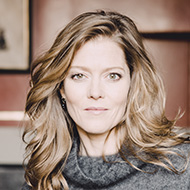
Barbara Hannigan (born 1971, Canada) is an internationally acclaimed soprano and conductor. She is one of the leading interpreters of contemporary music and collaborates with the world's most prestigious orchestras and opera houses. In addition to her successful career as a singer, she has also established herself as a conductor and is committed to fostering young musical talent. She has received numerous international awards for her artistic achievements.
You combine singing and conducting at the highest level – was there a moment in your career when you consciously decided to pursue both roles simultaneously?
There was a moment in my career when I decided to conduct alongside what was essentially a fully booked schedule as a singer. And that was shortly after my conducting debut in 2011. The conducting debut wasn't a decision I made to steer my career in that direction. It was simply an event I wanted to try, an experience I needed to have. And it took place in a rather public setting, namely at the Châtelet in Paris, at the Présences Festival. Only shortly before I went on stage for this event did I realize that conducting would likely demand a large part of my attention in the coming year and the years that followed. And that's exactly what happened. After my conducting debut, the phone started ringing, and I was asked to create special programs as both a singer and conductor, which I initially did. Over the months and years, I managed to combine my career as a solo singer in opera productions and concert halls with my conducting career by putting together programs in which I sang one or two pieces myself, surrounded by a purely instrumental repertoire that I conducted. A few years later, I was creating programs in which I only conducted. And for the last seven or eight years, I've had the freedom to create exactly what I want, whether it's conducting, singing, or both. Fifteen years have now passed since my conducting debut, and I'm very happy with the path my life has taken.
You are particularly known for contemporary music – what is it about it that appeals to you compared to the classical repertoire?
Contemporary music has attracted me since childhood. I remember enjoying the sounds themselves and the development of sound and melody in unexpected ways. And since I had a very good ear and was very well trained in harmony, sight-reading, and so on, I possessed a kind of aptitude – a aptitude fostered through training – which I developed further for the difficult, more demanding aspects of contemporary music. But I think the most important thing is that I have a passion for contemporary music, and I realized that this passion is something unique. So I turned this passion, combined with my skills, into a kind of vocation, using the word "voca," meaning "called." I felt it was a kind of duty for me, given this inner passion for music, to spend a large part of my time supporting composers and performing the music of our time. That is not to say that I don't love classical music. I do (!!) and most of my programs as a conductor are more classical than contemporary! But I try to maintain a balance, and fortunately, at this point in my career, I have the trust and the connection with audiences everywhere, so I can program pieces that may be unfamiliar to the audience, and they still come to the concerts because they are curious. I think they trust that everything I choose is, in my opinion, very much worth hearing.
You work closely with living composers – what does this creative process actually look like?
Working with living composers is different for each one. What interests me when selecting composers is their authenticity with themselves. I don't want them to write something they think the audience or I will like. I want them to write truly from their heart and from their own passion. That's why I do my best to support them in this, and our communication during the creation process of a piece can, in some cases, be very intense, extending to the selection of the text and very specific discussions about my voice before they even begin writing. That was the case with Hans Abrahamsen.
In the case of George Benjamin, before he began writing the opera "Written on Skin," I spent hours at his home singing and performing various pieces for him. He had seen me perform many times before and really insisted that he write this piece specifically for my voice. Other composers, like Laura Bowler, who just wrote "The White Book" for me, have followed my career and the projects I've worked on for many years. From the moment we met, there was a very strong bond of trust between us. So we didn't have meetings where I made suggestions. I simply received this absolutely beautiful vocal part and score for "The White Book" when the work was more or less finished. And it's an incredible piece that fits me perfectly, and I can't wait to perform it everywhere!
How do you approach interpreting a completely new work that has no established performance tradition?
I love engaging with a new piece of music that hasn't been recorded, a piece that no one has ever seen, touched, or performed before. For me, that's like a golden ticket. I often compare it to leaving the first footprints in freshly fallen snow. It's an adventure. I do everything I can to understand the composer's intentions and also to ensure that, as a performer, I discover and explore new possibilities within myself, whether I'm singing, conducting, or both. So, that's the reception of a new score. For me, it's an extraordinary gift.
Is there a piece you keep rediscovering, even though you've sung it many times?
Actually, I rediscover every piece I sing, no matter how often I've performed it. Whether it's an older work or something written for me, I approach every rehearsal and indeed every performance as if I were starting from a blank sheet of paper. And of course, that's impossible when you have a memory and have many performances and experiences behind you. But I constantly remind myself of the blank sheet and even go so far as to stick a white sheet of paper to the mirror in my dressing room to remind myself how important it is not to cling to things that may have gone very well, or even things that may not have gone so well in previous performances or rehearsals, and to remain in a constant state of renewal and discovery.
How do you manage to strike a balance between vocal control and emotional freedom on stage?
I make a very clear agreement with myself as a singer and actress, and this relates to your question about vocal control and emotional control, because many of the roles I sing are extremely emotional. For example, Poulenc's "La Voix humaine," the solo opera—it's so demanding, and the woman goes through such a traumatic and emotional journey that it can cause a lot of physical tension. When someone is close to tears, their throat naturally tightens in real life, and we're almost unable to speak. Well, as a singer, I can't allow that. After all, I still have to sing a great high C in the middle of the piece. So I make a deal with myself: the actress can play the role, but Barbara's voice has to be protected—it's a kind of conscious game and an agreement. It's a kind of playful agreement between the two, so that my voice can emerge unscathed from performances of particularly emotionally demanding pieces.
What have you learned about singing through conducting – and vice versa?
The most important connection between singing and conducting is breath. And as a singer, I know that when I've worked with conductors who breathed really well, I've been able to sing better because they were in sync with me in the line and the phrasing. That's something I bring to orchestras as a conductor. I've even given masterclasses on breathing with some of the orchestras I work with because it helps all of us, including the players who play string instruments or percussion. Breathing is extremely important as the foundation for our melodic line and phrasing. So I would say that's the most important connection: breath.
What qualities do you particularly value in orchestral musicians and directors?
I love working with orchestras that communicate with each other, so they are very cooperative within the orchestra. I love orchestras that are open to trying new things and taking risks. And I have this experience with basically all the orchestras I work with, I must say. And with directors—I assume you mean theater directors. There are certain directors I work with repeatedly. These are Katie Mitchell and Krzysztof Warlikowski, as well as Andreas Kriegenburg. I would say these are the three most important directors I have worked with more than once, and I am very much looking forward to realizing another project with the extraordinary Romeo Castellucci, with whom I worked last year, as well as with Christoph Marthaler, with whom I worked some time ago but would very much like to work again. I believe all these directors enable the performers to contribute to varying degrees. I think Katie Mitchell is the one who plans most in advance what will happen for her actors. With Warlikowski, on the other hand, we work a lot with improvisation, and the same is true for Christoph Marthaler. In the case of Romeo Castellucci, he worked with me and Jakub Orliński on Pergolesi's "Stabat Mater," and we contributed quite a lot through movement improvisation, since both Jakub and I are very expressive; Romeo then shaped it as he wanted and guided us—it was a very unique and enriching exchange.
Are there any projects or roles you have consciously turned down – and why?
Yes, there are some projects or roles I've turned down simply because I felt the vocal material might be too demanding for me, or that the dynamic wasn't right for me. I mean, of course, I have to turn down a lot of things because I'm not available and so on. And I have to choose what I do. That's why I'm very careful. Usually, it comes down to an instinct. Is this the right thing for me at the moment? Can I add something to this music that will benefit the piece?
What are your passions outside of music?
Being in nature, spending time with my cats, and cooking.
What inspired you to record the program for your new release, "An American Dream"?
The evolution of American music has always fascinated me. The first half of the 20th century, in particular, was, in my opinion, an extremely fruitful period in America. Jazz, Broadway, ragtime, folk music, but also composers like Aaron Copland, who, through disciplined training with teachers like Nadia Boulanger in Paris, tried to find their own voice, but then returned to America to truly write something they could define as a genuinely American sound—which I believe we certainly found in the music of Aaron Copland. Of course, jazz and Broadway play a major role on this album, with "Carousel Waltz," "Porgy and Bess," and the suite that Bill Elliott and I composed. I also wanted to explore the theme of nostalgia and take a somewhat melancholic look at what has become of the American Dream, questioning the American-centric behavior of this country and asking why it seems more dystopian than idyllic to many. So, the album primarily poses questions, which is why the album title includes a question mark. I don't provide answers, but I certainly ask a lot of questions.
Interview by Florian Schär | Classicpoint.net | July 1, 2026
Image Copyright: Marco Borggreve
January 14, 2027 - Barbara Hannigan (soprano, conductor & director), Delphine Dussaux (piano), Deutsches Symphonie-Orchester Berlin, Denis Guéguin (director)
March 17, 2027 - Barbara Hannigan
Barbara Hannigan
- Barbara Hannigan
- Barbara Hannigan
- Guest in Schaffhausen
- Schaffhausen Classical Concert 5: «BEETHOVEN»
May 6, 2027 - Bertrand Chamayou (piano), NDR Elbphilharmonie Orchestra, Barbara Hannigan (soprano & conductor)
July 1, 2027 - Barbara Hannigan (soprano), Magdalena Hoffmann (harp), Bavarian Radio Symphony Orchestra Simon Rattle (Director)



























































Do you want to attract more visitors to your concerts?
Find out more about the possibilities this portal offers.
With a concert search subscription, you will receive an email for your selected cantons/federal states as soon as a new concert is listed there. You can unsubscribe from the service at any time.
