

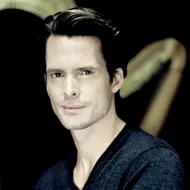
«There is hardly time for anything else.»

Xavier de Maistre is generally celebrated as the artist who has succeeded in bringing the harp out of the realm of delicate, admittedly wonderful but very gentle tones, into which it is all too quickly categorised. As a soloist, Xavier de Maistre regularly performs in the leading concert halls of Europe, Japan and the USA. Since 2001 Xavier de Maistre has been a professor at the Hamburg University of Music and Drama.
How did you come to the harp?
My parents sent me to music school as a boy, and I was so enthusiastic about the harp teacher that I was determined to learn the harp.
Before your harp studies, you studied political science at the renowned Ecole des Sciences Politiques in Paris and later at the London School of Economics.
I don't come from a musical family, and my parents wanted me to learn a "proper profession". Although all my teachers kept saying that it would be a waste of time and that I should focus entirely on my harp studies, my parents did not believe that I would earn enough as a musician to make a living.
From when did your parents also believe that you could make a good living as a musician?
That was when I got the position of principal harpist with the Symphony Orchestra of Bavarian Radio.
Are you still interested in politics today?
While studying political science, I realised that I could not live without music and that I absolutely wanted to devote myself fully to music. Nevertheless, I remain very interested in world events today. I read at least two daily newspapers every day.
Do you believe that other harpists could build a career on the scale of yours?
I would be very pleased. However, I fear that the market is still too small. The harp is a very spectacular instrument. When people get to know the instrument better, they want to hear more of it. It is also important that the repertoire be expanded. I could not have had a solo career with the standard repertoire. I have adapted a great many pieces for the harp and have thus been able to expand the repertoire.
You persuaded Krzysztof Penderecki to accept a commission.
Most composers have enormous respect for the instrument and do not dare to compose for it. My fame helps me, and I want to use it to persuade contemporary composers to write new works. Penderecki was also hesitant. However, I have already met with him several times and will continue to help him understand the instrument and show him its possibilities, so that the harp's vast range can be fully exploited. There have also been few composers in the past who engaged intensively with the harp, such as Maurice Ravel or Richard Strauss.
The vast majority of people who play the harp are women. Why is that?
That is historically determined. There is always this image of the 18th century, in which a pretty woman plays the harp in a salon. Although in the past men were the famous harp soloists, this cliché is deeply entrenched.
You are a professor in Hamburg and regularly give masterclasses at the Juilliard School New York, Toho University Tokyo and Trinity College London. Do you see a trend, through your work as a professor and as a role model for harpists, that more male students are now choosing the harp as their instrument alongside female students?
Yes, certainly. Not among the pupils at music schools, but among the students who wish to pursue the harp as a profession; there the trend is noticeable.
Can a harp also fill a large hall?
Indeed, one can fill large concert halls with the harp. Many soloists do not dare to play a triple piano. I have found from experience that it works very well. The audience holds its breath so as to still hear the notes. Afterwards, a fortissimo naturally sounds much louder again. The ear adapts to the range. I love those moments when a well-filled large hall suddenly falls completely silent so that the softest pianissimo can still be heard.
Before your international solo career, you spent over 10 years with the Vienna Philharmonic. How did you experience that time?
As a musician I learned a great deal from the many different outstanding conductors, for example how to shape the long phrases and lines and how to work in detail on the works. However, I was always very frustrated, as as a harpist I mainly had to wait during rehearsals and had rests. I wanted to play, and I do not regret for a second the decision to leave the orchestra and pursue a solo career.
What do you actually do when you are not playing the harp?
I play over one hundred concerts a year and travel a great deal. There is hardly time for anything else. However, I enjoy sport very much. Whenever possible, I go jogging, rowing or swimming. As I said, I read several newspapers every day. I also try to spend as much time as possible with my six-year-old daughter.
Interview by Florian Schär | Classicpoint.ch | 09.07.2012
Photo: Felix B. Röde