

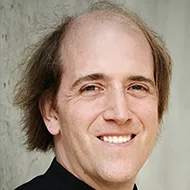
«I see myself as a servant of the work.»

Titus Engel made his operatic debut in 2000 with the world premiere of Benjamin Schweitzer's Jakob von Gunten at the Dresden Days of Contemporary Music. Since then he has conducted many productions across various genres at different venues, for example Monteverdi's L'Orfeo at Radialsystem V Berlin and at the Theater an der Wien, several operas at Theater Kampnagel Hamburg and at the Oper Stuttgart, through to Glass's Akhnaten at Opera Vlaanderen Antwerp/Ghent. At the invitation of Gerard Mortier, he made his debut at the Teatro Real Madrid with the world premiere of Pilar Jurado's La página en blanco in February 2011. He is now a regular guest there: in 2014, under his direction, Charles Wuorinen's opera Brokeback Mountain received its world premiere. In June 2016 he conducted the Swiss premiere and the third complete performance ever of Stockhausen's Donnerstag from the cycle Licht at the Theater Basel. The production received the award "Production of the Year" in the Opernwelt critics' poll 2016.
Engel has conducted numerous renowned orchestras, including the Orchestre de l'Opéra de Paris, the Orchester der Deutschen Oper Berlin, the Mozarteumorchester Salzburg, several radio symphony orchestras, the Orquesta Sinfónica de Castilla y León, the Berner Symphonieorchester, the Mahler Chamber Orchestra, the Danish National Chamber Orchestra, as well as several chamber orchestras in the southern German and Swiss region. He is also regularly invited by the leading ensembles for contemporary music. From 2000 to 2012 he was musical director of the ensemble courage. He has premiered numerous works (Sergej Newski, Leo Dick, Elena Mendoza, Olga Neuwirth, Michael Wertmüller, Rebecca Saunders), among others at the RuhrTriennale, the Berliner Festspiele, the Lucerne Festival, MaerzMusik, the Donaueschingen Music Days, the Salzburg Festival and Opera d'hoy Madrid.
Projects in 2017 included the world premieres of Elena Mendoza's opera La ciudad de las mentiras at the Teatro Real Madrid and Mozart's La Betulia liberata at the Oper Frankfurt. The world premiere of Chaya Czernowin's Infinite Now at Vlaanderen Opera and the Nationaltheater Mannheim was voted "World Premiere of the Year" by Opernwelt in 2017.
The Deutsche Bühne described him as a "conducting dervish" who guides all the performers safely through breakneck rapids.
You first studied musicology and philosophy. Were you already clear at that point that you would begin studying conducting afterwards?
Yes, I wanted to become a conductor from about the age of 17. During that time I conducted our school orchestra for the first time. It thrilled me so much that I immediately knew this was my dream profession. However, I wanted a broader education, which is why I decided on two courses of study, some of which ran in parallel.
To what extent can you make use of your philosophy studies in your conducting today?
Philosophy is concerned with the great questions of life. Kant formulated them particularly beautifully: What can I know? What is man? What should I do? What may I hope? I believe that reflecting on philosophical questions shapes me both as a person and as a musician. Music aesthetics and music psychology also fascinate me greatly. How can the wonder of music be explained? How can sound waves trigger such incredible emotions? To this day I don't know, but I remain curious...
Opernwelt named you Conductor of the Year in 2020. What tipped the balance, and how important is this title to you?
During the season I conducted two productions in which my work was received especially positively: Einstein on the Beach by Philip Glass in Geneva and Boris Godunov by Mussorgsky in Stuttgart, which was combined with a world premiere by Sergej Newski. This combination of new music and a major work of the Romantic era is something that particularly fascinates me, and I very much enjoy doing it. The title pleased me, and especially in Switzerland I received a great deal of personal encouragement because of it.
As an opera conductor, do you also have influence on how the director's concept is realised?
I very much like working with directors. What is exciting about opera is that, unlike in concert, you are not solely responsible for the project; it is a total work of art in which many people take part. I always try to get in touch with the director early on, something I learned from Gerard Mortier. Directors are often very interested in learning something new musically about the piece. A dialogue then usually develops, and of course that gives me influence over the staging as well.
You also try to bring different worlds of music and art together. Can you give us examples of projects?
The first that comes to mind is "Am Anfang" by Anselm Kiefer and Jörg Widmann, in which I was involved at the Bastille in Paris. It was incredibly fascinating to work with these two great artists. In my concert programmes I like to combine different musical worlds, for example Islam in contemporary music, or time and again the combination of Baroque and new music.
You are equally interested in early and in new music. Is your interpretive approach the same in both?
I see myself as a "servant of the work", as Hans Swarowsky, the famous conducting teacher, put it so beautifully. I always start from the score and read widely about the intellectual context of the work alongside it. With new music, collaboration with living composers is central to me, and I always learn a great deal there, including with regard to early music. It is simply not possible to notate everything in the score, however sophisticated the compositional technique, which is why conversation with the composers is so important. With early music I am interested in historical performance practice; here I can only communicate directly with the composer through books.
How are you experiencing the current pandemic situation?
My personal state of mind follows the waves of the pandemic. At the moment I am happy to be able to work at the Opéra de Lyon again. We cannot perform in front of an audience, but thanks to the careful planning of Serge Dorny we can now present Bartók's Bluebeard's Castle digitally. And looking towards the summer, I am cautiously optimistic and look forward to Wagner's Lohengrin and numerous world premieres. But I am very disappointed that, despite the numerous studies showing scientifically how small the risk of infection in theatres and concert halls is, these were the first venues to have to close and will probably be the last to reopen.
What lessons do you draw from this?
It is important that culture strengthens its lobby. We are not visible enough; especially with a view to the time after the pandemic, it is important to be more present with politicians. I also hope that the audience will help us in this. I receive a great many responses about how much audiences miss live performances.
What visions do you have for yourself personally and for the music world?
I dream of having my own orchestra that can combine new and early music in a special way, in which all pieces are played on the respective historical instruments. And I dream that those responsible for opera and concerts will dare more. Far too often the same repertoire is played over and over, while there is so much to discover.
What passions do you have besides music?
My family, sailing, reading and films.
Interview by Florian Schär | Classicpoint.net | 28.02.2021
More interviews
All interviews →


