

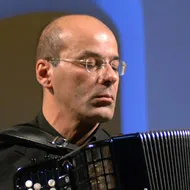
«Nobody was allowed to open my father's accordion case.»

More than 300 compositions have been written for Teodoro Anzellotti. For over 30 years he has been at home on the concert stage, teaches and records CDs. He has played a decisive role in bringing the accordion from folk music into classical music. Through extreme techniques he has expanded the tonal colours of his instrument to an extent previously thought impossible.
Classicpoint.ch: Your father already played the accordion while you were still living in Italy. What did the accordion mean to your father?
The accordion was part of his loves and his life. After emigrating, it became even more important to him in a foreign land. Had it been possible in his time and region to make a career in music, he would certainly have taken that path.
His hearing was infallible and he had thousands of pieces in his head. That remains unforgettably in my memory to this day.
How did you come to play the accordion?
Nobody was allowed to open my father's accordion case. And as is so often the case with children, this taboo created a particularly strong attraction. When I was finally allowed to play the accordion, I was captivated by it and at first could hardly be pried away from this instrument.
You grew up in Germany. If you compare Germany and Italy, your country of birth, what are the differences with regard to the accordion?
For the broader public, the accordion's connotation is still closely tied to folk music. If it is interesting or demanding, the accordion has a higher status.
In Italy there are still remnants of folk music with very ancient roots, for example in the Neapolitan songs. Elements of this music can even be found in Pergolesi's operas, with their ambiguities between major and minor, or rhythms from the tarantella. This music is still played and loved today – and with it also today's instrumental line-up and indeed the accordion. In Italy it seems to me that there is generally less prejudice and categorisation with regard to art and artists.
In German-speaking countries the accordion still has a somewhat staid and clumsy image. However, through the influence and presence of various world music, this image has been changing for some time.
Classical music lovers now also know and appreciate the accordion as a classical concert instrument. Especially at festivals, where curiosity, delight in surprises and a desire for innovation are greater than in subscription series, accordion programmes are well received, increasingly in demand and can be experienced.
In contemporary music festivals it is now a matter of course that it is part of the instrumentarium.
As a child you practised like someone possessed. Your parents, out of fear, even once took the accordion away from you and locked it up. What was your motivation?
It gave me an enormous amount of fun, and therefore there were at times these enthusiastic phases. Playing the accordion was by far what I loved most and what I was certainly best at.
I don't really know what exactly triggered this passion.
More than 350 works have been written for you. What fascinates composers about the accordion?
The accordion is an extremely flexible instrument. It possesses a great variety of sound and is a kind of 'synthesis instrument'. It can be combined well with all instrument groups or blended with them, merge with them or also stand apart from them in sound. It has a mysterious and sensuous sound world. It can sound delicate and supple, and in the highest registers light and also unordered, while on the other hand it can be direct, brightly glaring and charged with tremendous sound intensity and fullness, then again sound pale or liturgical.
But what is especially unique is that it is a polyphonic wind and keyboard instrument. The sounds can swell up and die away again out of nothing. The weight of the sounds can be shaped with both hands, arms or the whole body and made tangible. It is an instrument that audibly and visibly breathes, and I believe this quality particularly interests composers and fascinates listeners. For others, a certain appeal may lie in the unusual.
Why did composers of serious classical music only discover the instrument now?
Only since the 1960s of the last century could concert accordions be acquired without difficulty. Before that, this was only possible on request as a special commission directly from some manufacturers. Many probably didn't even know of its existence until then. Alban Berg, for example, had trouble finding a suitable accordionist for the premiere of his Wozzeck in 1925, one on whose instrument everything could be played in exact pitch and in the correct octave ranges. He only succeeded after a long search.
Or Sascha Heifetz, as an accordion enthusiast, had such a special instrument built for himself in Italy in the 1930s.
The difference from conventional accordions is that on these one can not only play mechanically pre-set bass notes with harmonically matching chords, which is practically arranged for a simple style of playing and quickly learned, but also possesses single notes across six octaves. Everything that was written for keyboard instruments can in principle be performed on it with technical correctness. From this time onward a serious and independent development of the repertoire gradually began, and the accordion could be led into new, complex dimensions both in sound and in playing technique.
Naturally, this also required exceptionally good, bold and inspiring pioneers who approached composers. At first, value was still placed on setting standards. A pedagogical aspect also played an understandable and important role at that time. Extremes were not sought.
I, on the other hand, am driven by an insatiable curiosity to explore every corner of the accordion. To question sound and technical standards; to continually probe and extend my own limits and those of the instrument. From this, and of course with the selection of composers, a corresponding repertoire, technique, playing style and also questions on improving accordion making have arisen.
Recently, far more new literature has been composed for the accordion than for any other instrument. Is the accordion the solo instrument of the future?
Indeed, a large number of interesting works have by now been created worldwide. Not only solo pieces, but also music for a wide variety of smaller and larger ensembles, or solo concertos with orchestra. For many musicians, especially keyboard players, solo pieces or purely solo programmes are initially an obvious challenge. Today there is an ocean of wonderful solo pieces that allow for very diverse and interesting programmes.
Nevertheless, I believe that in the future the accordion will develop even more in chamber music and will also become a firmer part of the new orchestral or ensemble repertoire.
You teach at the university in Bern and in Freiburg im Breisgau. Where do you see the differences between the university systems and the students in Switzerland and Germany?
As part of the Bologna reform, music academies in Germany were able to retain a four-year duration for the Bachelor's degree. For the main instrumental subject, the one additional year of study is noticeable.
In Switzerland, students appreciate that chamber music and also contemporary music are organised, scheduled and supported more thoroughly. Project work and openness to new things are encouraged and almost always lead to public performances. Students are generally supervised and mentored more closely, including in their minor subjects.
In Germany, students are expected to show more initiative, independence and flexibility. Much is also handled informally.
Yet despite individualised course content, locations or traditions, the universities are working intensively, especially in recent times, to bring the multifaceted prerequisites for later professional life up to date and to prepare students for them as well as possible. For example, the existence as a freelance 'patchwork musician' – which is increasingly becoming the reality for musicians today.
What is the situation with young talent? Is the number and quality of accordion students increasing or decreasing?
According to statistics, the accordion is the third most popular instrument among children in both Germany and Switzerland.
In rural regions, however, it is still more often taught by part-time teachers. The idea of working as an accordionist in a full-time profession and training through a comprehensive music degree at a university is still somewhat unusual in these circles or scenes.
Nevertheless, the number of accordion students has multiplied over the last 20 years. Applications have become more international. The quality has generally increased markedly. A high professional level of playing is now reached 3–4 years earlier.
In the renowned university classes one now finds at least one student who can play pieces that 20 years ago were considered extremely demanding and had only a few soloists in their repertoire.
Stylistic certainty and sound quality have also developed further.
Many instruments required a development period of 200 years to achieve a highly advanced playing technique and a large repertoire. The accordion went through it at a dizzyingly rapid pace. Like time-lapse photography.
Do you have other passions besides playing the accordion?
Apart from my family, I don't have much free time and try to consciously experience and enjoy everyday things. Beautiful landscapes, travel, good cooking. Or accordion making, which has interested me for a long time. I have very precise ideas and criteria, and I was fortunate to find, many years ago, an extraordinary accordion maker who is right for me: the Bugari workshop. I maintain intensive contact with its technicians. The pianist Pierre-Laurent Aimard made a fine comparison for dialogues between instrument makers and performers: "Roughly like a Formula 1 driver and his technicians."
Interview by Florian Schär | Classicpoint.ch | 4 August 2014
More interviews
All interviews →


