

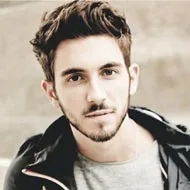
«I am at home wherever I have a piano»
Born in 1992 near Zurich, the Swiss-Canadian pianist Teo Gheorghiu made his concert debut in 2004 in his home city at the Tonhalle. Since then he has performed all over the world, including in Paris, Tokyo, St. Petersburg, Madrid, New York and at all the major venues in London. He has worked with leading orchestras, including the Danish National Symphony Orchestra, the Zürcher Kammerorchester, the Tchaikovsky Symphony Orchestra, the Royal Philharmonic Orchestra, the Tokyo Symphony Orchestra, the Orquestra Sinfonica de Bilbao and the Pittsburgh Symphony Orchestra.
Over the course of his career to date, he has worked with distinguished conductors such as Sir Neville Marriner, Vladimir Fedoseyev, Matthias Pintscher and Alexander Shelley. Teo has won 1st Prize at the San Marino International Piano Competition and the Franz Liszt International Piano Competition. In 2010 he became the youngest recipient of the coveted Beethoven Ring at the Beethovenfest Bonn, and in 2017 he was awarded the title "Best Canadian Artist" at the Concours Musical International de Montréal. His first CD was released by Deutsche Grammophon in 2009; since then he has been recording for Sony.
You are currently focusing on the national musical styles of Romania, Spain and France. How do these styles differ, and where are their characteristics?
There are more connections than differences!
All three musical traditions reflect different cultures and their histories, which are at once geographically rooted yet universal in their expressive power.
In my new album Duende – my tribute to the culture and nature of Spain – the strong influence of the guitar is palpable, as are the dramatic contrasts, intensity and passion that also characterise flamenco singing. Furthermore, the cultural influences of North Africa can be heard in the harmonies.
The Roma have shaped the musical landscape not only in Spain but also in Romania, where flutes, cymbalom and violins create a whirlwind of emotion. On my next recording I will try to capture all these colours, with works by Bartók and Enescu.
French musical style is less a classical embodiment of folk music and more an independent movement, marked by increasing harmonic refinement.
Your parents come from Romania, but you have lived in England and Switzerland. You are now trying to get to know Romania culturally as the land of your roots. What is your connection to Romania?
There is no question that my strongest connection to Romania is through music. Even as a child, Radu Lupu and Dinu Lipatti were two giant role models, and even today I get goosebumps when I listen to 'Taraf de Haidouks'. So far I have been to Romania only once – in Bucharest for a performance at the George Enescu Festival. In the near future I would like to get to know the Romanian countryside.
After your time in London, you now live in Switzerland. Where do you feel more at home?
I am at home wherever I have a piano and feel good. I spent 16 years in London, and that is where I became a man. The city became part of me, but towards the end I felt that it was no longer the right place for me – I needed more nature. Now I have more nature in Fribourg, and the city itself also has a special atmosphere – and three airports nearby!
You often go on long bicycle tours, for example from London to Morocco. Do you say that you can learn a lot for music from this?
Music is a reflection of life, and the performer must give expression to it. That means that even though making music is the centre of my life, I attach just as much importance to my experiences in life as a musician. I try first and foremost to remain balanced as a person, so that I have all my strength at my disposal. Only in that state can I truly give everything – in life, as well as on stage.
When I got on my bike in London and cycled towards Morocco, it was an act in search of balance in my life.
That month without practice is by far my longest 'dry spell' to date, and it had unexpected consequences shortly afterwards: after my return I learned Beethoven's Second Piano Concerto in just two weeks. I had expected it to take about six weeks, but this break from work had turned my brain into a dried-out sponge!
You are also searching for new discoveries in the world of folk music. How exactly do you go about it?
With a great deal of curiosity and passion. I simply keep my eyes and ears open, and I am immediately captivated by sounds that transport me into the most diverse sound worlds. In addition, the migration of the Roma from India – through North Africa and Europe – to Andalusia has also left its traces on my musical tastes.
You are also interested in politics. What bothers you about the present day?
2020 has shown how low culture ranks among political priorities: culture has to shut down, yet one can go on squandering money in casinos and on Black Friday? This inconsistency does nothing to ease the situation and inflicts serious damage on the entire cultural landscape.
Which composer who has already passed away would you most like to meet and exchange ideas with? And why?
I had to think about that for a long time, because I already feel a deep connection with my favourite composers through the works they have left behind.
I would like to spend time with Beethoven. An exchange of ideas is not absolutely necessary – I would most like simply to witness the creative process of Op. 111.
A cosmic piece that moves me profoundly every time.
What are your plans for the future?
In the short term, things change almost every day at the moment, so I prefer to live in the moment. Of course, I very much hope that my recital at the Tonhalle Maag (Meisterinterpreten) and the second piano recital with Alex Ullman at the Elbphilharmonie will take place. In the longer term, the 4-CD project with Claves gives me a concrete perspective in this special time.
Interview by Florian Schär | Classicpoint.net | 01.01.2021
More interviews
All interviews →


