

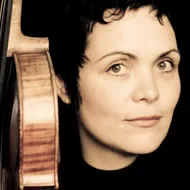
«That will probably always remain a question of perspective.»

Tabea Zimmermann is considered one of the leading viola players in the world. She is in demand internationally both as a soloist and as a member of the Arcanto Quartet. As the youngest professor in Germany, she began teaching in Saarbrücken in 1987. In 1994 she took over the viola class at the Hochschule für Musik und Darstellende Kunst Frankfurt am Main, and since October 2002 she has been a professor at the Hochschule für Musik „Hanns Eisler“ Berlin.
Classicpoint.ch: You began playing the viola at the age of 3. Do you think it is an advantage to start learning directly on the viola, or does it make no difference for a career as a violist whether one begins with the violin and only switches later?
Today I think it is less decisive whether one starts directly with the viola. However, I consider the quality of initial instruction so crucial that, depending on the quality of the local teachers, I would advise a musically interested child towards one instrument or the other. (Better an experienced violin teacher than an inexperienced viola teacher!)
When I look at it from the perspective of a university teacher, I am already very worried about the next generation. We often have to choose between outstandingly well-trained young Asian instrumentalists and young Germans who merely show interest but are several years behind, because they lack four to five years of intensive instrumental study.
You grew up in a family of musicians. Were your parents strict with you regarding learning the instrument?
My parents were very, very strict in raising their six children! And although this gave me a special position in my age group and I still benefit today from early musical education in many ways, I mourn a childhood that I was not allowed to have. That will probably always remain a question of perspective.
You have three children of your own, all of whom play an instrument. Do you accompany or monitor your children's practising?
My three children are indeed all very musical and have learned different instruments with relative ease. Based on my own experience, however, I cannot offer them the strictness that would undoubtedly lead them to greater achievements. Sometimes I doubt my relaxed attitude, but on the other hand my children have it infinitely harder, because they always see a result before them. I was able to gain my own experiences relaxed and without the knowledge or skill of parents within the protected framework of the music school, since my parents were simply not from the profession. They set and monitored the amount of time for practising, but in terms of content I was freer than my children can be.
You are a professor at the Hanns Eisler Academy of Music in Berlin. Are there moments of joy in teaching as well, like at a particularly successful concert?
There are endlessly many moments of joy that have to do with teaching in the broadest sense. They can, but need not, happen during the lesson itself. Sometimes, years after a graduation, I receive a letter that refers to details of the lessons. When someone writes, for example, that they only today realise what they learned back then, it makes me happy, because the fruit has grown from a seed I was allowed to plant. A feeling of happiness always arises when a student grows beyond themselves, when assumed limits are suddenly broken. I understand my teaching more as guidance towards self-study, towards testing boundaries and so on, than as an accumulation of perfectly learned pieces. However, a good experience is also connected with the student staying with one thing and arriving at a good result, rather than merely knowing in theory how a good result could be achieved. An important aspect is certainly good advice on choosing repertoire, on the quantity of works and on the allocation of energy. Better fewer but good concert experiences than playing too much too early – that is my motto here.
What do you think of competitions?
I very rarely suggest a competition, but if students want to work on an ambitious programme on their own initiative, I of course support them, although I do not conceal that I would often prefer they work intensively and without the pressure of success. But some young people need the comparison with others in order to assess themselves. Depending on personality, progress and so on, I have also strongly advised against it! It depends very much on the individual student.
You studied with Sándor Végh in Salzburg. How formative was he for you?
Sándor Végh was formative above all because his work reminded me of the wonderful work of my first teacher, Dietmar Mantel. Végh's imaginative work was a marvellous continuation of Mantel's, and so a circle closed. Unfortunately, all three of my teachers have since passed away, and I would still have liked to speak with them about one question or another!
A major part of your work is with the Arcanto string quartet. How did this collaboration come about?
The Arcanto Quartet is for me (and I hope for my colleagues too :-)) the most wonderful 'pastime'. In 2002 we met at a festival in Provence and played the first programme together. This was preceded by various chamber music experiences in almost every possible combination. Since we often share similar musical goals and also get on very well personally, I would like to call it a stroke of luck. I hope we will continue to play together for at least another ten years, work on many more masterpieces together and take even more joy in our shared work!
What do you particularly appreciate about playing string quartets compared with performing as a soloist?
I especially value the opportunity for mutual development, both personally and musically. Since these areas always belong together for an artistic statement, chamber musicians, in my view, arrive at deeper experiences than would ever be possible in the way a symphony orchestra works. How fortunate that, as a quartet, one keeps trying out new approaches to a work even after years of working on it, practising difficult passages for intonation for the hundredth time and so on. It can really be a great pleasure to take delight in the shared vibration of the instruments and in the harmony of thought. Sometimes, however, our motto is 'each as they wish', once we have clarified the framework of the joint interpretation and the score allows such an individual approach to the thematic material...
You have engaged very intensively with Bartók's Viola Concerto. What fascinates you about Bartók, and what in particular about this work?
What fascinates me about Bartók's Viola Concerto is the state in which, because of his early death, Bartók had to leave it to us, and the engagement with his intellectual legacy. It may even have been the first work in which I could recognise the striking difference between 'tradition' and sketches actually written by the composer.
Today I by no means claim to know what Bartók intended – but I am certain that neither his pupil Tibor Serly nor his son Peter Bartók could identify the composer's intention beyond doubt from the two versions currently in force.
I would be very interested to know what a composer such as Kurtág or indeed Eötvös would read out of the sketches in order to fill in the blank passages in the orchestral parts.
As a performer but also as a teacher, I find it a fascinating process to 'interrogate' the score, to know as many works as possible by the composer concerned in order to learn his own musical language and grammar. Here, too, I am less concerned with the finished product than with the path a young person takes towards a personal view of a score. For that is surely the only reason why we musicians have not yet been replaced by machines. If there were one valid, perfect reading, if tempo and dynamics depended solely on the composer and were subject to no variation from the acoustics of the hall, the day's form or personal interpretation, then one could simply let computers play! But fortunately it is about the human aspect, the ability to let time seemingly stand still, to make shared breathing possible, and and and...
Are there other works that you have engaged with with the same intensity?
In recent years I have engaged very intensively with the work of Paul Hindemith and try, in concert, through my reading to create an enjoyable listening experience for the audience. But there is less doubt about the composer's intention, since he notated very precisely and came so much from practical music-making himself that there would be little room for different versions – though certainly room for different readings!
Interview by Florian Schär | Classicpoint.ch | 5 February 2013
© Photo: Marco Borggreve
More interviews
All interviews →


