

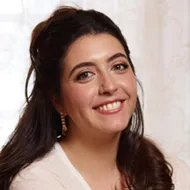
«Music is for me a cloak of warmth that only yields happiness when shared.»

Sophie Pacini (born 1991 in Munich) is a German-Italian pianist who ranks among the outstanding musicians of her generation. As a child she received gifted-child support and gave her first concert at the age of eight. She studied with Pavel Gililov, among others, and developed an international concert career at an early stage.
Pacini regularly performs in leading concert halls across Europe, Asia and North America, and works with renowned orchestras and conductors. Her recordings and interpretations – particularly of works from the Romantic era – have earned her several awards, including the Echo Klassik and the ICMA Award. Alongside her work as a concert pianist, Sophie Pacini is committed to making classical music accessible and runs her own projects that combine art and social engagement.
How did you come to play the piano as a child?
My mother had given my father a piano out of her first savings, to fulfil his long-held dream of starting to play and taking lessons. I immediately showed curiosity too, and at the open day of our local music school I discovered a grand piano for the first time – or, as I affectionately call it, “my black panther” – and fell in love with its independent, powerfully subtle elegance. And since I learned that as a pupil you were only allowed to play the grand piano once you were good on the upright piano, it was clear to me that I wanted to become really good quickly, so that I could sit down at the grand piano in no time. And once I got there, I didn't want to leave. I had found my favourite place.
In 2023 you founded your own festival, “Nuancen”. What distinguishes this festival?
“Nuancen” is for me a commitment to the nuances, to everything that connects people who pursue completely different cultural interests, who perhaps have had no contact with music before, or who simply want to experience high culture with a view of the Alps, the scent of linden trees and in the midst of Bavarian coziness. It is a festival that celebrates the diversity of perception – in music, in literature, in human exchange. We live in a world that often speaks in slogans. I wanted to create a space in which the fine transitions, the delicate nuances and the unspoken receive a stage. And where contrasts show that they condition one another in order to create a balanced harmony.
You perform not only in the great concert halls of Europe. You also bring your music to places that rarely come into contact with classical music, for example giving concerts again and again in women's shelters. What led to this, and what are your experiences?
I have always been moved by the fact that music can be healing, a comfort, an anchor. Women's shelters are places where people seek new hope and need reassurance – and playing music there makes its essence tangible: it gives strength where words cannot take root. These are among the most moving concerts of my career, because they show the immediate effect of the essence of music and serve as a compass for one's own self. They offer a moment of self-care, self-worth, renewed courage, inner resonance and a touching of the soul. After every concert, each woman always gives me a hug, we have even cooked pasta together, and I feel fulfilled and renewed, honestly inspired. There are two sentences in particular that I have taken from my concerts so far and carry deep in my heart: “You have left the place more hopeful and brighter than we experienced it before.” “Please speak about us, tell our story. Please give us a voice.” And that is my goal: to fulfil a mission with my public visibility. The mission to give back appreciation, to tell stories of undeserved bitterness and the outlook on a future yet to be discovered. To stand up for women as a woman for other women and make a difference. Simply because music for me is a cloak of warmth that only yields happiness when shared.
Your new CD “Bittersweet” also emerged from such a performance. Can you tell us more about it?
“Bittersweet” is a mirror of life itself: joy and pain, the journey through darkness into light. The idea for the album actually arose from one of these concerts at the women's shelter, where I sensed that such an embrace through music would be ideal for an album – an encouragement to go, a little piano book for your bag, a talisman box to keep. It is not an escape from reality, but a living-through of it.
For years you have championed teaching classical music to children and young people, and you want to make classical music accessible to everyone and everywhere, and you are developing new concert and broadcast formats for radio and television. What are your experiences in this regard?
Again and again I experience that children have an unprejudiced, almost magical relationship with music. There is no “classical”, “pop” or “modern” drawer – there is only wonder. That is exactly what I want to preserve. In my projects I try to create formats that do not lecture but invite. Classical music must not be a museum; it must breathe, it must be alive. This succeeds when we ask not “Does anyone understand this?” but “Does it move us?”
Since 2019 you have been touring as a piano duo with Martha Argerich. What is it like to play together with her?
Playing with Martha is like flying – you never know which winds will carry you, but you trust them. She is a musical volcano, full of energy and surprise, and at the same time an incredibly warm-hearted partner. Making music together with her is less a “process” than a dream come true, a joyful adventure that builds treasures for life.
You have a 50-year age difference. Are there different approaches to works or things you would like to interpret differently?
Of course there are differences – shaped by time, experience and life paths. But precisely these differences are the treasure. It is not about being right, but about opening spaces together. Martha brings an immediacy, a timeless curiosity that is unconditionally infectious. And I perhaps bring the joy of recording and holding on to all the shared emotions that are to be grasped. In the end we join hands – in the music, which, both thrilling and challenging, watches over us both.
Do you have further ideas or project wishes for the future?
I continue to pursue my women's shelter mission with determination, I also campaign for other communities and associations that need visibility and a supportive embrace through music. In the meantime I have become an ambassador for various institutions that have contacted me over the last few months after drawing attention to the women's shelters. I am also increasingly engaged in German cultural policy, following the motto: anyone can complain from the sidelines. Get out, act, build. Besides this, I pursue my busy activity as initiator and presenter of new radio formats, and I will not tire of inspiring everyone to embrace the budding magic of music. And perhaps someday also a book about short fantasy pieces from my life through the eyes of a pianist.
What passions do you have besides music?
I like to write, I enjoy walking but most of all only in the forest (!), I observe people in cafés or while travelling and invent stories about them, and recently I have again taken out a gym membership. I also like to make the people around me laugh and decorate my home according to my mood. Anything that sharpens perception is a passion for me.
Interview by Florian Schär | Classicpoint.net | 01.12.2025
Image: Vitaliy Bachaco
More interviews
All interviews →


