

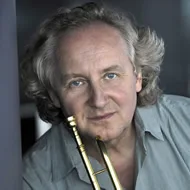
«When will the gay brass players come out?»
Since his success at the ARD Competition in 1986, Reinhold Friedrich has been a guest on all the major stages of the world. Alongside his concert activities, he is Professor of Trumpet at the Hochschule für Musik Karlsruhe, Honorary Professor at the Royal Academy of Music in London, and Guest Professor at the Royal Academy of Music in Aarhus/Denmark as well as at the Elisabethen-Hochschule für Musik in Hiroshima/Japan.
Classicpoint.ch: When and why did you begin learning the trumpet?
I was 7 years old and came out of the woods, sweaty, with my best friend from a game of cowboys and Indians. He showed me a new "disc" (meaning a small record, formerly called a single) with the Brandenburg Concerto. I was so fascinated by it that, when I got home, I told my parents only that I needed a trumpet, because I was now a trumpeter. At my next birthday, it finally happened. I had the first "borrowed" trumpet in my hands and was overjoyed!
You are active worldwide as a soloist, orchestral musician and chamber musician. Yet you place your professorship at the centre of your life. What makes your passion for teaching?
Many, many years ago, the good old Celibidache impressed upon me: the noblest and most important, but also the most difficult task in life is teaching. Today I receive the fruits of that work back so often that I must say in hindsight: I am the one who has been given the gift. What could be more wonderful than helping young people to a life perspective? One plays the B. A. Zimmermann Concerto, another plays the baroque trumpet with wonderful ensembles, or gets one of the rare positions as a professor of trumpet.
You play not only the modern trumpet but also the baroque trumpet. How does playing differ?
There are instruments such as the trombone or violin, or think of singing, where the overlap between the new and the old is quite high. There, the switch is easier. With the baroque trumpet, the difference is enormous, which makes concentrating on this one thing sensible. There are people who are somewhat cleverer than I am. They play only Baroque or only Modern. I "try" again and again to bridge the gap between these extremes. It requires a different mouthpiece, a different playing technique, articulation, style, etc. This ice is thin and dangerous. Sometimes you get a sense of elation: "Exactly how it should be!" That is why I do it. Meanwhile, it has also become part of a contemporary requirement in everyday teaching. We professors must keep educating and working ourselves, not only the students...
As a special skill, you also play the keyed trumpet. Can you explain the peculiarities of this instrument?
Well, you come out with strong words there. WHO really masters this instrument? The keyed trumpet is and remains a BASTARD. Felix Mendelssohn-Bartholdy wrote from Italy in a letter to Fanny: "I am here in Italy and hear these keyed trumpets. They sound like women with beards or men with breasts!" By the way, since we're on the subject and the Olympics have just ended: greetings to Sochi and to Mr Putin (When will the gay brass players finally come out? The footballers have started – the last bastion of machismo is the brass players!)
How do German and American trumpet models actually differ?
German with rotary valves (sitzt – meaning it is held across, i.e. played horizontally): softer, more blending, better basic intonation, more air.
American/French with piston valves (steht – meaning it is held straight or upright while played): more soloistic, more present, more agile, cheekier.
Besides Baroque music, you are also keenly interested in new music. You have premiered and first performed numerous works by Wolfgang Rihm, Sir Peter Maxwell Davies, Rebecca Saunders, Hans Werner Henze, Nicolaus A. Huber or Adriana Hölszky. Did you have contact with the composers during the rehearsal process for these compositions?
Not to forget: the new Basel professor Johannes Caspar Walter, Herbert Willi – the Mozart from Vorarlberg, Luca Lombardi – B. A. Zimmermann's last pupil, together with Peter Eötvös, Christian Wolff from New York, Benedict Mason from London, and the recently deceased Theo Brandmüller. The processes of creation were so varied and different that I would need a special edition of your interview series...
Have you also influenced the composition of certain works?
Hopefully not too much (laughs). As an avowed hands-on and lip-on craftsman, I have a bad influence on the creativity and spontaneity of the "artists". But sometimes it cannot be prevented. The composers do ask one or another question about the feasibility and capabilities of the performer. What comes out of it often turns the asked-about completely on its head. For example, the question: How high can you play? Answer (R.F.): Well, up to about g```, a```. Then the composition comes in with a B``` or even higher. Among these gentlemen there is certainly the odd crank, sound terrorist, musician-tormentor. But that is exactly what advances the matter. People who are willing to break taboos – to cross boundaries.
You were awarded the ECHO Klassik Prize for the recording of the solo concerto "Nobody knows the trouble I see" by Bernd Alois Zimmermann. What fascinates you about this work?
It is one of the most beautiful, if not indeed the most beautiful and most significant concerto for our instrument, and at its 70 years it is prettier and younger than Heidi Klum!
Since the year of its founding, you have been the permanent principal trumpet of the Lucerne Festival Orchestra under Claudio Abbado. In your opinion, how has the orchestra developed over the last 10 years?
Today, shortly after his death, it is difficult to speak about this, especially since this orchestra came into being with him and will therefore also disappear with him. What comes next remains to be seen. The world keeps turning, and we cannot remain in mourning forever. But at the moment the tears are still wet and the gap he leaves behind is so large that my imagination is not enough to picture how things should go on. Of course, over the 10 years we have dealt with each other ever more closely and intensively and had those FLOW moments that every artist yearns for. But these were also carried by our mutual love, the esteem and the respect that we owed, and still owe, to the works.
Besides the trumpet, do you also have time for other interests?
Did you mean giving interviews for newspapers, radio or television, or did you mean dealing with e-mails, text messages, answering machines and post, or sitting on committees such as the German Music Competition, or being allowed to write programmes for young musicians' festivals? When I drive my car through the forest, for example between Erfurt and the Kirchheimer Dreieck towards Frankfurt, it can happen that something – my right foot – slams on the brakes, and a minute later I have a small collection of porcini on my back seat. For mushrooms I nearly lose track of time, and also for cooking afterwards: a fine hen of the woods (Krause Glucke) with a little salt, pepper and some good pasta ... hmm, my mouth is watering. So: picking mushrooms, cooking, drinking wine, reading books, sitting together with friends. My Pavoni espresso machine and a good coffee are as important as my little wine cellar. Also citrus fruits, blood oranges, grapefruit, lemons etc. I have no problem with lemon-biting listeners in the front row; contrary to the common opinion, that doesn't bother me at all – I love lemons!
Interview by Florian Schär | Classicpoint.ch | 1.4.2014
Photo: Rosa Frank
More interviews
All interviews →


