

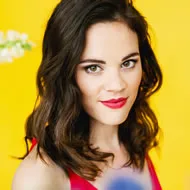
« Directors are the biggest divas. »
The Lucerne-born Regula Mühlemann is currently taking the opera world by storm. Alongside the operatic repertoire, Regula Mühlemann also devotes herself to the art song. She has received numerous awards.
Can you still remember the first opera you ever heard?
Yes, that was at the Opernhaus Zürich, a performance of Le Nozze di Figaro. I was a young teenager, and the small role of Barbarina particularly fascinated me. The way she stood at the start of the fourth act with a picnic basket on her arm and sang that beautiful cavatina "l'ho perduta me meschina". It moved me so much that I absolutely wanted to do that too, to be on stage and sing. That was a key moment for me and has certainly left its mark.
What do you do on a performance day before and after singing in an opera?
Usually I sleep in in the morning and take the day calmly, because a performance demands quite a lot of concentration and energy. I do more administrative work and try not to sing too much. When I have a concert, I have to do my make-up and hair and then warm up my voice. It's almost a meditative ritual. In opera it's easier, as make-up artists and wardrobe staff take care of making sure everything fits perfectly... Then it's very important that I eat. I need to eat quite a lot, about an hour before the performance, usually pasta or meat.
After the performance I go for a beer with my colleagues. We talk together and wait until the adrenaline has subsided, so that I can then sleep around 1:00 a.m. I enjoy this time together very much.
Your mother is a dressmaker and your father a fireplace builder. Did they have to get used to the idea that their daughter would become an opera singer?
I had to get used to it myself. I had finished my Abitur and still didn't know exactly what I wanted to do. Because singing had always been a passionate hobby of mine – I also sang in the Luzerner Kantorei, rehearsed many classical works, including solo parts – I embarked on a music degree. At the beginning, though, I didn't know that the path would lead to becoming an opera singer. If you study classical singing, there are other possibilities too. My first steps in opera were in a co-production with the Luzerner Theater. I was thrilled, and it became clear to me that opera should be a part of my later work. My parents supported me in this and gave me a great deal of freedom.
What are your current dream roles, the ones you would love to sing?
I notice that my voice has developed and become more voluminous. This means new roles are now under consideration, which I would gladly sing, such as Susanna in Le Nozze di Figaro, Pamina in The Magic Flute and Adina in L'elisir d'amore, Norina in Don Pasquale or Juliette in Gounod's opera. My dream roles generally lie within the range in which I can sing or soon could sing.
Your sister has Down syndrome. How does she react to your singing?
She mainly likes Ländler and schlager music. So my singing is not her first choice. Nevertheless, she comes along every now and then and enjoys it, even though sitting still for an entire opera is long and tiring.
How would you recommend opera to people who have never attended one?
To get started I recommend the lighter works, so don't start straight away with a Wagner opera. It's also helpful to read the libretto before going to the opera, so that you really understand what it's about. Especially with modern productions there is often so much information to process that it's an advantage to know the plot well.
Have you ever sung rock and pop, and did you ever feel like singing in a band?
I sang a lot of pop, but I didn't want to study it. As a pop singer you should be able to write your own songs, and ultimately that interested me too little. Classical vocal technique fascinated me much more. Over time I also noticed that it's better for my voice if I no longer sing pop and rock songs.
Who is usually the biggest diva: singer, director or conductor?
Good question (laughs). The days when singers were divas are, in my opinion, over. Today a singer must be very adaptable and always be able to go along with all the outlandish ideas. Conductors can also be diva-like, but I think the directors are the biggest divas.
Many singers are afraid of catching a cold and wear a scarf all the time, etc. What's your approach?
I'm actually rarely ill. Usually I catch something once a year. However, I believe there's not much you can do about it. I try to be a little careful and avoid people with colds in my immediate surroundings, but otherwise I behave like everyone else.
Can you tell us a little about the unpleasant sides of an opera performance?
A lot can happen. You can have a coughing fit during a death scene, have an allergy backstage, and you can be ill and still have to perform. But otherwise I don't see any unpleasant sides.
Where do you find balance, and how do you deal with all the stress?
I need a bit of playing with risk. I also cope very well with stress. Nevertheless, I make sure not to do everything at once. I also try to spend time without music and meet friends.
Interview by Florian Schär | Classicpoint.net | 1.4.2017
© Photo: Henning Ross / Sony Classical
More interviews
All interviews →


