

«There are, of course, differing opinions.»
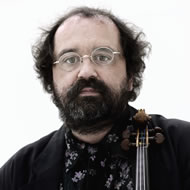
Rainer Schmidt has been a member of the Hagen Quartet since 1987, where he plays second violin. In 1989 he founded the Ravinia Trio. Rainer Schmidt teaches at the Mozarteum Salzburg, at the Escuela superior Reina Sofia in Madrid, and is Professor of Violin and Chamber Music at the Hochschule für Musik of the Musik-Akademie der Stadt Basel.
Classicpoint.ch: How did you actually come to join the Hagen Quartet?
I was studying in the USA in the 1986/1987 academic year. There, the Quartet called me and asked whether I would come to Salzburg to rehearse together and see whether we had a future together. It went very well, and a few months later I began.
Unlike the other three members of the quartet, you are not part of the family. Have there already been moments when you felt that?
I was treated like a new member of the family from the very beginning, which was lovely and touching. During our actual work, namely rehearsing and performing, I notice nothing. Those moments come more from outside.
You have been with the Hagen Quartet for 24 years now. How do rehearsals work? Is there someone who takes the lead?
It depends. There is no predetermined leader, but rather changing initiatives.
In any group of people who work and live together intensively, there are inevitably different roles, hierarchical structures and subgroup formations. How is it in the Hagen Quartet?
I can definitely rule out subgroup formations. Differing opinions do occur now and then, of course. These are handled democratically, and so far we have reached an agreement each time that everyone could live with. Hierarchical structures, apart from those we have set up ourselves to make certain processes easier, do not exist. Different roles we naturally have, but ones with which we can get along well.
Do you ever have arguments?
Very rarely.
What is the recipe for working together successfully and joyfully for so long, rather than slowly remaining together merely as a marriage of convenience?
Mutual respect, no “egos”, setting the right priorities.
You always play second violin. What attracts you to this voice, and are there moments when you would like to play first violin?
I would certainly like to play the other instruments in the quartet at some point too, especially the cello would appeal to me. Every instrument has its own very distinct function, without which the quartet would be incomplete. The meaning of the melodic line only becomes clear through the other voices. A typical role of the second violin is to give the whole its essential character in the first place.
Which string quartets do you particularly like?
There were and still are some outstanding ensembles that I admire, and to whom I would like to express my gratitude for the great amount of work they have invested.
You moved from Deutsche Grammophon to the small label Myrios Klassik with the Hagen Quartet. Why?
We no longer saw a place for ourselves at DGG. Artistically, it was no longer our home. Myrios Klassik, or rather Mr Stephan Cahen, offers us a great deal. We are glad to have found this label and look forward to the recordings we will make together.
You also teach at the Musik Akademie Basel and in Salzburg. Where do you see the differences between these two institutions?
There are differences and similarities. Both institutions have tradition and are rooted in their cities, yet they also tell different stories. My home is now Basel, and I am very happy there.
Interview by Florian Schär | Classicpoint.ch | 12.10.2011
Photo: Harald Hoffmann
More interviews
All interviews →


