

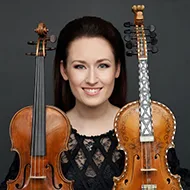
« Music is my life and my passion »
Ragnhild Hemsing was born in 1988 in the heart of Norway. She began playing the violin at the age of five. As a particularly versatile artist, Ragnhild Hemsing stands out among Norway's rising talents. Since childhood she has been deeply connected to the rich folk traditions of her homeland, Norway. This has enabled her, as one of the first artists, to successfully combine the typical characteristics of Norwegian folk music and classical music in a youthful, fresh and thoroughly modern way. At just 14 years old, Ragnhild made her debut with both the Bergen Philharmonic Orchestra and the Trondheim Symphony Orchestra, performing Mendelssohn's Violin Concerto. Since then she has performed with all of Norway's major orchestras. Alongside her extensive repertoire of classical solo works for violin, she complements it with lesser-known, complex works for the traditional Hardanger fiddle.
In the following interview, Ragnhild Hemsing talks about the Hardanger fiddle, the Hemsing Festival in Norway and Norwegian folk music.
Classicpoint.net: You have engaged deeply with Norwegian folk music. What are its typical characteristics?
Our family home in Aurdal in Valdres has always been full of music. Aurdal is a small village of just 700 inhabitants, high up in the mountains of Norway. My mother is a violin teacher and plays Norwegian folk music. From the very beginning, my siblings and I accompanied our mother when she gave concerts with her colleagues. We gained a natural access to folk music and classical music. I loved music from an early age, its power, and the way one can express one's feelings and statements through something magical like the violin.
When I was 4 years old, I asked my parents "Where is my violin?", and from the age of 5 I began learning classical music on the violin and folk music on the Hardanger fiddle. I enjoyed the duality of these two genres, the contrasts but also the similarity, and ever since then I have always played both instruments. Typical features of Norwegian folk music include, for example, its varied rhythms. The rhythm of dance tunes changes depending on which valley and mountain region one is in within Norway. It is the same as with language and dialects.
You want to combine Norwegian folk music with classical music. How do you do this?
I have always combined classical music with Norwegian folk music, and it has become my musical identity. The uniqueness of the Hardanger fiddle in combination with the classical violin has always fascinated me. Both instruments and both genres enrich each other. I find it very interesting to combine a repertoire in which the composer has been inspired by the folk music and folk traditions of the respective countries. I try to put together a repertoire that is interconnected. Beethoven's many compositions, for example his Violin Sonata No. 8, are influenced by the German Ländler dance, and I find it very exciting and interesting to combine this with folk tunes on the Hardanger fiddle. For me it is important to be open to other influences, and I find it wonderful that young composers use folk music in a new musical language. Folk music is not set in a playing style of the instrument.
You mentioned the Norwegian Hardanger fiddle. Could you introduce this instrument to us?
The Hardanger fiddle, or in Norwegian "hardingfele", is Norway's national instrument. The first Hardanger fiddle was built in the mid-1600s in a region called Hardanger. The fiddle has 9 strings. Four of the strings are stopped and played like a violin, while the remaining ones, aptly called undertones or sympathetic strings, resonate under the influence of the other four.
The fiddle can be tuned in more than 20 different tunings, depending on the pieces and the region the melodies come from. The undertones are tuned so that they resonate in accordance with the main tuning. The Hardanger fiddle is used mainly in the south-western part of Norway, while the ordinary violin (called flatfele – "flat fiddle", like the originally classical violin) can be found elsewhere. The Hardanger fiddle is used for dancing, accompanied by loud, rhythmic foot-stamping.
The instrument is beautifully decorated, with a carved animal (usually a dragon or the Lion of Norway) forming part of the scroll at the upper end of the pegbox. The pegbox and fingerboard feature extensive mother-of-pearl inlays, and the body of the instrument has black ink decorations known as "rosing". Sometimes pieces of bone are used to decorate the pegs and the edges of the instrument.
What can one play on the Hardanger fiddle, and where does this tradition come from?
One usually plays traditional melodies on the Hardanger fiddle, which have been handed down from generation to generation. Traditionally, these melodies are not learned by reading sheet music, but by listening and imitating our fiddle masters. The fiddle is a beautiful solo instrument, but it is also often played in a group with other fiddle players or with other instruments from earlier times. Over the course of history, tradition has given melodies a special role at weddings, for example. The wedding march is one of them. Among the dance tunes there are dances for couples, such as the "halling" in 2/4 or 6/8 time and the "bonde". In Valdres, where I come from, we have a very special dance rhythm called the "springar", which is characterised by an asymmetrical ¾ rhythm.
Around 1900, Norwegian composers began writing pieces for Hardanger fiddle and orchestra. Even today this is still not very common. An example of such pieces is Johan Halvorsen's "Fossegrimen Suite". Another Norwegian composer, Edvard Grieg, was likewise strongly inspired by Norwegian folk music and folk melodies and incorporated them into his compositions. He composed melodies for the Hardanger fiddle as part of his score for Ibsen's "Peer Gynt Suite No. 1". The opening phrase of "Morning Mood" from Grieg's Peer Gynt music is derived from the tuning of the sympathetic strings of the Hardanger fiddle: A F♯ E D E E F♯ and so on...
Folk music can be presented in many different ways. I find it exciting when younger composers think in new ways and have a connection to Norwegian folk music.
You also founded the Hemsing Festival in your homeland of Norway. What makes this festival special?
I founded the festival together with my sister Eldbjørg (also a violinist) in 2013 in our home town of Valdres. Eldbjørg and I are artistic directors together, and I am the festival's director. The Hemsing Festival is organised annually in Aurdal. Edvard Grieg and Knut Hamsun were inspired by the village's beautiful nature, and Frydenlund Skysstasjon was an important meeting place for artists from all over Norway. The Hemsing Festival invites you to experience wonderful music in an intimate setting and presents classical music at a high international level in collaboration with local musical and cultural traditions. The festival offers a unique combination of music, local culinary traditions and experiences of nature.
Eldbjørg and I grew up in the village and were introduced to both classical and folk music at an early age. Today we are both artists working around the world. It was our experience of the power and depth of this music, but also of its potential for human communication, that inspired us to establish an international chamber music festival in our home village. Our wish was to bring our own abilities to the environment in which we grew up, and thus to show how music can influence a community and create identity and a sense of belonging. Every year at the end of February, distinguished musicians of high international standing from all over the world gather in Aurdal for a completely unique chamber music festival to create unforgettable memories.
Over five days, 15 concerts take place. The village's beautiful church, dating from 1737, forms the centre of the festival; the building next door, Frikar-Smia, provides a modern stage space; and Frydenlund Skysstasjon has a historic character, while the modern mountain church at Aurdalsåsen invites you to combine skiing in beautiful nature with wonderful musical experiences.
The Hemsing Festival is deeply rooted in the region and has offered activities specifically for children and young people from the very beginning. Our wish is to make classical music meaningful for the local community by engaging the local cultural school for its own concerts. This, combined with the village's rich culinary traditions, a supportive local business community and a particularly large contribution from volunteers, makes it possible to bring the festival to life with great success.
The festival offers a complete winter adventure with wonderful classical music in a historic setting, high-quality accommodation, local culinary experiences and activities such as cross-country skiing, snowshoeing and husky tours.
Your debut album with Berlin Classics is planned as a co-production with WDR for the end of June 2020. What can we look forward to?
I am really looking forward to working with the Berlin Classics label. And I am so excited to record my first album with Berlin Classics in a co-production with WDR. The album will include all of the Norwegian music – played on both the violin and the Hardanger fiddle – and I am very much looking forward to working with WDR. The recording will take place at the end of June this year, and I am delighted that the wonderful musicians Mario Häring (piano) and Benedict Klöckner (cello) will join me for some of the pieces. I very much look forward to presenting the album to you early next year.
How are you currently coping with the lockdown due to the coronavirus? How are you spending your time?
I think that everyone has been surprised by the consequences of the coronavirus. But in these times, I believe it is more important than ever to think positively and to use the moment to be creative.
You are still very young. What are your visions and dreams?
Music is my life and my passion. My vision is to bring the Hardanger fiddle to the world, to promote it, and to view the tradition in a new light. I would also like to continue highlighting the connection between classical music and folk music.
What are your interests besides music?
Since I was a little girl I have loved drawing and designing concert clothing. I am also very interested in interior architecture. Having grown up in a beautiful setting in Valdres, I love being in nature and experiencing the tranquillity it gives me. Because my father worked in nature, we always had the unique opportunity to experience culture and nature hand in hand. And for that I am very grateful.
Interview by Florian Schär | Classicpoint.net | 4 May 2020
Photography: © Kaupo Kikkas
More interviews
All interviews →


