

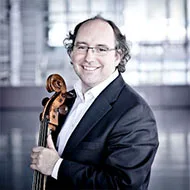
«We were able to keep our hunger.»
As a chamber musician, Rafael Rosenfeld has performed at many festivals, including the Ittinger Pfingstkonzerte, the Davos “Young Concert Artists”, the Lucerne Festival, the Menuhin Festival Gstaad, the Open Chamber Music Festival Prussia Cove and the Leicester International Music Festival. He has been chamber music partner of András Schiff, Heinz Holliger, Joshua Bell, Tabea Zimmermann, Gábor Tákacs-Nagy and Daniel Phillips, among others. In 2002 he co-founded the Merel Quartet. Since autumn 2005 he has led a training and concert class for cello at the Hochschule für Musik Basel.
You became principal cellist of the Tonhalle Orchestra Zurich at just 22. How has the orchestra developed over all these years?
When I joined the Tonhalle Orchestra in 1995, it was in the middle of a period of change. During those years, many positions in the orchestra were filled with young musicians who approached their work highly motivated and full of energy. My first season also marked the beginning of the David Zinman era. So there was a sense of new beginnings – somewhat like now, with the appointment of Paavo Järvi as chief conductor and the reopening of the old Tonhalle.
In my view, the orchestra is even more stable today; the level of the individual players is perhaps even more balanced than 20 years ago. Fortunately, we have been able to keep our “hunger” for making music. Järvi is an absolute stroke of luck: he brings an unparalleled mix of vision and ideas, but also calm and trust, which allows us to play at our highest level.
For me personally, it is not easy that my longtime partner and friend Thomas Grossenbacher has decided to leave the orchestra in favour of his teaching and other projects. We are currently working on settling his succession; there will surely be a very good solution, but it is still hard to imagine how this wonderful musician and person can be replaced.
You are a member of the Merel String Quartet. What sets the quartet apart, and where are your main focuses?
Chamber music, and the string quartet in particular, has always been my greatest passion. The repertoire is so endlessly rich and exciting, and I feel most at home in this small, well-rehearsed formation. At the heart of our work is the shared search for understanding and experiencing these masterpieces. They are so profound that one always feels able to grasp only a small part of them, but through years of living with them one does (hopefully) go a little further, step by step. Our task in concert is to make these works tangible and experiential for the audience.
We play a very broad repertoire, from early to contemporary music. Yet there is already a core of composers – Haydn, Mozart, Beethoven, Schubert, Schumann, Mendelssohn, Brahms, Dvořák, Bartók (whom am I forgetting here?) – whom one could describe as the golden age of the string quartet, and to whom we devote ourselves most of all.
You have taught at the Basel University of Music since 2005. What do you enjoy about teaching, and what annoys you?
Working with young musicians gives me enormous pleasure. It stimulates you incredibly to think and reflect; you have to re-examine and evaluate patterns that you have followed for years or even decades. I also always try to listen to the works I teach afresh and to consider how one might approach them differently.
One of the greatest difficulties is, together with the students, to achieve that they can make full use of their potential. Becoming a truly good cellist and musician requires an enormous commitment and perseverance. The young people we admit to the school certainly bring a very good talent with them, otherwise they would not prevail in the entrance examinations. What they then make of it depends on many factors, but above all on the aforementioned.
What do you look for in the entrance examinations of young cellists? Do you have any tips for the students reading along?
It is always an overall impression made up of various aspects. Above all, we try to sense what potential someone has, technically and artistically. What helps enormously is if you have already been able to work with someone beforehand; you can then assess them much better. I would therefore advise young students to get in touch early with various possible teachers they would like to work with, either by attending courses or by asking for an audition.
Do you have any rituals yourself?
Probably, yes, but I am not very aware of them. What has helped me most in dealing with stage fright or nerves is the Alexander Technique. I devoted myself to it intensively for a while; if someone can teach it well, it is worth its weight in gold.
You are artistic director of the Zwischentöne chamber music festival in Engelberg. To what extent does this festival stand out from other classical music festivals?
Zwischentöne is designed with a great deal of personal love and dedication. My wife, Mary Ellen Woodside, puts together a programme each time that has coherent inner and outer connections. Both the works we programme and the guest artists we invite are especially close to our hearts.
It is also particularly lovely that in Engelberg, with its magnificent mountain backdrop, we are close to the audience, there are many opportunities for exchange, and a genuine “chamber music atmosphere” prevails.
The festival takes place in just 2 weeks, from 15–17 October, and I am really looking forward to it; it is a highlight of my year every time.
What are the festival's future plans?
Since last year, most of the concerts have been held in the newly renovated Kursaal, which has a wonderful atmosphere and is really the perfect size for such an occasion. We already have many programme ideas and contacts with artists whom we want to invite in the coming years.
A new addition is a chamber music series in the other half of the year, the Merel Chamber Series, which we will launch in spring 2022 in Lucerne and Zurich. Another format in which we will present our favourite programmes to our audience.
You are very active in many areas, with orchestra, teaching, chamber music and solo appearances. Nevertheless, are there daily recurring activities or tasks in your working day that have become rituals?
Perhaps the very changeover is the ritual: repeatedly attuning myself anew to the different situations and tasks. Of course there are many recurring tasks, sometimes very administrative; I would sometimes gladly do without those.
What I always experience as a kind of “wellness” are the quartet rehearsals, which we usually begin by playing slowly. Tuning in to the music and listening to one another is one of the most beautiful parts of my work.
What are your passions besides music?
One is watching films and series, as a way to relax. Recently we bought tickets for the Zurich Film Festival for several films, partly to force ourselves to take a breather before the final preparations for Zwischentöne begin. We have already seen three very good ones.
My absolute favourite series is “Breaking Bad”, for me a masterpiece of storytelling, acting, staging and music. We have watched it at least four, if not five, times and still keep discovering many details. I have also listened to the “Insider Podcast”, in which one learns a great deal about how the whole thing was made – which I in turn find instructive for what we do in terms of collaboration.
Is there anything you would still like to do but have never got round to?
Not never, but too rarely: really long holidays or breaks; the year is usually too crammed. Ideally I would take about 6 weeks off in one go, but that almost never works out.
Interview by Florian Schär | Classicpoint.net | 30 September 2021
More interviews
All interviews →


