

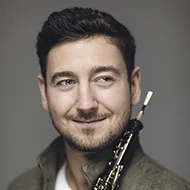
«I go jogging with my students»
«I go jogging with my students»
Philippe Tondre was born in 1989 and began playing the oboe in his hometown of Mulhouse, France, with Yves Cautres, before studying with David Walter at the Conservatoire National Supérieur de Musique in Paris. His professional career began while he was still a student, at the age of 18, when he was appointed principal oboe of the SWR Sinfonieorchester Stuttgart. He was also invited as principal oboe to leading orchestras, including the Royal Concertgebouw Orchestra Amsterdam, the Budapest Festival Orchestra and the Symphonieorchester des Bayerischen Rundfunks. In 2010, Seiji Ozawa chose him as principal oboe of the Saito Kinen Festival Orchestra, now known as the Seiji Ozawa Festival Orchestra. His total devotion to the oboe and his constant desire to become a better musician led to five intense, demanding years of international competitions. Undoubtedly one of his greatest moments was winning the ARD International Music Competition in Munich in 2011 and being awarded the prestigious Beethoven Ring, a musical honour conferred by the Beethovenfest in Bonn. In 2016 he was appointed principal oboe of the Gewandhausorchester Leipzig. In 2020 he was appointed principal oboe of the Chamber Orchestra of Europe and, in the same year, he won the coveted position of principal oboe of the Philadelphia Orchestra under music director Yannick Nézet-Séguin. In 2022 he was appointed Professor at the Curtis Institute of Music in Philadelphia.
You became principal oboe of the SWR Sinfonieorchester while you were still a student. What was this start to your professional life like?
Becoming principal oboe of the SWR Sinfonieorchester while I was still studying was an exciting and formative experience. It was an incredible honour to hold such a prominent position at such a young age, but it also came with great responsibility. Balancing my studies with the demands of professional life required discipline and a steep learning curve.
I was very fortunate to have exceptional colleagues who welcomed me with open arms and were patient enough to take a young newcomer under their wing. Their support and generosity allowed me to grow into the role and develop both my skills and my self-confidence. Working with such accomplished musicians was inspiring and helped me mature quickly, both as a musician and as a team player. Looking back, I am very grateful for this opportunity – it shaped my approach to making music and instilled in me a lifelong pursuit of excellence.
Three years later, Seiji Ozawa appointed you principal oboe of the Saito Kinen Orchestra. How did you get to know the culture and people of Japan?
Three years after the start of my professional career, being appointed principal oboe of the Saito Kinen Orchestra by Seiji Ozawa was a significant milestone for me. It gave me not only the opportunity to work with one of the most inspiring conductors of our time, but also introduced me to Japan's rich cultural heritage and the warmth of its people.
My connection to Japan began through music, but it quickly went far beyond that. Working with the Saito Kinen Orchestra was like becoming part of a family – there was an incredible sense of camaraderie and shared purpose among the musicians. Outside of rehearsals and performances, I immersed myself in Japanese culture, explored the country's art, history and cuisine, and experienced the deep respect and care that are part of everyday life in Japan.
What impressed me most was the emphasis on harmony and the attention to detail in all areas of Japanese culture, something that deeply resonated with my own approach to music. These experiences have not only enriched my personal life but have also profoundly shaped my perspective as a musician. Japan has remained a special place for me, both professionally and personally.
Seiji Ozawa was far more than a conductor to me – he was a mentor and almost a father figure. His dedication, his vision and his humanity were endlessly inspiring, and his belief in me gave me the self-confidence to develop both as a musician and as a person. He taught me invaluable lessons about music, leadership and humility, and his influence stays with me to this day. Working with him was a privilege and an experience that I will always treasure.
In 2016 you moved to the Gewandhausorchester Leipzig as principal oboe. What were the differences compared with the orchestras you had played in before?
Joining the Gewandhausorchester Leipzig as principal oboe in 2016 was an extraordinary experience. The Gewandhausorchester has a remarkable tradition reaching back over two centuries, and being part of such a renowned institution was both humbling and inspiring.
One of the most important differences from my previous orchestras was the unique sound tradition of the Gewandhausorchester. The orchestra's sound has an unmistakable warmth and depth, rooted in its long-standing relationship with composers such as Mendelssohn and Brahms. Adapting to this distinctive sound world was both a challenge and a privilege, as I had to refine my own playing in order to blend seamlessly into the ensemble while still bringing my own voice as principal oboe.
In addition, the Gewandhausorchester's close bond with its home city of Leipzig created a deep sense of community. The connection with the audience felt very personal, as if the orchestra were an integral part of the city's cultural identity. This differed somewhat from the more international outlook of other orchestras I had played with, and it gave the performances an incredibly meaningful and intimate dimension.
Every orchestra has its own character, and the emphasis on tradition and team spirit at the Gewandhaus has taught me a great deal about the importance of heritage and about how music connects us with the past while inspiring the present.
Then in 2020 you moved to the Philadelphia Orchestra as principal oboe. How did you experience the cultural differences in America?
Moving to the Philadelphia Orchestra as principal oboe in 2020 was an exciting step in my career, but it also brought new challenges – particularly adjusting to a different cultural environment. The United States has a unique musical culture that emphasises both individual expression and collective collaboration. There is a very strong awareness that the musician's voice is an integral part of the orchestral fabric, and I quickly felt this in Philadelphia.
One of the most striking differences for me was the openness to experimentation and innovation in the American music scene. There is a willingness to explore new interpretations, to push boundaries and to try things that may not be as common in more traditional European institutions. At the same time, there is deep respect for the classical tradition, and I have found a genuine balance between honouring the past and embracing the present.
All in all, the move to the Philadelphia Orchestra has been enriching in every respect. It is not only about the musical differences, but also about how these differences reflect the values and spirit of the culture here in the USA.
Along the way you have won several important competitions, which served as a springboard for your parallel solo career. Which competition was the most important for you, and how did you experience it?
Competitions were an important part of my musical career, and each one taught me invaluable lessons. If I had to choose the most significant, it would be the ARD International Music Competition in Munich in 2011. Winning this prestigious competition was a decisive moment for my career, as it opened many doors for me and established me on the international stage.
Preparing for and taking part in such a high-level competition was an intense experience. It required months of dedicated practice and concentration, not only to perfect the repertoire but also to develop the mental strength needed to perform under pressure. The ARD competition was particularly challenging because it places emphasis on both soloists and chamber music. It pushed me to demonstrate my versatility and my ability to connect with other musicians – skills I still draw on today.
Apart from the technical and musical demands, this competition was especially significant because it gave me the opportunity to reach a wider audience and to meet exceptional musicians from around the world. The victory was a confirmation of my years of hard work, but even more important was that it gave me a platform to present myself as a soloist to a larger audience. It was a decisive moment that shaped my path as both an orchestral musician and a soloist.
You also teach as a professor at the Curtis Institute of Music in Philadelphia. What do you pay particular attention to when selecting your students?
Teaching at the Curtis Institute of Music is a very fulfilling part of my career. Curtis is known for its tradition of excellence and for training some of the finest young musicians in the world, so the selection process is both rigorous and careful.
When selecting students, I pay particular attention to their musicality and their potential. A solid technical foundation is of course important, but what truly impresses me is their ability to convey something that goes beyond the notes on the page – whether through phrasing, tone colour or an emotional connection to the music. I look for individuality, for that spark of creativity and curiosity which shows that they are ready to develop as artists.
Another crucial quality is commitment. Being a musician requires not only talent, but also an exceptional work ethic and resilience. I want to work with students who are passionate and open-minded and who are willing to work hard to refine their craft and develop their unique voice.
Finally, I value team spirit. Music is a shared experience, and at Curtis, where chamber music and ensemble playing are an integral part of the curriculum, it is important that students can work with others in a meaningful and respectful way. My aim is to train versatile musicians who are not only technically accomplished, but also artistically thoughtful and ready to contribute to the world of music.
I have read that you also go jogging with your students. Do you try to build a class into a team, or does this come from the students themselves?
Yes, it's true that I go jogging with my students! I believe that building a sense of community and camaraderie within the class is just as important as focusing on individual development. Music can be very competitive, but it is also deeply collaborative, so I try to create an environment in which students can support and inspire one another, both inside and outside lessons.
Running together – or simply spending time in a relaxed atmosphere – helps to break down barriers and creates a space where we can connect on a more personal level. It is not only about physical activity, but also about building trust, encouraging open communication and creating a sense of belonging. However, team spirit also arises quite naturally from the students themselves. They bring their own energy and personality to the group, and I am lucky to have classes that genuinely enjoy working together and growing together.
Ultimately, I see my task not only as teaching the oboe, but also as helping my students become versatile musicians and individuals. Whether it's jogging, chamber music or studio discussions – I try to create an atmosphere in which everyone feels encouraged to contribute, to collaborate and to spur one another on to achieve their best.
Do your students prefer a solo career or a position in an orchestra? What do you recommend?
My students have different goals – some dream of a solo career, others would rather play in an orchestra. At the Curtis School of Music we support both paths, as well as chamber music, teaching and other creative opportunities for building a career in music.
What I recommend depends on the individual student. A solo career requires not only exceptional playing, but also a strong artistic self-confidence, independence and the ability to hold one's own in a highly unpredictable environment. An orchestral position, on the other hand, demands great adaptability, teamwork and the ability to blend in seamlessly while preserving a personal voice. Both paths are rewarding in their own way, and I always advise my students to stay open, as careers often take unexpected turns.
More important still, I encourage them to gain a variety of experiences during their training – whether by taking part in solo competitions, playing in orchestras or founding chamber music ensembles – so that they can discover what truly inspires them. The most fulfilling career is the one that matches one's passions and strengths, whether as a soloist, an orchestral musician or a combination of both.
You are still young. What are your musical goals and ambitions?
I consider myself very fortunate to have experienced so many different facets of the musical world – performing as a soloist, playing in incredible orchestras and teaching the next generation of musicians. My greatest aim for the future is to continue developing as an artist and to find new ways of sharing music with audiences.
One of my goals is to expand the oboe repertoire by championing lesser-known works and collaborating with composers to create new music. The oboe has such a rich and expressive sound, and I want to contribute to its development by opening up new perspectives for this instrument.
At the same time, I would like to deepen my artistic collaborations further, whether through chamber music, recording projects or interdisciplinary work that combines music with other art forms. And of course, teaching remains an important part of my life – I hope to continue inspiring and supporting young musicians as they find their own way.
Ultimately, my goal is to discover, learn and share my love of music in as many meaningful ways as possible.
What are your passions outside music?
Music is a big part of my life, but I also have passions outside music that inspire and balance me. I love sport and like to stay active – whether swimming, jogging, cycling or hiking; being outdoors helps me to recover physically and mentally. Swimming is vital to me.
I also greatly appreciate the visual arts. My sister and I share a passion for painting and drawing, and I find that visual creativity is a different but equally powerful form of expression. Travel is another great passion of mine – discovering new cultures, meeting people from different backgrounds and experiencing the rich artistic and culinary traditions of the world constantly inspires me anew, both personally and musically.
Ultimately, I believe my interests outside music help me stay open and creative, and they often influence how I approach my playing and my teaching.
Interview by Florian Schär | Classicpoint.net | 01.06.2025
© Image: Philippe Tondre