

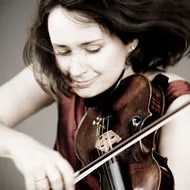
«That is what I live for.»
Patricia Kopatchinskaja plays wildly and passionately. The Moldovan-born violinist is one of the most interesting violinists of her generation. She pays no heed to the rules of the classical music business. Her playing is direct and uncompromising. She studied composition and violin in Vienna and Bern. Today she lives in Bern.
At the age of 13 you fled from Moldova to Vienna. How did you experience that time?
That time was very threatening. We arrived with a few suitcases and a dog, had to surrender our fingerprints and lived in a refugee shelter with almost no money. That was when I understood that nobody would help me if I did not help myself.
Your parents are both musicians. What work did they do in Vienna?
My father was a superstar in my homeland. He led a large folk ensemble with musicians and dancers. He gave 300 concerts a year in the Eastern Bloc and other Soviet-friendly countries. My mother performed with them. We were well off. In the West he could not continue this career. It was a very difficult time.
You moved from Vienna to Bern. How great was the change?
I came to Bern through the violin teacher Igor Ozim, who helped me a great deal. If you come from Moldova, the difference between Vienna and Bern is not so great. Of course, in Bern one misses the abundant cultural offerings of Vienna. In return, the people are patient and friendly, and the landscape is right on your doorstep and wonderful.
What do you miss today when you think of your homeland, Moldova?
Above all I miss my late grandmother. And you cannot find tomatoes like those in Moldova in supermarkets here.
You began composing as a child and only later learned the violin. What did composing mean to you as a child, and what does it mean to you today?
It was only in Vienna that I got to know the Second Viennese School (Schoenberg, Berg, Webern). If you came from the Eastern Bloc, it was like a revelation. Alongside my instrumental studies I also studied composition and composed a great deal back then. Today I compose little, but still now and then. When you compose, you approach music in a very different way, for example more experimentally, whether it is old or new. The living composers with whom I have been able to work, by the way, have never objected to my free handling of the material.
You have a young daughter. What is your daughter's relationship to music?
The daughter will soon be seven years old. Her relationship to music is ambivalent, because she is jealous of music. I am away so often. However, she has a great enthusiasm for opera and, for example, was determined to watch a three-hour performance of Wagner's The Flying Dutchman to the end, even though it was played without intervals.
What does it feel like when you can truly immerse yourself in the music during a concert?
It is like a drug-induced high. That is what I live for.
Do you prefer contemporary music to the well-known great violin works of the Classical and Romantic periods?
"Prefer" may not be quite the right word. But the older works have been played so often and so well that it is difficult to add a new perspective. Moreover, the Classical and Romantic periods belong to a bygone era.
One can contribute much more that is new when one brings the music of our time closer to the audience. That is my contribution and my real mission.
What are your favourite works?
My favourite work is always whichever one I am playing at the moment. But I feel especially close to the works of Bartók, Kurtág, Ligeti and also Mansurian.
You seek to break all boundaries and look for ecstasy in performance. Isn't that incredibly exhausting? Where do you get this energy?
It is indeed incredibly exhausting, and between concerts I am often completely drained. But I want to give the composer and the work everything I have. I do not want to leave anything owed.
And anyway, what is the point of playing at half strength? I would rather stay at home.
Have there been conductors or chamber music partners whose energy and way of playing were too extreme for you?
Yes, of course. Finding the right musicians (and the right audience, too) is a lifelong task. Fortunately, it succeeds again and again. Recently, for example, I came together with Pekka Kuusisto, Lilli Maijala and Pieter Wispelwey to form a string quartet. We work very freely and experimentally, as in a laboratory. We call it "quartet-lab". A magnificent experience.
Interview by Florian Schär | Classicpoint.ch | 5 October 2012
© Photo: Marco Borggreve, Amsterdam
More interviews
All interviews →


