

«What interests me first and foremost is good storytelling.»
«What interests me first and foremost is good storytelling.»
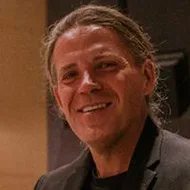
The Canadian composer Nathan Henninger studied piano and film music and additionally gained experience as a horn player and choral singer. His album debut »Five Scenes for Orchestra« with the Scoring Berlin Orchestra – members of the Berlin Philharmonic and other renowned Berlin ensembles – conducted by the composer, was recorded at Teldex Studio Berlin. Henninger created these sound landscapes in a quiet retreat on the Azores, which he occasionally exchanges for his vibrant home in New York. Sometimes eruptive, sometimes dreamlike, the dense work evokes images in Cinemascope format.
You studied piano and horn. How did you come to composition?
Well, my father was a composer. He recently turned 80. I remember being fascinated by an orchestra from when I was a very small child, when one of his pieces was performed by an orchestra. My parents met in the choir at college, so music was always a bridge in our house, something we all had in common. My sister played the violin. My mother was a psychologist and sang and gave concerts in her spare time. It was then that I first saw "Star Wars" and was captivated by the music. Ever since childhood I have been enthralled by orchestras. I think Prokofiev's "Peter and the Wolf" made me aware that all these instruments are characters who want to communicate with one another. What are they saying?
Yes, I have been learning piano and horn since childhood, playing in school musicals and singing in choirs. It was only in high school that I began studying music theory, and when I came to university I began composition seriously, which was my major. After college I moved to New York and studied music at the Juilliard Extension, took private composition lessons and piano lessons with Taka Kigawa at the Greenwich House Music School. More recently I have studied at workshops and privately with some of the best Hollywood orchestrators. I keep learning with every piece I write. My newest work, "Romanza", we recorded on 12 June in Budapest with musicians from some of the best orchestras there. I would say that I seriously began composing during the COVID pandemic, when I was teaching piano at a conservatory on the Azores. I decided to focus on it professionally.
What do you want to express with your music?
Always to make music that we love, that you as a listener would like to hear, and that is hopefully direct and speaks to what is most personal or intimate, what is familiar to you, what you may need. I believe that music has a real power to heal and to enable us to name in our hearts things we do not want to forget, things we somehow need to remember. In my music I am therefore interested in exploring this aspect and sharing it with other musicians and the audience, in order to create something special and hopefully useful. What interests me first and foremost is good storytelling.
What is your greatest source of inspiration for your compositions?
I believe that my own childhood memories and experiences with music created these obsessions and musical ideas as a starting point for my imagination and my education. A kind of "Hansel and Gretel" trail in my heart and my mind. What moves me most, and why, connects me with something that feels emotionally essential to me. It can be a chord change or a gesture, a phrase.
Sometimes music haunts me from a small scene in a film. Nature, and the opportunity to spend time in nature, is also a very important source of ideas and inspiration. I currently live on the Azores and have always loved hiking, camping and being by the sea.
How do you approach a composition, and what steps lead to the finished work?
I regard myself as a melodic composer. I am interested in orchestration, in creating textures and new environments for musical ideas. I describe my music as impressionistic, since I am clearly influenced by composers such as Debussy and love evocative sound landscapes, but also as "neo-romantic", since I am first and foremost a melodic composer.
As a pianist I like to improvise at the piano, use the music memo app on my phone and record these improvisations. Often I find harmonic, melodic or rhythmic sequences or ideas and then start afresh on the manuscript paper. My notation software is Dorico Pro.
I studied with good teachers and learned from Hollywood orchestrators such as Norman Ludwin, Conrad Pope and Nan Schwartz the principles of good arranging and how to develop material in interesting ways. So when I begin with an idea, I look for ways to vary and unify it, to present it, so to speak, in different "garments". In doing so I always serve the narrative and build the material organically and emotionally, as the music implies and suggests.
Once I have a sketch of the piece's form, I often outline it like a story, and here I write down ideas, keys, transitional ideas, general goals and the mood of each section. Then I set about writing the music. And once this structure and the musical draft are in place, I begin the orchestration. Every part of the process generates new ideas. It is a little like sculpting: you are constantly learning what is needed by checking your natural reaction to the whole musical experience and paying attention to what is still missing.
Hopefully, in the end, music emerges that feels welcome and necessary, like a good friend. By putting yourself in the position of the audience, you can be honest and adjust details until you feel that it works.
You lived in New York and moved to the Portuguese Azores shortly before the pandemic. How did that come about?
I came to the island of Terceira on the Azores on holiday for my birthday in December 2018, and fell in love with it. As a teenager I went camping every summer for seven years on Catalina Island, off the coast of Long Beach in California. And Terceira, particularly my neighbourhood of Sao Pedro with its view of Monte Brasil and the cross on its summit, always reminds me of those carefree summers of my youth on Catalina. I had an immediate sense of déjà vu on Terceira and began to explore how I could live there. By the end of that week I had already found an apartment. When I returned to New York I looked for a flatmate for my apartment and moved in February 2019 with my cat Heidi. I found a position there as a piano teacher at a conservatory, and when COVID broke out, I felt safer in a remote setting than in a big city, so I decided to stay. I took Portuguese lessons, found new friends, but kept my professional life and my connections to New York.
And how have your life and your work changed?
Life on the Azores has led me to take my lifelong love of nature more seriously and let it become a larger part of my daily life. In many ways, then, I have changed. But I think I am now better in touch with parts of myself that have always been there, but are more accessible in a natural environment.
I leave the island regularly for work or workshops, so I find a good balance between city life and retreat into the calm and nature that I love so much. Put simply, on the Azores I can find my way back to myself more easily.
At first, as a foreigner, I felt a little like a fish out of water. But I had my cat with me, she was my mother's cat, Heidi. When my mother died, I adopted Heidi and she became my best friend. Heidi loved life on Terceira. She died shortly before I had completed most of the music for "Five Scenes for Orchestra" and recorded it in Berlin. I see the duet between flute and horn at the beginning of Scene 5 as a tribute to her and to our deep friendship. At that time I also adopted my new cat Lua, whom I met on my daily walks on Monte Brasil.
The greatest professional change was that during COVID I began to regard composing seriously as a profession. In the years since the lockdown I have composed a lot of music, recorded in various cities, attended workshops and in 2023 resumed my studies at the Film Scoring Academy of Europe. Today this is my full-time occupation and my business.
Your newest work is "Five Scenes for Orchestras", recorded with musicians from the city's most renowned ensembles: the Berlin Philharmonic, the DSO Berlin, the RSB, the Deutsche Oper Berlin and others. What makes this work so special?
It was a great joy and honour to work with some of the best musicians in Berlin and the world at Teldex Studio. I love the documentary that Sascha Knorr of AudLab produced, which can be seen on my YouTube channel. It shows not only the project but also the musicians. Many of them have become friends and we stay in touch. When I turn to chamber music or solo works, I immediately think of particular musicians with whom I have already worked. Making music can be a little like a family or a community! I love the idea of recurring collaborations, similar to repertory theatre, where you see the same actors in different plays and contexts. I hope I can do the same with the musicians I meet along the way! The Berlin musicians were all very down-to-earth, musically outstanding and generous in their performances.
I think what is special about "Five Scenes for Orchestra" is that it conveys both a sense of grandeur and mystery, yet is fundamentally intimate and personal. It is also about friendship and loss, about the fact that in the end nothing can truly be taken from you.
What are your next projects?
I have just completed the recordings for "Romanza", a multi-movement tone poem for string orchestra, percussion and solo piano. The recordings in Budapest were a joy, we have just begun the mixing, and as with "Five Scenes" there will be videos and a documentary. Next I am turning to piano pieces and chamber music that explore this atmosphere further and are intended to serve as "companion pieces" for my next album "Romanza", which will be released in early 2026.
What are your passions outside music?
I love animals, my cat Lua. I love hiking and nature. I also love art and photography. I am a great fan of the artist Andy Goldsworthy. I once made an international art photography project with bicycles in various settings, called "Cycles". I greatly enjoy visiting art museums when I am in a larger city.
Interview by Florian Schär | Classicpoint.net | 01.08.2025
© Image: NateChet Music LLC