

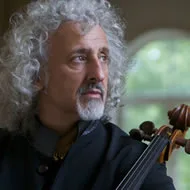
«I stopped smoking at 8 and took up the cello.»

Mischa Maisky is one of the most important cellists of our time. Born in Latvia, the artist was already being hailed early on as the future successor to Rostropovich. The world-famous soloist was sent to a Soviet labour camp at the age of 22 for 18 months and was forced to shovel cement for more than a year without his cello. All the more astonishing is the international career he launched afterwards.
Classicpoint.ch: When and why did you start playing the cello?
By the standards of the Soviet Union at the time, I started playing the cello very late. It was the year I stopped smoking – I was eight. I was the third child; my sister already played the piano, my brother the violin. My mother had had enough; she wanted a 'normal' child, so at first I went to a regular school, but then I insisted on playing the cello. Why the cello of all instruments, I no longer know. Perhaps there was a romantic story: I heard a cello from an open window in the street and fell in love with that beautiful sound. But I always have to disappoint people by saying that I can't remember. Perhaps it was simply a practical decision, so that I could play trios with my siblings. That never came to pass, which is why I later dreamed of founding a family trio with my own children.
After your father died young, Rostropovich was like a second father to you. How did that come about?
I was completely obsessed with Rostropovich's personality as a cellist, teacher and musician. It was my lifelong dream to study with him. When my father unexpectedly died of lung cancer, Rostropovich supported me, although I was not yet his student. After the Tchaikovsky Competition he accepted me into his class. We had a close relationship, certainly on a musical level, but also on a personal one, perhaps because he had always wished for a son (he had two daughters). When we talked at length shortly before his death, he told me that I had been like a son to him.
In the middle of your studies at the Moscow Conservatory with Rostropovich, you were arrested. After four months in prison you had to shovel cement for a further 14 months. What happened, and why could Rostropovich not help you?
They were incredibly unfortunate circumstances. When I was arrested in the summer of 1970, Rostropovich was himself facing major problems because he was supporting the writer Solzhenitsyn, who was then already living at Rostropovich's country house. He did what he could, but at precisely that moment he lost his enormous influence. That I was released after 18 months is a stroke of luck; it could have turned out much worse.
Did anyone ever apologise to you in any form?
I never received an apology. But however difficult the experience was, it was rather positive for my development – for even though it meant I could never complete my degree at the Moscow Conservatory, I gathered important life experience during that time. I try always to see the glass as half full. In this case, at least a quarter full.
How did it feel to play the cello again after that period? Did your experiences find expression in your music?
Yes, of course. Probably unconsciously, but that period shaped me. I did not play the cello for two years in total. Those two years felt to me like 20 years of life experience. When I started again, it was not easy, but not as difficult as one might think. I had a great deal of new energy and was glad to be able to begin a new life.
After your time with Rostropovich, you studied with Piatigorsky. Why Piatigorsky in particular?
He was a legend, especially in Russia. I met him in 1966 at the Tchaikovsky Competition, where he sat on the jury. He was a good friend of Zubin Mehta, whom I knew from Israel. It was Mehta's suggestion, and Rostropovich also recommended only him when I left the Soviet Union. I was very fortunate to have those special four months with him, even though he was already very ill. Shortly afterwards he died of lung cancer, like my father.
If you had to say in a few sentences what he taught you, what would it be?
That is really difficult to say in a few sentences. He stood at the end of his life and knew it. For me it was the beginning of my new life. He loved speaking Russian, and it was for him the last chance to share his incredible life experience and knowledge with someone who soaked it up like a sponge. It was an intense exchange, and in those four months I probably spent more time with him than with Rostropovich in four years, because the latter was always on the road. To say that Piatigorsky was a better teacher than Rostropovich would be as nonsensical as claiming that Mozart was a better composer than Bach, but one can say that I was a better pupil. I had a very close relationship with both; Piatigorsky became my second father in my second life.
You are the only cellist who studied with both Rostropovich and Piatigorsky. How different were these two great cellists in their approach to teaching?
They were very different personalities, but interestingly they had a similar way of teaching. Both almost never spoke about cello playing as such. It was about music and musical expression, and the main thing I learned from both is that the cello (in my case) is no more than an instrument. It is a means that helps us pursue a goal, namely music. One must keep reminding oneself of this, so that music does not become a means of showing how well someone masters their instrument.
Do you listen to recordings by other cellists, and do you also attend concerts as a listener?
Yes, absolutely. I listen to as much music as I can. I listen to other cellists because I believe it is important for developing one's own musical taste, training the ear and not falling into routine. One can learn from every recording and every concert – from the good and interesting things, and equally from the mistakes of others. Music has become my profession, but first and foremost it is my passion. I love music and enjoy hearing it, so I go to concerts to hear magnificent music and outstanding artists as often as I have time.
Would you please tell us the story of how you came to your Montagnana cello?
When I came out of Russia, I did not have a good instrument. I was glad when Charles Beare, a violin maker from London, made an instrument available to me. In 1973 I made my debut at Carnegie Hall on it, with the Pittsburgh Symphony Orchestra. After the concert, a gentleman waited until everyone had left and told me that he loved classical music and had very much enjoyed my concert. His uncle had been an amateur cellist and owned this magnificent instrument, which he could no longer play because he was 94 years old and partly paralysed. He wanted a young artist to perform concerts on the instrument so that many people could enjoy hearing it. The next day I went to visit him; we talked for a long time and I played a great deal for him. When I left, he had tears in his eyes and said that he could now die in peace, knowing that the cello would be in good hands. He wanted to give it to me, but it was his only fortune and his wife was much younger, so he offered it to me at a very symbolic price. As I had no money at all, a foundation bought the cello and I played it until I could take out a loan of my own to buy it from the foundation. So the cello and I have gone through various stages in our relationship: first we fell in love at first sight, or rather at first sound, then we had a wonderful affair for several years. When I bought it from the foundation, we were, so to speak, engaged, and when I had repaid the loan, we got married. We celebrate our anniversary every year – last year was our 40th! It is a long relationship, and I hope we still have just as many years ahead of us.
At your appearance at the Zaubersee Festival in Lucerne, you will be playing works by Rachmaninoff. What do the composer and his music mean to you?
Although I do not come from Russia but from Latvia, I was trained in Russia and naturally have a strong and close connection to Russian music, Russian culture and Russian literature. Rachmaninoff is one of my favourite composers, although I could say the same of at least a dozen others. Sometimes I wish I were a pianist, so that I could play even more of his music, but he wrote many romances and shorter pieces for piano and voice that suit the cello so well that I have allowed myself to arrange them, following the example of his own arrangement of the famous 'Vocalise'. Wherever I have performed these pieces so far, they have been well received, and I hope the audience in Lucerne will enjoy them too.
You are coming with your daughter, who will accompany you on the piano. Even though this is not the entire family trio you spoke of – how do you experience the artistic collaboration with her?
I have been playing with my daughter for many, many years. It has always been my lifelong dream to make music with my children, and that dream has now come true. It is extremely natural and inspiring. I am very much looking forward to performing together again in Lucerne.
Interview by Florian Schär, Johanna Ludwig | Classicpoint.ch | 2.5.2014
Photo: Hideki Shiozawa
More interviews
All interviews →


