

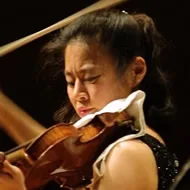
« Music nurtures, feeds, heals and inspires the spirit. »
Midori is a visionary artist, activist and educator. Through her tireless determination to explore and expand the connections between music and the human experience itself, her unique career has broken through traditional boundaries. This energetic delight in innovation, and the expressive interpretations and projects that have made Midori one of the truly great violinists of our time, also run through her other roles as a leading international cultural ambassador and passionate music educator.
Classicpoint.net: You inspired the composer Peter Eötvös to write his Violin Concerto DoReMi, which you also premiered. Was it a collaboration between you?
I greatly enjoyed working with Mr Eötvös, both as a composer and as a conductor. It was something special to perform under his direction and to record the piece. He is a very clear composer, and yet the character of this piece is very rhapsodic and individual. At the beginning I was somewhat overwhelmed by its depth. It is not a long piece, but it contains a great deal.
You founded two non-profit organisations, which celebrated their 25th anniversary last year. Could you tell us about them?
When I saw music being cut from New York's public schools in the early 1990s (I was 19 years old at the time), I wanted to do something about it. Music brings us together, and I know the joy it can bring. I felt that these immeasurable benefits should not be withheld from students, which is why I began giving concerts in schools and talking with the students about music, my instrument, my career, etc. That was the beginning of Midori & Friends. To date, it has reached around 250,000 students in underserved public schools in New York.
In the same year I founded MUSIC SHARING in Japan. At first it was the Tokyo branch of Midori & Friends; since 2002 it has been an independent non-profit organisation. MUSIC SHARING is committed to serving the needs of children. The organisation brings Western classical music and traditional Japanese music into the lives of young people in Japan and in (predominantly developing) regions across Asia. It offers free activities in schools, hospitals and other institutions, and in the 25 years since its founding it has reached 250,000 children. Many of these children would otherwise not have had the opportunity to learn about music or to enjoy live musical performances. Once a year, for example, we organise the "International Community Engagement Program" (ICEP). It is a cultural exchange, outreach and training programme. Each year I form a string quartet with three young musicians, and together we spend two weeks in an Asian country, mainly in underserved regions. Half a year later we spend another two weeks in Japan, where we visit schools, hospitals, refugee camps, housing projects and other educational or social organisations that care for people in difficult situations, and perform there.
You have also developed other projects. Could you tell us something about those as well?
One of my other projects is the "Partners in Performance" programme, which presents chamber music concerts with the aim of stimulating interest in classical music, particularly in smaller communities beyond the reach of larger urban centres that lack the necessary financial resources. And then there is the "Orchestra Residencies Program", which supports American youth orchestras. Over a period of five to seven days I take part in a variety of events, such as masterclasses, performance workshops, meals with Q&A sessions, etc.
You regularly give lectures on cultural diplomacy. What are the core messages of these lectures?
The belief that music nurtures, feeds, heals and inspires the spirit, and that it has, and will continue to have, a positive effect on our future as a global society if we bring music closer to children and teach it to them.
You have received various awards, such as the Crystal Award of the World Economic Forum in Davos, and you are a UN Messenger of Peace. Where can you exercise your influence?
I enjoy bringing people together to work collaboratively, get to know one another and hold discussions. Music is very effective for this. Ultimately I can exercise my influence anywhere, whether in the concert hall, when teaching students, or when I am active in one of the organisations I founded.
You have taught in Los Angeles for 14 years and are now moving to Philadelphia. At the same time, you also work as a visiting professor in Japan. Where do you see the greatest differences in classical music between these two cultures?
My main teaching has always been in the USA. In Japan I teach public masterclasses twice a year. There I do not have my own students as I do in my "studio" at the US schools. In addition, I teach masterclasses in Europe during the summer, or during the school year too, provided it can be arranged.
You also studied gender studies and psychology at New York University and developed a holistic teaching philosophy. Could you explain it?
I enjoy working with young artists and helping them find their own voice by taking their whole personality into account.
You are so versatile and committed. How do you bring all of this into harmony?
I enjoy the work I can do in all these different areas in which I am involved. Each project inspires the others, and they serve as motivation for new projects.
Do you have time for yourself?
Yes.
What do you wish for your own future and the future of humanity?
That we all find the peace to enjoy the joy that art brings; that state which allows us to savour the beautiful things in life. It is not only a peace that brings physical well-being, but also allows us to feel happy, to feel human and to be at peace with the rest of the world.
Interview by Florian Schär | Classicpoint.net | 1.5.2018
© Photo: K. Miura
More interviews
All interviews →


