

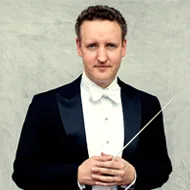
« There are times when I miss the physical pleasure of producing sound. »
Michael Francis is the new Chief Conductor of the Deutsche Staatsphilharmonie Rheinland-Pfalz at the start of its jubilee season 2019/2020. The Englishman is in his fourth season as Music Director of The Florida Orchestra and, since summer 2015, has been responsible as musical and artistic director for the Mainly Mozart Festival in San Diego. In Europe, his engagements have taken him to orchestras such as the Rundfunk-Sinfonieorchester Berlin, the MDR Sinfonieorchester, the Dresden Philharmonic, the Orchestre Philharmonique de Radio France, the Symphony Orchestra of the Mariinsky Theatre, the Trondheim Symphony, the Helsinki Philharmonic Orchestra and the Orquesta y Coro de RTVE Madrid. He has also conducted the London Symphony Orchestra on several occasions. It was here, when he was still the orchestra's double bass player, that he first demonstrated his talent for conducting. He was mentored by Valery Gergiev as well as Sir Colin Davis. In Asia he has conducted the NHK Symphony Orchestra as well as the Japan, Seoul and Hong Kong Philharmonic. In North America he has impressed, among others, on the podium of the New York Philharmonic, the Cleveland Orchestra and the symphony orchestras in Pittsburgh, Houston, Atlanta, Cincinnati, Montreal and Toronto. He has now signed a five-year contract with the Staatsphilharmonie.
Classicpoint.net: You are the new Chief Conductor of the Deutsche Staatsphilharmonie Rheinland-Pfalz, which is celebrating its 100th anniversary this year. What is your impression of the orchestra?
The orchestra is wonderful. They have an ideal balance: on the one hand, they are extremely talented, and on the other, they have the desire to maximise their potential. With this combination, all things are possible. It also helps that they are such wonderful people and try to create a positive, friendly environment for work. I am fortunate to have an inspiring partner in Intendant Beat Fehlmann, who, together with his excellent staff, achieves outstanding results.
In the anniversary year, you have set yourself the goal of providing diverse access to classical music and broad cultural participation. What is concretely planned?
Michael Francis: We have just completed an exciting collaboration with the ensemble Re:Soulution, a Mannheim modern dance group, which brought its unique style to Stravinsky's Pulcinella. This was enthusiastically received by the audience and was paired with Varèse's Ameriques and Satie's Parade: a very stimulating evening! We are also presenting a new concert format in Ludwigshafen, which we call "Keynote Concerts". In the first part of the concert, we discuss a masterpiece with live orchestral examples, followed by a complete performance in the second part. The aim is to foster deeper listening and understanding among the audience and to create an incentive for new audiences.
What are your personal goals in working with this orchestra?
Michael Francis: I see my task as creating excellent conditions through which our musicians can always deliver their best performance, so that our broad and rich community in Rhineland-Palatinate can experience the intentions of every composer at the highest level. I want to maximise our potential and inspire our community.
What are your principles when working with an orchestra?
Michael Francis: Enjoying our wonderful jobs! Striving for artistic excellence in everything we do. Encouraging an environment of bold creativity and the collective responsibility of every individual musician. Strengthening leadership within the orchestra, since only in this way can the highest level be reached and sustained. Always making sure that I am doing my work excellently, so that the musicians can do theirs excellently.
In your opinion, what are the most important qualities that successful conductors should possess?
After all, the musicians make the music. Respect for the intentions of the composer. Artistic vision combined with openness to what each musician brings. Technical competence, so that the musicians can play with confidence. Communication, in order to read the truths out of the music, with the aim that every concert helps the listener to better understand his or her own life and the lives of others around them. Unconditional commitment to delving deeper into our wonderful art form and making it accessible to as broad an audience as possible.
Are there also moments when you would rather play an instrument in the orchestra than stand at the front on the podium?
There are times when I miss the physical pleasure of producing sound. I played the double bass, and this instrument has an incredible physicality – especially in the Mahler or Beethoven symphonies, in Strauss's tone poems and, of course, at the end of Stravinsky's Le sacre du printemps!
You originally studied double bass. Do you still play this instrument?
I can still play it, but now it only hurts! The calluses on my fingers have disappeared, and it would take a few months to get back to a decent standard. At the moment I only play my instrument for myself, but hopefully one day for everyone again…
As a conductor, you are very exposed. Can you tell us an anecdote about a particularly embarrassing moment and a particularly successful one?
Live music always produces surprising moments. Recently, when I was conducting Varèse's Ameriques in Mannheim, I somehow flicked my baton and thereby turned half the pages of my score at once. This meant that I had to turn back to the right place extremely quickly while remaining calm and focused. It was the first time I had conducted this rarely performed masterpiece, so conducting from memory was not an option. The musicians' hearts sank into their boots, and afterwards they asked me what I would have done if I had not immediately found the right place in the score during such complex music. I replied: "Smile and conduct at the same time!" All successful moments of this kind involve having to quickly resolve a situation in which someone else's mistakes would have blown us up – of course I am too discreet to mention these... ;-))
Your home is in Florida with your wife and child. How often are you actually at home?
I have just been away for three months, conducting in North America and Europe. It was a particularly long time living out of a suitcase, but fortunately my daughter is young enough that we can still travel together. During the main season between September and July, however, I am at home about half of the time.
You have a preference for composers from your home country. Which ones do you particularly like, and why?
The United Kingdom is known for its literature and poetry, and perhaps its music has been overlooked as a result. I enjoy bringing the music of British composers to other countries, for one reason only: it is wonderful music and it deserves to be heard! So far, orchestras and audiences seem to enjoy getting to know new masterpieces by Vaughan Williams, Britten, Walton, Panufnik and Elgar.
Interview by Florian Schär | Classicpoint.net | 1 November 2019
Photographer: © Felix Broede
More interviews
All interviews →


