

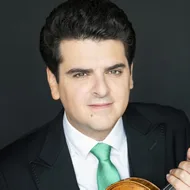
«It is very important to us to train true artists.»

Michael Barenboim began playing the piano at the age of four. After the family moved to Berlin in 1992, he switched to the violin. Barenboim was taught by Abraham Jaffe and studied with Axel Wilczok at the Hochschule für Musik und Theater Rostock. Since 2000, Michael Barenboim has been a member of the West-Eastern Divan Orchestra, and since 2003 its concertmaster. In this capacity he has performed, among other venues, at the Royal Albert Hall in London, the Théâtre du Châtelet in Paris, the Staatsoper Unter den Linden, the Berlin Philharmonie, the Salzburg Festival, Carnegie Hall in New York and the Teatro Colón in Buenos Aires.
As a soloist he has appeared with the Mahler Chamber Orchestra under Pierre Boulez, the Vienna Philharmonic, the Symphony Orchestra of the Bavarian Radio under Mariss Jansons, the Chicago Symphony Orchestra, the Munich Philharmonic under Lorin Maazel, the NDR Symphony Orchestra and – as part of the Summa Cum Laude Festival – the Filasteen Young Musicians Orchestra.
Since 2020, Barenboim has served as Dean of the Barenboim-Said Akademie in Berlin, where he also teaches as a professor.
You are Dean of the Barenboim-Said Akademie. What sets this academy apart from conventional music conservatories?
There are two aspects that distinguish us from other music academies: firstly, because of our origins and close ties to the West-Eastern Divan Orchestra, we have a strong focus on the Middle East and North Africa; around 75% of our students come from these regions.
Secondly, we have integrated a humanities component into the curriculum. This means that all students must take philosophy, literature and history alongside their music subjects. The scope is of course designed so that there is still enough time for practising and rehearsing, but it is very important to us to train true artists. That includes looking beyond the edge of the plate and being more than merely a specialist in instrumental playing.
You yourself once studied philosophy. Which of the big questions still occupies you today?
First of all, I would of course have been very happy at our academy. As it was, I had to break off my philosophy studies after two years in order to concentrate on music.
Fortunately, I retained the ability to think critically, and also the ability to put the right questions to a text (and therefore also to a score).
There are of course many "big questions", as you say, that occupy me. One of them: what can we know with certainty? Socrates already knew that he knew nothing. We live in a world of technological progress, where the internet can give an immediate answer to almost anything. But to a genuinely philosophical question such as "why is there something rather than nothing", you will not get a real answer. I actually tried it.
Have you found your own answers to these questions?
If ChatGPT doesn't have an answer, I certainly don't!
You are regarded as an expert in contemporary music. Do you really enjoy practising contemporary music just as much as the great classics?
Right now, I particularly enjoy the variety. When, as I am now, I play a contemporary recital alongside the tour with the Swiss Orchestra, it is admittedly more work, but it fulfils me the most!
As for practising, one has to admit this: it is not always fun – whether the piece is by Mozart or by Berio makes no difference there. Unfortunately, though, none of it works without practice.
You have just performed the rarely played Violin Concerto by Hermann Suter. What is your experience of it?
For me it was a real discovery! It is a beautiful work in the late-Romantic style. The closest comparison is Richard Strauss. It is really worth listening to and performing this piece, and I hope that it was not the last time for me.
Your new album with Elgar's Violin Concerto is due out in September. In what way will your recording differ from the existing ones on the market?
It is not my intention to do something different at all costs. That should never be the primary motivation. With a piece like this, one must always start from the score itself and develop one's own reading; it is also important to know and respect the tradition. After all, there is a recording of this piece conducted by Elgar himself, with the young Menuhin as violinist. It is not uninteresting when they do something that is not in the score.
I am also fortunate to have played other works by Elgar, such as the Piano Quintet and the Violin Sonata. That is important to me, because then one knows and recognises the musical gestures and ideas that are typical of Elgar. Of course, that also feeds into the interpretation. I think the recording is very successful, played with great expressiveness by me and by the orchestra.
Your brother David makes hip hop music. Are there any joint projects or ideas for the future?
Now and then I have recorded a few bars when he asked me. But that doesn't really happen very often, and that's fine. Still, whenever the sound of a live violin was needed, I was there.
I deliberately do not ask any questions about your father, because I can imagine that this can sometimes be annoying. Which question would you like to be asked in an interview?
It would be presumptuous to want to determine the questions as well, when I am already allowed to give the answers. Of course, some questions come up in almost every interview, but that is simply part of it.
What are your passions besides music?
I enjoy watching and playing snooker, although in recent years it has become very rare for me to play. There simply isn't the time. That is why my level of play is correspondingly modest. If I could, I would play much more often – and then probably also much better.
What do you wish for in the future with regard to your own career?
I have made a habit of not looking too far ahead. I am fortunate to be allowed to make music on stage; I cannot wish for anything more beautiful.
Interview by Florian Schär | Classicpoint.net | 01.06.2023
Photo: Neda Navaee
More interviews
All interviews →


