

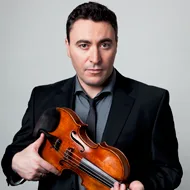
« There is nothing more powerful than love »
The violinist Maxim Vengerov, born in 1974 in Russia, began violin lessons with Galina Turchaninova at the age of five. Today he performs on all the major stages around the world. The artistic director of the Swiss Menuhin Music Academy talks in this interview about his artistic career, his many mentors, his three professions as violinist, conductor and teacher, and his work as a juror at the Isaac Stern Competition.
Classicpoint.net: You studied with Zakhar Bron and followed him from the Eastern Bloc to the Lübeck University of Music in the 1990s. Could you tell us about that time?
Before I studied with Professor Bron, I had been with Galina Turchaninova for 5 years. As a student of Bron, I went to Lübeck to both study and perform. It was a really exciting time for me, especially as I came from Russia. At that time Russia was still part of the Soviet Union, and the cultural difference between my new destination and my origins was extraordinary. As a young person it was a very important time to get to know Western culture, to see where the differences between Eastern and Western culture lay, and to spend time absorbing the great Western offerings. When I came to Germany I was already at an advanced stage, as I had had a fantastic, intensive musical education in Russia – I had studied not only the violin but also harmony and other musical disciplines. Looking back, it was a truly amazing time, because at 13 I was already a travelling musician who was about to see the world for a second time.
When you won the Carl Flesch Competition and suddenly received 70 engagements around the world, you were not yet sure whether you should become a professional musician. Why did you have this uncertainty, and what ultimately led you to become a musician?
For 11 years I learned in pedagogy from two great teachers. The result was that everyone saw me as a professional musician, because my repertoire was very large. I was no longer regarded as a child prodigy. After my studies with Bron, I decided not to have another teacher. If you have been with such a great teacher, who can you have next? The level with Bron was truly exceptional, but I had to leave him because of a family situation. So I had to work alone and discover the music for myself. Around this time I contacted Isaac Stern for a short lesson. He asked me to play the scales, which I then did. He told me I could not connect two notes together, and that he was very glad that I had so many concerts and engagements in London, Japan and the United States, but that I had not yet reached musical professionalism. I asked him to help me and to tell me what was wrong. He replied that he could of course tell me, but that he believed I had the potential to find it out myself. He told me that at 16 he had also been alone, without a teacher. If he could discover music for himself, then I could too. That set me on a challenging path, because I understood that I had to change my direction.
I listened to orchestras, symphonies and operas, and studied harmony and music analysis as well as many other disciplines beyond the violin. This really helped me to broaden my horizons, because I realised that I could not have a career as a violinist without additional knowledge. A year later I had several teachers, none of whom was a violin teacher, and I was performing intensively, with 70 concerts. When I turned 17, I met the great Rostropovich and Barenboim, who became my mentors for life. With them I recorded a large part of the core repertoire. They opened new horizons and perspectives in my musical life, and I am very grateful to them.
In 2007 you had an injury to your right arm and were unable to play the violin for 4 years. How did this affect your future career?
I never had an arm injury! I needed time to take stock of my life. People cannot understand how one can leave a great career in order to study something else. Nobody believed the real reason, so they invented an arm injury. What actually happened was that I felt I had to stop doing what I was doing and instead learn to conduct. If I had continued conducting while still performing, I would not have been able to learn in a profound way. I really wanted to learn the art of conducting from the inside. I told everyone that I would return in 2011, which I did, because in May 2011 I played Brahms in Brussels. Since then I have been playing again, but at a different level, because the study of conducting gave me a deeper understanding and a new dimension to my work as a violinist. The great concertos are mostly written as symphonies into which the violin parts are integrated. If you want to understand the texture of the orchestra, you need a basic understanding of what the orchestra is. When you are able to conduct, you move into another dimension, because you are able to speak the same language as the conductor. This process helps me enormously; I have certainly gained a much deeper understanding of the works of Brahms and Beethoven.
Rostropovich and Barenboim – what can you tell us about these two personalities? What was your relationship like, and what did you learn from them?
They were completely different, like the sun and the moon. I remember that both were quite hard on me. Once, before a concert, I played Sibelius’s Violin Concerto for Barenboim. I was satisfied with the way I played the whole piece, as I had performed it successfully a month earlier. But within a few seconds Barenboim’s silence completely destroyed all my confidence! Those seconds felt like an eternity. I asked him whether he was happy. He said that I could certainly play the piece, but that it was not Sibelius’s Violin Concerto. I asked him what it was, and he gave me the score and said I had to find out one evening.
The next morning I saw him again, and he told me that it was not enough merely to practise; instead I had to connect my violin part with the orchestral lines. After the first rehearsal he encouraged me, saying I had made a good start.
But when I then gave concerts with Barenboim, he still insisted on his interpretation. When I played with Rostropovich, he threw an enormous amount of information at me, but he left me alone to shape the musical content as I felt during concerts. And those were the fundamental differences between Rostropovich and Barenboim. Rostropovich truly gave me the stage and let me shape things freely.
You also sit on competition juries. What do you look for when selecting the best?
I have been involved in many violin competitions. One of them is the Isaac Stern Competition, where next year I will sit on the jury in the final round. At the Wieniawski Competition in Poland I have served on the jury twice, which was a remarkable experience because of the innovative aspects of the competition. I conducted the entire preliminary selection live and heard 220 players in 9 cities around the world. The second time, I made a preliminary selection of 250 players from America, Europe and Japan. From this number I had to choose 45. It was remarkable, because each time I listened to the players I gave them 20 minutes to play, and then we always had 5 minutes to talk. I saw what was within them and what they really needed. My idea of the competition is not who reaches the final or even wins. For me it is important that everyone who takes part gains something from it. They must be transformed. It is also a great platform for young musicians to meet and interact.
History teaches us that not all prizewinners make it to the top. I believe that the competition is an opportunity to compare young players with different repertoires. For example, you may play Mendelssohn’s Violin Concerto very well, but your Bach may not be so stylistically interesting.
In competitions we have the opportunity to see what the player can do. We recognise that these young people cannot yet be called mature musicians; they are only in their twenties. That is why we concentrate very much on their potential and on how we believe their playing will look in a few years. It is very rare to encounter a young player who can already be regarded as a mature musician, but it is possible.
You see music as a healing tool in our hectic times. How and why can music help us?
Music is light and music is vibration. Whatever vibrates therefore has the capacity to influence people. It is very important always to choose the repertoire and the music that you are absolutely in love with. The greatest energy there is, is love. There is nothing more powerful than love. And if you are not sure that you love the composition you are playing, then it is better not to play it!
I greatly admire the work of the American-Maltese composer Alexey Shor. He is Composer in Residence of the Armenian State Symphony Orchestra (ASSO), and I am its Artist in Residence. That is why we have joined forces for the forthcoming European tour. We are making a lovely tour through five cities in January, and for the programme we will combine Bruch’s "Violin Concerto No. 1" and Ravel’s "Tzigane" with new, emotional works by Alexey Shor, presenting either "Barcarolle" or "Lonely Sail" depending on the concert. In addition, the ASSO is performing the European premiere of the 2nd Symphony by the Armenian composer John Ter-Tatevosian, "The Fate of Man".
Shor’s work is beautiful and melodic and fits very well with the rest of the ASSO’s programme. Shor’s music has density and is essentially songs without words that describe nature. It is very strongly connected with aspects of nature, and that is why all the names he gives his pieces refer either to the sea or to something similarly picturesque. A great example of picturesque music is Debussy’s La Mer. The music speaks for itself and helps us to understand it.
I believe there are two kinds of music. One kind is that created by Brahms and Beethoven. You play the symphony, you feel the structure, and it is like a monument. Then there is the picturesque type, by composers such as Debussy, Fauré and Poulenc. What is interesting about their music is that it lets the audience imagine what the composer intends.
Last year you made your debut as an opera conductor and took additional singing lessons. What comes next, what do you still want to learn?
One day I would like to compose something. I have conducted most of the great compositions, and now I am itching to compose myself. But I want to do it when I have time and when I am not in a hurry. I want to let it happen when it has to. Combining my three professions as conductor, violinist and teacher is quite a challenge, and having a family is a full-time job!
I am also really looking forward to working with the Armenian State Symphony Orchestra and Sergey Smbatyan on the European tour. I met Sergey when he was in his early twenties, and as a violinist he is very talented. Although he does not often perform on stage, he understands the violin, and that makes you feel very comfortable with him. The orchestra consists of talented players who have great energy and enormous potential.
Which recording or project are you most proud of?
I am proud of the recording of Tchaikovsky’s Violin Concerto that I made with Myung-Whun Chung and the Orchestra of Radio France in 2015. I think it sounds different to me now, because I now play it in a more symphonic way, since I conducted Tchaikovsky’s Symphony. Chung is also a great conductor and a fantastic partner, and the orchestra did an amazing job.
I am also proud of the performance I gave live from Carnegie Hall last year in a recital with the pianist Roustem Saitkoulov. The concert lasted almost 2 hours! We played works by Rachmaninoff, Paganini and Kreisler. We also played Ernst’s The Last Rose of Summer, which I am proud of, because I was only ten years old when I first played it! So I picked it up again to indulge in memories.
Apart from music, do you have another passion?
My passion is my family. My children also play instruments. My eldest has just made her first orchestral debut in Russia, playing the piano.
Interview by Florian Schär | Classicpoint.net | 3.01.2020
Photographer: © Benjamin Ealovega
More interviews
All interviews →


