

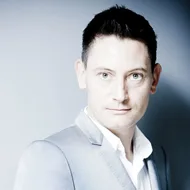
«This love has matured, but it is as fresh as it was back then.»
«This love has matured, but it is as fresh as it was back then.»
The Independent called Maurice Steger "The world's leading recorder virtuoso". Indeed, through his worldwide concert activity and numerous CD recordings, some of them honoured with top prizes, the artist has succeeded in establishing himself as one of the most popular soloists in the field of early music. Thanks to his lively manner and his playing, which is as spontaneous as it is technically brilliant, Maurice Steger has also succeeded in enhancing the recorder as an instrument and repositioning it.
Classicpoint.ch: There are many different recorders that differ in pitch and size. How many instruments do you have that you play regularly?
Yes, that's true. A violinist only needs one fantastic instrument, whereas we recorder players need many different flute instruments, which also differ in construction and tuning. If I divide my instruments into categories, they are modern recorders, historical instruments in a wide variety of designs and reconstructed after originals, as well as special commissions – altogether probably a little more than 70 recorders, all of them wonderful and ready for use at a high level.
You are a sought-after specialist in early music worldwide. How did you acquire this knowledge?
On the one hand, I studied early music, and in doing so I not only dealt with wind instrument methods but also dared to venture over the garden fence to the strings. I read many scores, later studied continuo, and only then, with my papers in my pocket (mine are lying in the attic of my parents' home), did the real work begin. I was very fortunate to grow up in the famous early music groups at a young age; learning about German music with Reinhard Goebel also moved me forward. Getting to know the Italian style of playing was a wonderful thing. Later I studied conducting, and in recent years I have also worked with English orchestras. Through 'Europa Galante', 'Musica Antiqua Köln', 'Akademie für Alte Musik Berlin', 'I Barocchisti' and 'The English Concert', I have made a European Baroque journey with many impressions, moments of learning and approaches – probably better than any place of learning.
The recorder is considered an entry-level instrument before one learns a "proper" instrument. How did you come to the recorder and why did you stay with it?
At first I had great difficulties with the instrument; I was really very clumsy with fine motor skills. That is why I had to put the recorder away in my cupboard for a few years, and I only began learning the instrument at the age of 10. I started to love it at 13, and by 15 there was nothing else in my life. This love has matured, but it is still as fresh as it was back then.
With the Tino Flautino project you address schoolchildren. Can you tell us something about the project and what makes it appealing to you?
With our first Tino Flautino project featuring music by early composers, we reached a great many children, and we experienced our task of giving the youngest something wonderful and valuable to take with them. The great success motivated us to develop a continuation of the story with music that the young French-Swiss composer Rodolphe Schacher wrote specifically for it. As in the first fairy tale, we started from mood pictures that are important for children, and tried to depict elements of nature, human emotional states and scenes using textual and musical means, and to combine them into a total work of art in which an exciting story is told and catchy music is played. Children are a fantastic, honest, direct audience. They notice whether something is genuine. That is a good school for us musicians! And even after perhaps 200 children's concerts, it still fascinates me again and again to play for children. In spring 2011 I also conducted the world premiere of Victor Fortin's 'Pinocchio und der Flötenspieler' and invited some outstanding young people as soloists in order to build a bridge to the little ones – that was lovely!
You also conduct. As an expert in early music, you are often invited by modern orchestras as a conductor that have little experience with historically informed performance practice. How open are orchestral musicians really to new perspectives?
In this country the perspectives are no longer new; the orchestras are working on themselves, and today the question is what a conductor has to do with and in early music. The actual conducting, telling a great story as a good conductor should do with a Beethoven symphony, is to a considerable extent omitted when conducting Baroque music. Rather, this work is about conveying technical playing qualities, realising musical ideas and implementing them as well as possible in terms of craftsmanship, the motivation to make great music, and recognising the wit, the language, yes, even the dialect of a piece of music, playing with it, and not feeling restricted just because the usual vibrato or the heavy bow pressure is omitted. It is a beautiful task that ignites new energy in every orchestra and enhances the sensual experience of early music – and it fulfils me.
You work with the ZKO. What exactly is your role?
My connection with the ZKO is a really long collaboration. As a student I was already allowed to play my first solo concerto there. Later I was invited again and again to perform with the orchestra. I was able to help devise the children's concerts, and in the last two seasons I was finally the orchestra's 'Baroque Director'. In this role I made the Baroque concerts socially acceptable with very distinguished and inspiring guests, a clear concept and a lot of good music – during this time I experienced many beautiful concerts with the ZKO, whether conducting or as a guest in the audience. The Baroque subscription has meanwhile become established, and my role ends this summer. With Roger Norrington, the orchestra has a man who has a great deal of experience with Baroque music.
Do you sometimes feel restricted and limited by the repertoire?
No. Restrictions usually have to do with people, not with the subject matter.
How do you view the relationship between knowledge gained from studying sources and an artist's interpretative freedom?
The art lies in feeling free within laws and conventions. In a certain way I am a serious musician who, on the basis of well-founded knowledge of the repertoire and sources, knows what the freedom of a performing musician should look and sound like. Exploring these freedoms optimally is an art. I believe that this range of freedom is somewhat greater today than it was back then, since we know many styles and epochs. Performance habits, the size of the halls and the compositions of orchestras are also different. It is about the wonderful blend of emotional music-making, stylistically aware, genuine, modern and adapted to today's circumstances, and at the same time inviting us to immerse ourselves in Baroque worlds.
As a soloist, how do you experience collaboration with the leading top ensembles of early music? Is there a certain agreement on performance practice, or are there still very different approaches?
We all have the same information, and we all interpret it differently. What a lovely observation! Most of the surviving sources are written in German, and these are read, pronounced and interpreted differently by a Berliner than by a Frenchman, who understands the content but translates it. The same goes for Italian instructions, French descriptions of rules or English treatises. In addition, each musician's origin is defined per se by their mother tongue. A North German already learns as a child to form long sentences perfectly, to stress them clearly, and thereby to create a clear definition of what is spoken. The same happens in music: when you read Bach or Telemann, you quickly recognise that this constructed music makes perfect sense precisely through its accents and articulation. Quite different, for example, are the Italians. The language sings; it dispenses with accents that are clearly articulated, otherwise it sounds like a educated lady from Hanover ordering her lunch in a hotel in Rome: it sounds defined, the consonants are articulated, it is spoken perfectly, yet the Italian waiter struggles to suppress his laughter, because his language is distorted by this, and it is less about definition and more about sound. And exactly so it is in music. Of course we have all learned to understand our neighbours and to integrate, but – the different cultures live on – and still, when I listen to a Bach suite with the Akademie für Alte Musik Berlin, I not only understand everything; I feel dialectal interpretations down to the smallest detail, and the listening pleasure also conveys information to me. And when I listen to a Baroque opera in Naples, it is the same: I am overwhelmed by the sound of the language.
Audience numbers at classical concerts are falling. Is classical music a dying form?
No, I don't believe that. Classical music is a form of music that appeals to only a small part of people, and it does so at a high level. That has been the case for a long time. Constantly new hybrid forms are emerging between classical music, folk music, pop and entertainment music. This development builds bridges between styles and also appeals to a larger audience. Pure classical music remains reserved for insiders.
Personally, I am extremely happy that my concerts are always very well attended, whether with familiar repertoire or with specialities of the house. Recently I performed a concert by the little-known Graupner in the sold-out Kölner Philharmonie: it could not have been more absurd – people came in droves, even for this music, which represents yet another specialisation within Baroque music! My CD of early Baroque music from around 1625 has also been a frequently heard guest in many households since its release date. The music and its composers are unknown even to classical fans. Our chamber ensemble with recorder, viola da gamba and lute – three forgotten instruments – is the most successful group with which I perform in the largest halls in Europe. This shows me that it is about content, enthusiasm for music, interpretations and the joy of the new. That makes one happy.
Interview by Florian Schär | Classicpoint.ch | 22.08.2011
Photo: MARCO BORGGREVE