

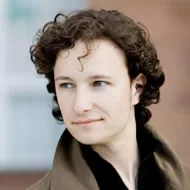
«I intend to take lessons for the rest of my life.»

Among young pianists, Martin Helmchen stands out for his expressiveness, unpretentious playing and profound musical interpretation. With two “ECHO Klassik” awards and the “Credit Suisse Young Artist Award”, he can point to significant prizes in the music scene.
Classicpoint.ch: Your parents were not musicians. How did they react when, as a child, you already decided to become a pianist?
They were probably rather astonished, in contrast to some musician parents, where something like relief seems to set in… However, I always experienced the greatest support, without any excessive pressure to meet expectations.
You attended the Bach-Gymnasium in Berlin, where you focused on instrumental teaching. How did you experience your school years?
It was a valuable time, marked by mutual motivation and enrichment. Apart from the friendships, I still regularly work professionally with many of my schoolmates. There was genuine freedom to devote oneself intensively to music early on, made possible by a school timetable in which the general academic subjects and the young-student programme were coordinated with one another. A unique concept, from three specialist music schools “left over” from the GDR era, which does not otherwise exist in this form in the German-speaking world.
Of course, everyone at this school wants to become a professional musician. Are there people from your class or the whole school who have also succeeded in a solo career?
I received inspiration and artistic impulses from many of my classmates, which in some cases have shaped me permanently, including from those who did not become “soloists”. Important friends and at the same time musical influences were, for example, the outstanding pianist Evgeny Sudbin, as well as Dmitri Jurowski, who began as a cellist and is now a conductor, like the rest of his family.
You had eight years of lessons with Frau Hillenhagen Iwanzowa. Was that the notorious Russian school?
Probably, and certainly the good side of it! One could mention: very comprehensive, far-reaching sound concepts extending to dynamic extremes, also a melodic sound ideal derived from singing; a natural, perhaps holistic technical awareness that can become very athletic, but is always conceived in complete unity with the music; vivid imagery; great emotional depth, even if that may sound like a cliché.
You then moved to Arie Vardi. How did he shape you?
Very lastingly, both personally and musically. He conveys a generosity and nobility that are almost irresistible, both in personal dealings and in music. One is imparted appreciation and enthusiasm both for musicology and for the simplest moments of pure musical joy. Added to this is an enormous store of practical experience regarding performance and the pitfalls of the artist’s life. And he has the gift of explaining music and sharing feelings and insights in such a way that one usually feels one is confronting the greatest music of all (which, in the piano repertoire, is sometimes indeed the case).
You were taught chamber music by Boris Pergamenschikow and then played together with him. How did you experience him and making music with him?
Pergamenschikow was, like Heinrich Schiff later on, as important a mentor as my piano teachers. It was he who kindled my love of chamber music. Without him I would be a very different musician, certainly with a much smaller horizon. Rehearsing in lessons with his students, and later playing as equals with him himself, were unforgettable experiences. In him one encountered a mixture of human warmth, humility, enthusiasm and professionalism that I can only describe as a high ideal.
You now teach yourself as Associate Professor of Chamber Music at the Kronberg Academy. What is important to you in teaching?
Perhaps one could summarise it as creating or sharpening awareness of meaning and expression in music, of my own abilities and limitations, but also always of inner motivations. Why do I do something? Why do I use this particular musical means here and not there? And why do I make music at all?
Do you still take lessons yourself?
Very regularly. I also intend to keep this up for the rest of my life. It is a habit I first saw in Boris Pergamenschikow.
Besides your solo activity, chamber music also means a great deal to you. With which partners do you particularly like to play, and why?
With partners with whom I can share a certain basic attitude towards music. I believe I have already named the most important keywords when describing the qualities and values of my teachers. Furthermore, I have always been fortunate to be able to play chamber music with partners who were further along than I was and to learn from them in a very natural way. A certain spontaneity on stage is also something very gratifying.
You are married to the cellist Marie-Elisabeth Hecker and also play many chamber music concerts with her. You will soon perform with her at the Verbier Festival. What are the differences when you perform with your wife?
Naturally, above all that we know each other inside and out, both personally and musically, and there is boundless trust. But as a married couple one must also consciously maintain a certain professionalism, for example during rehearsals. By the way, she was already my favourite musician before we became a couple privately.
You are still very young. What plans and visions do you have for your future?
As a pianist, one always has an enormous repertoire that one would like to play. A lifetime hardly suffices for it. Bach and Schubert cycles in concert are goals in the medium term that I am working towards. And simply to become a better communicator – both in the modern sense, related to the concert market, and in the more philosophical or spiritual sense of the word.
Interview by Florian Schär | Classicpoint.ch | 1.7.2014
© Photo: Marco Borggreve
More interviews
All interviews →


