

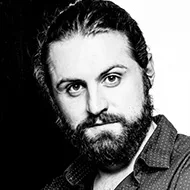
«I put the song recital first.»
Konstantin Krimmel, of German-Romanian descent, first came into contact with music and was fascinated by it during his musical training with the St. Georgs Chorknaben in Ulm. At the age of 21 he began his singing studies with Prof. Teru Yoshihara, which the singer completed in 2020 with distinction. Already during his studies, Konstantin Krimmel developed a particular love for the concert and song repertoire, which he quickly expanded. He has since won numerous competitions, among them the Deutscher Musikwettbewerb 2019 as well as the 1st prize at the Internationaler Helmut Deutsch Liedwettbewerb, the 2nd prize at the Internationaler Gesangswettbewerb ‚Das Lied‘ in Heidelberg and the Gian Battista Viotti International Music Competition. Accordingly, the artist already performs nationally and internationally. He is also a member of the Bayerische Staatsoper and, since 2019, an exclusive artist of the French label Alpha.
When did you discover your singing voice?
I sang in the boys' choir for 15 years. That is how I unconsciously discovered my voice very early on (at 5 years old), and it took shape over a long period. At first, for many years, it was only the choir, and later solo singing lessons were added.
Originally you wanted to become a mountain infantryman. Why did you nevertheless become a singer?
During my time in the Bundeswehr I noticed that something was missing that I had always had before. Only as a hobby, but music had always been there. Singing, playing piano and bassoon, a little trumpet. And after a year in the extra chorus at the Theater Ulm, I followed this calling and went to Stuttgart to study.
Do you prefer song recitals or opera?
I find song recitals less complicated. A good song recital depends on very few components. And I am my own master: I can direct myself, choose the tempi and the interpretation as well. A successful evening at the opera can of course be something very fulfilling, because music takes place in a much larger framework, and on the opera stage there is a scope for shaping that exists nowhere else. However, I do place the song recital first.
How does the use of your voice differ between the different disciplines?
In opera the voice is used in a larger and more voluminous framework, simply because the space that needs to be filled is larger. And acting on stage certainly also promotes vocal development in many cases.
In art song and oratorio, the entire focus is on the music and the voice. I find this demanding in a somewhat different way than opera. The dynamic range, especially for the lower voice types, is somewhat greater in song than in opera.
At the upcoming 50th Schubertiade in Schwarzenberg you will sing the three great song cycles by Franz Schubert: „Die schöne Müllerin“, „Winterreise“ and „Schwanengesang“. What do these works mean to you?
First of all, it is an incredible honour to be allowed to perform these cycles in such a place, and I am really looking forward to it. The Schubertiade creates a very pleasant, family-like atmosphere in which one feels at ease.
Actually, every song recital there is like a dream coming true.
Die schöne Müllerin is certainly closest to me at the moment, since I have performed it more than the other two cycles and it has been honoured with an award.
I am greatly looking forward to the journey through these three masterpieces and am curious how I will feel at the end.
You are of German-Romanian descent and also speak Romanian. There are hardly any songs by Romanian composers. Do you have contact with contemporary Romanian composers?
Unfortunately not yet with living Romanian composers. Perhaps and hopefully something will still come about.
But there is a wonderful composer who also has Romanian roots… Eusebius Mandyczewski. He was actually a publisher in his time and was very good friends with Brahms. He composed himself, a lot of instrumental music, and published the first edition of many songs by Schubert, Schumann and Brahms.
He set two volumes of poems by the great Romanian poet Vasile Alecsandri to music. I have performed a handful of them frequently with Ammiel Bushakevitz, including in Schwarzenberg. Magnificent songs, very romantic music, but in parts also very folk-song-like. Similar to Brahms.
You have been a member of the Bayerische Staatsoper since 2021. How do you experience singing at this traditional house?
I find singing at this wonderful house very pleasant. It has a great acoustic, and I owe a great debt of gratitude to the Nationaltheater, to Serge Dorny and to the whole team behind the stage, because here I experience a great deal of trust and support and get to sing wonderful roles and meet phenomenal new colleagues. Above all, slipping into the costume of Papageno in this historic and magnificent production by August Everding fills me with great joy and also awe, every single time.
What projects do you wish for in the future?
Actually, I am content with nothing more. I get to sing such wonderful music with magnificent musicians in such splendid venues, and to see that opera performances are full, that concerts – especially during Passiontide and Christmas, but also song recitals – are sold out… what more could we wish for, especially in today's times. Giving people a few hours out and letting them revel.
And seeing so many children at performances of The Magic Flute… wonderful.
I would like to sing Elias von Mendelssohn more in the future. Very little comes close to this magnificent work.
What are your passions besides music?
My family, my female dogs, who often come along on trips. And the mountains. A place of rest to recharge. Both in summer, with everything that can be done there, and in winter. Skiing, ski touring,…
Singing, rehearsing and practising take place for the most part in enclosed spaces. So I need the balance of being outdoors in nature.
Interview by Florian Schär | Classicpoint.net | 01.05.2025
© Image: Maren Ulrich, Guido Werner & Flo Huber
More interviews
All interviews →


