

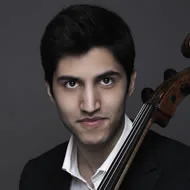
« I would like to approach my career in a relaxed way. »
Since winning First Prize at the »Internationalen Paulo Cello Competition 2013« in Helsinki at the latest, the just 24-year-old Kian Soltani has established himself at the highest level of the new generation of cellists. He went on to win further First Prizes at the »Karl Davidoff International Cello Competition« in Latvia and at the »International Cello Competition Antonio Janigro« in Croatia. Kian Soltani was a scholarship holder of the Mozart-Gesellschaft Dortmund and is a scholarship holder of the renowned “Anne-Sophie Mutter Stiftung”.
Classicpoint.net: Not long ago we published an interview with Ivan Monighetti here. You were his pupil for 11 years. What did he teach you?
His lessons were not focused solely on cello-related matters. I learnt a great deal about the general approach to pieces of music, with everything connected to it. In lessons I sometimes also had to play the piano. I had to accompany him on the piano. I had to recite poems, sing songs, read books he recommended, listen to concerts, go for walks and jogs together. I stayed overnight at his place and we talked about all sorts of things. He treated me like a son. We have a very personal relationship. I am very grateful to him for that. It was much more than cello lessons.
Looking back on this long period of lessons, can it be divided into different phases?
I came to him when I was 11. He didn't change everything at once. His teaching is a very slow and gradual build-up. For the first 2-3 years I didn't yet understand everything. It was a getting-to-know-you phase, in which I simply had to place complete trust in him, as did my father. Later I realised how everything had an effect and was able to reap the first fruits of our joint work. In the final phase Ivan Monighetti then gave me back my trust and let me work more and more on my own. I was able to take on more and more responsibility and grow out of him, so that the farewell was very organic.
You had to travel from Vorarlberg to Basel and back every week for lessons. That makes 6 hours of travel. So from age 12 to 23 your weekends were effectively always booked with lessons in Basel. Did you never miss playing with friends, etc.?
Fortunately, lessons did not always fall on weekends. I could also travel to cello lessons during the week and, upon application, was granted time off school on those days. My father drove me by car. That way I could sleep. So it was more of a strain for my father. At 13 I practised about 3 hours a day and still had plenty of time to play with the other children. We played a lot on the street with balls. Later I practised more and more, until I reached 5-6 hours a day. As a pupil I took my A-levels at the same time as the others.
You grew up in Austria. Your family comes from Iran. What about you is Persian?
Quite a lot, actually. Certainly my appearance. In addition, I always spoke Persian with my parents. We celebrated all the Persian holidays. We ate Persian food and celebrated Persian festivities. At the same time, though, I am also very Austrian. We celebrated those holidays too. I always had two New Year celebrations, for example. One on New Year's Eve and the Persian one, which is celebrated at the beginning of spring, around 20 March. A typical Persian trait is also an exaggerated politeness, in which one often declines offers even when one actually wants to say yes. Even though I don't really do that, I would like to keep up Persian politeness!
Together with your parents, you play Persian music among other things. What does this music mean to you?
Persian music is extremely important to me. It means home, my roots, my childhood and my family. I grew up with it. But only in the last few years have I engaged with it intensively. I give about 1 to 2 concerts a year with my father, sometimes not only with the cello but also with the kamancheh, a spike fiddle. But my focus is of course always on classical music.
Having only just turned 24, you have already won several competitions, yet you have now decided no longer to take part in competitions. What were the reasons for this decision?
With Monighetti, much was geared towards competitions. I took part in a great many competitions. When I stopped studying with Monighetti, I simultaneously also ended my participation in competitions. One must always ask oneself: why do I compete? During my time with Monighetti I did it for the experience and the motivation to practise. It was good to work towards goals in such a focused way, and the successes gave me self-confidence. Then the moment came when I no longer needed competitions as motivation, for self-confidence, or to prove something to others.
You are supported by numerous stars, have played with Martha Argerich, Daniel Barenboim and others, and are part of the Anne-Sophie Mutter Stiftung. Quite a few believe you are destined for a great career. Do you feel any pressure to meet expectations?
The pressure to meet expectations was always there at competitions too. Interestingly, before all the competitions I never believed I would win. I was very relaxed. Perhaps that very quality was the key to success. I have the same relaxed feeling about my career. Of course I still have high expectations of my cello abilities. In the end I can only play as well as I am able to. If that is enough for a great career, that is wonderful; otherwise I will still be happy. I am very glad to be supported by such distinguished artists.
You are still very young. What are your career goals and visions?
I have three great cello role models: Giovanni Sollima, Steven Isserlis and Yo-Yo Ma. They differ in their approach. Giovanni Sollima is a magnificent artist who can do everything on the cello – playing all kinds of styles, composing, and he is extremely creative. For me he is a role model as a free musician and artist. Steven Isserlis is for me the model of the classical musician with an absolutely score-faithful interpretation, meticulously rehearsed. The score is almost a bible, a sacred text. With this incredibly intense and disciplined dedication he is a great role model for me. Yo-Yo Ma is for me a genius with his instinct for the right projects. He is also very open to everything. My goal is to combine these three remarkable characters within myself in order to attain these qualities. I would also like to have a class one day and teach students.
Do you also compose?
I have so far composed only one encore piece, improvise a lot and arrange pieces. In future I would like to work more in this direction, especially with Persian music.
What else occupies you besides music?
A lot, and yet everything is connected with music. I am the type who does something very intensively for a certain time and then, after a while, loses interest somewhat in order to take up something else. So I was almost fanatical about certain sports, later magic and conjuring. I love films at the cinema. After music, films are my greatest passion. If I had not become a musician, it would have been something to do with film: actor, director, film composer or, best of all, all of these in one.
Interview by Florian Schär | Classicpoint.net | 1.2.2017
Image © Juventino Mateo
More interviews
All interviews →


