

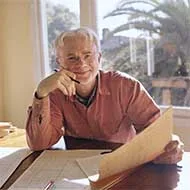
«I do everything that interests me.»

Adams learned the clarinet from his father and played in marching bands and smaller orchestras. His earliest musical experience was a performance of Ralph Vaughan Williams's Fantasia on a Theme by Thomas Tallis, which, in his own words, "shaped him for life". He began composing at the age of ten, and as a teenager he heard the first orchestral performance of one of his works. Adams studied at Harvard University, where he was taught by Leon Kirchner. As a student he occasionally played with the Boston Symphony Orchestra and conducted the Harvard University Bach Society Orchestra. In 1970 he received a BMI Student Composer Award. After completing his studies he moved to San Francisco in 1971, where he has lived ever since. In 1997 he was elected to the American Academy of Arts and Sciences. Adams taught for ten years at the San Francisco Conservatory of Music before becoming composer-in-residence with the San Francisco Symphony from 1982 to 1985, where he developed, for its music director Edo de Waart, the successful and controversial concert series New and Unusual Music. A number of Adams's orchestral works were written specifically for the San Francisco Symphony, among them Harmonium (1981), Grand Pianola Music (1982), Harmonielehre (1985) and El Dorado (1992).
You began composing when you were ten years old. How did you come to it?
I believe most children are naturally creative and find ways to express themselves, but most parents seem not to understand and nurture that creativity. As the saying goes: "Life gets in the way". When I was nine, a children's biography of Mozart was read to us by our teacher, and I immediately wanted to become a composer. Of course I then discovered that I had no idea about harmony and did not know how to handle form, but my parents were wise enough to understand this, and they found someone who taught me. Both my parents were amateur musicians who enjoyed not only classical music but also jazz and show music. So I grew up in a very musical environment, and I think that has always been typical of Americans - we love our popular music just as much as Bach and Beethoven.
You heard the first orchestral performance of one of your works when you were still a teenager. How did that come about?
I had written a suite for string orchestra, which was performed by an amateur adult orchestra in our town in New Hampshire. The concerts took place in the auditorium of a psychiatric hospital, so the audience consisted almost entirely of seriously disturbed patients. I remember how they slowly filed into the hall, and the first thing that struck me was the smell, and even at that young age I realised how terribly dreary and hopeless their lives were. For them it must have been a great relief, a great joy, to hear music, especially live music. I think it was this experience that made me recognise the emotional power of music. It left an indelible impression on my memory that lasts to this day.
You studied with Leon Kirchner at Harvard University. Can you tell us something about your student years?
I studied in a very chaotic period in the United States. The six years I spent as a student encompassed not only the disastrous Vietnam War (from which I narrowly escaped military service), but also the "Summer of Love", the great flowering of rock and soul music, jazz, LSD (which I certainly experienced!) and the birth of ecological awareness. Nobody used words like "climate change" in 1970, but the cleverest minds sensed that this would happen eventually.
At school I was torn between what my professors said about Schoenberg and Webern and what I heard in my dormitory, where I listened to Jimi Hendrix and Miles Davis. At the same time I began conducting student orchestras, and I also occasionally played clarinet in the Boston Symphony. So I experienced what is called "cognitive dissonance" and tried to find my own voice amid a chaos of contradictory influences. Eventually I decided to leave the East Coast and the academic world, which I felt was too bound to conservative European values. So I went to California, thinking I would stay only a few months. I never went back!
You have now lived in California for almost fifty years. To what extent does your place of residence play a role in your artistic work?
I am often asked this question. The world is so connected by technology today that "place" no longer has the significance it had fifty or a hundred years ago. We all constantly communicate by telephone and internet with friends and colleagues around the world. My management is in London, my publisher and record company in New York. I regularly work with the Los Angeles Philharmonic. So where one lives today does not have as great an influence on creativity or identity as it did, for example, for Bartók or Sibelius. On the other hand, I can say that I have long been influenced by the landscape of the American West, the mountains and, above all, the coast. Several of my pieces bear witness to this influence: The Dharma at Big Sur, Hallelujah Junction (the two piano pieces), both of which are set in actual places in California, and, on a more subtle level, my orchestral works such as Harmonium, City Noir (inspired by the film music of Hollywood "noir") and, of course, my most recent opera "Girls of the Golden West", which deals with the California Gold Rush.
Your orchestral work Shaker Loops made you known worldwide. What do you think of this work today?
I must be sceptical about terms like "world-famous", because we are talking about the very small world of classical music. And even within that small world, the number of listeners who are interested in anything other than Beethoven or "The Four Seasons" is smaller still. I am quite open about how small my audience is compared with a pop musician or a film director. Nevertheless, I am grateful for the appreciation I receive when someone tells me how much my music means to them. That is enough. James Joyce had a tiny audience during his lifetime, as did Walt Whitman, and so I am always aware of how things can change.
Your works are regarded as modern classics of minimal music. What attracts you to this kind of music?
It amuses me when I come to Europe and see that I am regarded as a "minimalist". I do not think that anything I have written since 1990 can really be classed as "minimalist". But people are obstinate and cling to their classifications. My earliest works, from the late 1970s and 1980s, show the influence of minimalism in their regular pulsation, their use of repeated motifs and their essentially tonal harmonic language, which are all hallmarks of the "classic" minimalist pieces of Reich and Glass. But from the outset I was opposed to the rigidity of this kind of musical method. I wanted to create a musical language capable of greater expressivity, one that is less "regular" and admits more dramatic contrasts and surprises. Perhaps because I was also a conductor, I was too aware of the subtleties and complexity of the great works of Debussy, Ravel, Stravinsky and Bartók, and I could not imagine writing in as strict and simplified a style as the original minimalists. Nevertheless, Reich and Glass had an enormous influence, and I believe that American minimalism changed the course of contemporary music by offering a musical experience refreshingly free of the terribly opaque and inaccessible styles of the European avant-garde. That was of course very controversial thirty years ago, when figures such as Boulez or Elliott Carter were regarded in that way and kept insisting that their view of the future was the only correct one.
That said, my earlier works such as Shaker Loops, Harmonium and parts of "Nixon in China" clearly show influences of minimalist techniques.
While your works have always been performed very frequently in America, a renaissance in the performance of Adams's works has only been observed in Europe since 2010.
I am not so sure about that. I think that among American composers I have been very fortunate to be performed frequently in Europe since the early 1990s, especially in Great Britain and Holland. My operas are performed more often in Europe than in the USA. "Nixon in China" is still performed regularly - okay, not as often as Puccini, but certainly more often than most contemporary operas! For 2020, four different productions of the same opera were planned, but of course they were all cancelled because of the pandemic. My orchestral music is played very frequently in the United Kingdom, Scandinavia and France. When I conduct in Holland, I have a large and very enthusiastic audience. So I am very happy with the attention my work receives. I love conducting my own music, but I am glad that so many conductors, from the older generation of Rattle and Tilson Thomas to younger ones such as Dudamel and even younger still, understand this music and perform it so often. Gustavo Dudamel has decided to stage a completely new production of "Nixon in China" at the Paris Opera next season. I will give a concert performance of "The Death of Klinghoffer" at the Concertgebouw and also conduct the European premiere of my newest opera, "Antony and Cleopatra", at the Liceu in Barcelona, both in 2023.
If there is one disappointment for me, it is that my operas have not yet been accepted in Berlin and Vienna. The Berlin Philharmonic devoted an entire season to my music and released a wonderful CD box of performances by Rattle, Dudamel, Petrenko, Gilbert and me. It was an unforgettable experience, and I intend to return there. But when it comes to opera, the administrators of these two famous cities repeatedly resist. And not only against mine, but apparently against all American operas, even those of Philip Glass. Why is that? Do they think our American operas are inferior and unworthy of their audiences?
How do you see the differences between Europe and America?
I do not think there is any significant difference. The British audience seems the most knowledgeable and best informed. The French audience is the most enthusiastic (at least in my experience). And I have the most fun with Dutch musicians, who seem to understand my musical language most instinctively. Last autumn, after not conducting for 18 months, I had wonderful experiences with orchestras, of all places in Lahti, Finland, and with the Rotterdam Philharmonic, who played my large, demanding pieces with great commitment and expression, almost as if they knew them. In fact I have reached a point where many orchestras, when I am invited to conduct and suggest one of my pieces, say: "No, we played your piece only two years ago." That is a problem I am glad to have!
How would you assess your personal development as a composer? Are there cycles, phases?
That is too difficult to answer. I can say that the hardest thing for me is the transition from "composer" to "conductor". When I have been at home for a while, leading a quiet, mostly solitary life, I always find it traumatic to have to change my personality - almost like Dr Jekyll and Mr Hyde - to become an extrovert in order to stand in front of an orchestra of 80 or 100 players, many of whom I do not know. It never gets easier, even though I often work today with orchestras I know, such as the Los Angeles Philharmonic or the Cleveland Orchestra or the LSO. I have to work hard to turn myself into a completely different person, but somehow I manage it, and after the first rehearsal I usually feel comfortable and enjoy the interaction with the musicians. I learn so much when I am with them. I could not imagine my music without this other life as a conductor. And it is not only my own music - I do everything that interests me. Of course I am not hired to conduct Mahler, but in recent months in particular I have had the great pleasure of conducting, for example, Ravel's "La Valse", Bartók's Music for Strings, Percussion and Celesta, and Sibelius's Symphony No. 1. It keeps my mind fresh, so that I do not fall into a rut with only my own music in my head!
Interview by Florian Schär | Classicpoint.net | 08.02.2021