

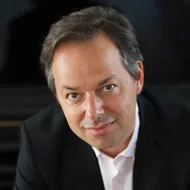
«Digital networks have shaken up things for us musicians too.»
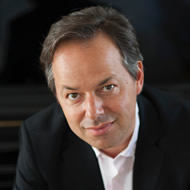
Originally from Stuttgart. After finishing school, he studied violin with Aida Stucki in Winterthur and with Yfah Neam at the Guildhall School London. In 1989 he won first prize at the Rhan Competition of the Swiss music academies, in 1991 a medal at the RAI Italian Television competition for the Mozart Year, and in the same year he was awarded the soloist diploma. Since then he has made numerous recordings for radio, television and CD. As a soloist, leader and chamber musician, he has performed in most European countries as well as in Africa and Asia. Studies in conducting (Lucerne) and musicology and philosophy (Freiburg) have broadened his musical horizons, as has his intensive engagement with new music. Jens Lohmann has been a lecturer at the Zurich University of the Arts and the Zurich Conservatory since 1991. In 2006 he founded the Festival Herbst in der Helferei in Zurich as artistic director, which gives young musicians the opportunity to perform in concerts over one week alongside established artists.
After your violin studies, you also studied musicology and philosophy. How did that come about?
On 7 June 1991, having just received my freshly minted soloist diploma, I stood in front of the Winterthur Stadthaussaal after a performance of Tchaikovsky's Violin Concerto and decided in the following days to do "something else". That a course of life, the way of life, should change so fundamentally after a course of study that, from the outside, had generally been perceived as "very successful" probably has several causes: it seems I had been carrying my school leaving certificate around with me as a kind of legacy, a promise still to be fulfilled, and with the completion of my music studies came, alongside the freedom to take new paths, a few personal matters and a coincidence: on their holiday in Crete, my parents met a distinguished musicologist who taught in Freiburg im Breisgau, who effectively extended an invitation to the Albert-Ludwig University – and that is the invitation I followed.
In 2006 you founded the festival week "Herbst in der Helferei". What makes this concert series special?
In 2006 I would have said: the principle of generations, today meets tomorrow, the consistent realisation of established meets young and talented – a festival of encounters, in other words. But that was somehow in the air, and many others now do this too. Today I would therefore answer: after almost 20 years, the festival has remained personal. Critics occasionally write "small but fine". That certainly refers first to the wonderful location, the Helferei Grossmünster, then to the artists, who are often from my close or wider circle of acquaintances (Zurich, as a city with three great orchestras, really offers an incredibly international pool here), and – not least – to the support of a group (which we call the OK, Organising Committee) that does wonderful work in hundreds of voluntary hours and gives the whole event its special flair and style. The icing on the cake is the apéro that we offer after the concerts, where you can make astonishing acquaintances – a place to see and be seen, perfect for a selfie with celebrities: when Sumina Studer played with us in 2019, Ray Chen came along to the best apéro in town. And finally, that thanks to our shared energy and enthusiasm – combined with a bit of luck – we have repeatedly been able to attract the very best known names: where Mischa Maisky and Patricia Kopatchinskaja once came and went, you can invite anyone – as this year, for example, Avi Avital.
You are also artistic director of the interactive orchestra Stringendo. What is special about it?
Since 1999 it has been a long, intense and beautiful story. Stringendo means departure, movement, action. Stringendo is an inspiring idea, a young style. Our music is different. Listen to it! ..
Have you ever heard a concert? Then you would understand that this is truly the case!
I don't know how many musicians working today as professionals in Zurich and the surrounding area were once Stringendi. The Stringendo milieu has a kind of lingering "smell of the stable" that keeps earlier generations in contact for a long time (possibly for a whole lifetime) and gives them a lasting sense of belonging.
Moreover, Stringendo and the autumn festival are closely intertwined because the two respective Stringendo generations (teenagers and students) perform as the festival orchestra, which creates a win-win situation for ALL those involved.
The support of young musicians is particularly important to you. Has there been a change in young musicians compared with previous generations?
Social media!! Digital networks have shaken up things for us musicians too. On the one hand there are the profitable advantages, such as YouTube, which lets us surf the concert halls of the world free of charge at any time: 24/7 inspiration from living stars as well as from the legends Oistrakh, Rubinstein or Toscanini. – On the other hand, we often cannot get rid of the spirits we have summoned: it starts with the more difficult task of maintaining concentration during practice; it continues with the time-consuming "obligation" to be present online: it is somewhat the case that values have shifted, the online reality (everything that hymns of self-praise on homepages have to say) has overtaken the "old" reality out there; and then there is also a noticeable restlessness that existed much less before 2000: because the parents of gifted young people are constantly presented online with all the celebrities (and pseudo-celebrities), they live under the (inner) pressure that they might be missing out for their children. They are on the move from one event to the next, from one masterclass to the next, from one professor to the next (between which, in some cases, many flying hours have to be covered).
What are the challenges for young musicians today?
Above all: keeping calm (see the previous question); watching with a keen eye (and ear) what genuinely good work is developing, and – as undisturbed as possible – continuing to advance one's own work with perseverance, daily diligence and lasting joy in this wonderful subject matter.
You have been teaching at the Zurich Conservatory MKZ City and the University of the Arts for over 20 years. How has your teaching developed over this time?
I hope it has improved! Three examples: when I started, I brought a few music books to the Florhof, and the students had to play something from them whether they liked it or not; today I have three truly extensive libraries at my disposal: one in several cupboards, one on my phone and then IMSLP. – Secondly: when I started, I had far fewer approaches and images to draw on, and had to develop my ideas, exercises and system in the course of working with the students and their problems; today the entire repertoire is available. This also means that when something does not work straight away, I think: next week we will try it again, differently, I must find the right "key" – so the student repeatedly receives my renewed confidence that he or she can manage it. – Thirdly: thanks to the autumn festival, the class and I are always oriented positively throughout the year. The major project, in which almost everyone usually takes part, creates a flow, and the outstanding artists we invite always bring new ideas and perspectives that enrich us again.
You teach future professional musicians. Far more musicians are trained than the market needs. How do you deal with this?
Counter-questions: if we decided for or against courses of study purely on the basis of market orientation, according to demand – would not everyone then have to study computer science or something in that direction? Have there not long been, or always been, practical degrees, and on the other hand, studies chosen out of inclination rather than for the prospect of a decent income? And will work in other fields not also become less through AI? – You become a musician, of course, because your teachers attest to your talent and you may expect to spend your life in this profession; but above all you become one because you absolutely want to, because you feel called (even if you have to fear that you will not be the very, very best).
Even in the musical profession there are rocky moments, smaller or larger "defeats", doubts; in these situations you are best equipped if you know: I wanted to do this absolutely, it is my "thing".
You also regularly sit on competition juries. What experiences have you had with this format?
I have been on many competition juries and always doubted that I had decided everything entirely fairly – there always remains a faintly uneasy feeling when I experience it from this perspective. Thank God it happens much more often that I prepare my students for competitions. That is always entirely positive: we have a goal towards which we move with motivation and purpose – in cycling I would compare it to a stage. And when the competition's stage is over, it is mainly the progress that remains. (Only in very rare cases have I been really dissatisfied with my fellow jurors' performances; then you have to pick the student back up again ..).
What personal goals would you still like to achieve?
Professionally, I of course want to keep improving, as a teacher, as a conductor and ensemble leader, and and; as a violinist, too, I want to develop (regardless of my age), which goes without saying – it is like young people at a competition: goals are waypoints, no more and no less. And as artistic director of "Herbst in der Helferei", I want to organise many unforgettable concerts in this truly special calendar week 38.
Privately, I want to be – every day – a (reasonably) good father to my children (which is not always easy in our profession); the goal here is that I can increasingly "keep my head above water" so that I may spend time with them.
What passions do you have outside music?
As I said: the children, ..
Then: reading. On my mother's side I come from a literarily interesting and generally interested family, I grew up in a house with an enormous library, and in my (always scarce) free time I have very, very much enjoyed reading a great deal.
Finally: sport. In my youth I did a lot of sport, table tennis, football and and. Nowadays I hardly find the time for it and have become more of a spectator, but with great interest and undiminished enthusiasm.
Interview by Florian Schär | Classicpoint.net | 01.09.2023
More interviews
All interviews →


