

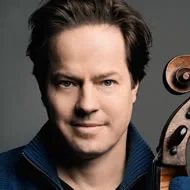
«Music must have social relevance.»

Jan Vogler, who today lives with his wife and two daughters in Dresden and New York, began his career as principal cellist of the Staatskapelle Dresden at the age of 20. He gave up this position in 1997 in order to concentrate fully on his successful career as a soloist. Jan Vogler is also artistic director of the Moritzburg Festival near Dresden and, since October 2008, also intendant of the Dresdner Musikfestspiele.
Classicpoint.ch: You were already a solo cellist with the Staatskapelle Dresden at the age of 20, and in 1997 you gave up this position to start a solo career. Isn't it particularly difficult for an orchestral musician to become a soloist?
You cannot plan to become a soloist. It is a mutual reaction and fascination between performer and audience. I simply wanted to try. It was an old dream from my childhood to travel the world with my cello and play for people of all backgrounds.
I grew up in the GDR. There, such a life was already impossible because of the lack of freedom to travel. So I became a solo cellist. In hindsight, this was a great stroke of luck for me: in the orchestra I played a lot of repertoire and had time to order my thoughts.
Do you sometimes miss playing in an orchestra?
No, that was suddenly over, just like that. From 1997 onwards I was caught up in the whirlwind of my own projects, concerts and CD recordings, and I increasingly looked after my chamber music festival in Moritzburg. A new circle of friends and colleagues emerged, and a completely new lifestyle fascinated and challenged me. It is now almost 20 years since I left the orchestra; time has passed incredibly quickly!
You live with your family in Dresden and New York. What is that like?
New York is our home base; it is my place of calm. There I prepare my tours and projects and let myself be inspired by the music metropolis. We are very rarely in Dresden with the family. But this residence allows me to look after my festivals, and it is also a stop for me between the various concerts in Europe. Moving between the continents has a refreshing side for me. The different mentalities in the USA and Europe help me to put things into perspective and to maintain a certain flexibility.
You have 2 daughters. Do they also practise their instruments diligently?
Both of them play the violin and take it seriously. Even if they probably won't become musicians, it is part of their lives. I see how they overcome difficulties and have small moments of success. They learn to work continuously at something over years, to concentrate and to express their feelings. Only now do I truly understand how important it is for children to learn an instrument.
You are artistic director of the Moritzburg Festival near Dresden. What is special about this festival?
It is paradise on earth, both for the musicians and for the audience! Imagine an idyllic landscape, with fantastic musician friends from all over the world. We live in one place, work intensively on great music, eat together, and in our free time we play table tennis or table football. All the works we perform at the festival, and that is about 25 every year, are rehearsed together in Moritzburg. We have a great deal of fun, and that carries over to the audience.
You are also intendant of the Dresdner Musikfestspiele. What priorities do you set there?
Here I am driven by a vision: what should a modern classical music festival look like in the 21st century?
In 2008 the city of Dresden asked me to completely reorient the festival; it was to become more international and to increase its reach. For me it was clear that this required a message. What fascinated me here was the history of Dresden: its enormous musical tradition, but also its destruction in the Second World War and its reconstruction. At the time I felt that the festival should stand for openness to the world, understanding and tolerance. The festival has developed splendidly, and many visitors come to Dresden from all over the world.
But it could not prevent us from seeing thousands of demonstrators on the streets of Dresden this winter, protesting against an alleged 'Islamisation of the Occident'.
For me this confirmed that music must have social relevance, and that we must work even harder to reach people and to make them aware.
You have already been awarded the ECHO Klassik prize 3 times. Do these 3 prizes have different meanings for you?
The first ECHO was very important to me. In 2000 my solo career was still quite young, and the prize, at that time for my recording of the cello concertos by Schumann and Widmann, supported me greatly. The 2nd ECHO was for a Moritzburg recording with Mozart, and that also motivated all the supporters of the festival to continue working intensively on this project. The 3rd ECHO was a complete surprise: for a long time I was sceptical about whether I should dare to record the Bach Kolloquien at all. When it was finished, I never listened to it again, although I was very happy in the studio while working. After its release I completely 'let go' of the recording; it has found its own path, and I have continued my own path with Bach.
In October 2014, before the ECHO ceremony, you called for tolerance and humanity. What is especially important to you in this?
It is quite painful to see how different the world of artists is from the real world. We have friends and colleagues all over the world; there is complete tolerance and acceptance of each other's way of life, religion or sexual orientation. Add to that open-minded dialogues about music, the environment or politics. And what is the current reality? Hatred and intolerance are increasing everywhere; confrontation and aggression increasingly set the tone, even in Europe. So it was important to me to use the brief attention surrounding the ECHO ceremony to make a start: an attempt to formulate, from within the world of artists, a voice for the basic values of democracy.
Do you also see a need for action in the classical music world?
Less so in the classical music world. Beethoven, Bach and Brahms are conquering Asia and India; classical music is spreading to almost every part of the world. But we must try to convey values through music, to reach people emotionally as directly as possible; only then do we change our listeners, and the music fulfils its true purpose.
Could you imagine becoming politically active at some point?
No, that would be a mistake. But the tradition of musicians standing up for humanism must be revived. It was stronger in the 19th and 20th centuries; there is a wide field for social engagement there, very close to our work as musicians, but far removed from politics, and we must make use of it.
What are your next projects?
At the moment I am occupied with a recording of works by Tchaikovsky. The Rococo Variations for cello and orchestra, but also 2 violin works interest me here, Sérénade mélancolique and Meditation. For me Tchaikovsky is a great dramatist and poet, like Dostoevsky or Tolstoy in literature. I also want to continue experimenting with gut strings. In 2014 I strung my Stradivarius with gut strings for 'Concerti di Venezia'. That was a wonderful experience, and it has also changed my playing on steel strings. Now I would also like to perform works of the 19th century on gut strings; this summer, Beethoven's Triple Concerto and Schumann's Cello Concerto will follow.
Interview by Florian Schär | Classicpoint.ch | 4 May 2015
Photo Jim Rakete
More interviews
All interviews →


