

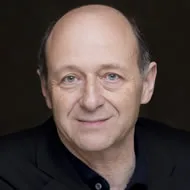
«Where speech ends, music begins.»
The Hungarian Iván Fischer is one of the world's most visionary and successful orchestral conductors. He works with numerous renowned orchestras across the globe and has been Director of Opera at the Opéra de Lyon and at the Kent Opera in Great Britain. In 1983 Iván Fischer founded the Budapest Festival Orchestra in his homeland, where he still serves as Music Director. Since August 2012 he has been Chief Conductor of the Konzerthausorchester Berlin. Recently, Iván Fischer has also become active as a composer.
Classicpoint.ch: You come from Hungary and live half of the time there and half of the time in Berlin. How do you perceive the cultural differences?
There are numerous ones: large country - small country, world language - isolated language, East - West, rationality - inspiration, etc. But there are also similarities. Both capitals are full of foreigners and full of culture; art in particular crops up everywhere.
You worked with Harnoncourt. Where did you disagree with him?
I agreed with him that music is a means of communication. Ideas, thoughts, feelings. Music is not a drug that merely sounds beautiful. Harnoncourt used the word "sound-speech" (Klangrede). I would like to go one step further and say that where speech ends, music begins, because music also conveys something that we cannot express in words.
You founded the Budapest Festival Orchestra in 1983 and shaped it into a top-class orchestra. What distinguishes this orchestra from other top orchestras?
The most striking difference is its innovative spirit, because the BFO intensively explores what the orchestra of the future will look like. The BFO has the highest quality, but a constant appetite for experimentation sets us apart from the top orchestras, which above all preserve tradition.
You have developed your own seating arrangement. Can you explain its advantages?
That is just one of many reform measures. With different heights we balance differences in volume, for example between woodwinds and brass. The woodwinds sound better and cleaner when the basses and not the brass are behind their necks. The double basses play and sound better side by side than in a heap. The second violins are freed from oppression on my right-hand side.
In Hungary there are serious problems with minorities. With your orchestra you have developed aid projects. You also organised refugee aid: lorries, accommodation, food, blankets, etc. What is the current situation?
Now there are hardly any refugees there. Instead, there are almost a million Sinti and Roma, who are mostly poor and have few prospects.
You perform with your musicians in forgotten, taboo places. Can you tell us a little about them?
We regularly visit abandoned synagogues. They mostly stand in "Jew-free" villages and towns. We play for the population, which knows very little about the past. A rabbi tells them about the only Jewish neighbours and about the function of the synagogue. Some have been beautifully restored thanks to donations from emigrated Jews or state support; others are ruins, storage rooms or sports halls.
Where does your main work as a conductor lie?
Music is my miracle cure. My purpose is to serve society. The orchestra is my family.
You have been composing yourself for 18 years now. How would you describe your style?
I mix many styles; the result is something eclectic. Nevertheless, my closest friends say that my music has something personal about it. When I hear that, I am pleased, because I hope that the personal element lies not in the language but in the content.
You have said in an interview that you do not feel obliged to perform contemporary music. What do you think of the quality of contemporary works?
Yes, I find "obligation" counterproductive. If it continues this way, a three-cornered relationship can arise in which the composer writes something boring, the audience is bored, and the conductor programmes it out of obligation. I would rather feel an obligation towards the cultural needs of the audience.
As for quality, one cannot say anything general. There is both beautiful and ugly music. Tonality is slowly winning out over atonality. Atonality will probably go down in history like other failed experiments of the twentieth century. But there are also wonderful atonal works.
At the Verbier Festival you appear in a Wagner evening. What does Wagner's music mean to you in general?
He was one of the greatest geniuses of European culture. His creativity and originality are incredible. He created an entire world.
Could you perhaps say a brief personal word about each of the individual works?
- Die Meistersinger von Nürnberg, Overture: Two worlds collide here. Tradition and the romantic melody. Both are fantastically beautiful.
- Parsifal, Good Friday Music: Pure poetry. When Wagner is lyrical, he is very sensitive.
- Tristan und Isolde, Prelude and Liebestod: Ideally one should read Schopenhauer alongside it.
- Götterdämmerung: Dawn, Siegfried's Rhine Journey, Siegfried's Funeral March and Brünnhilde's Immolation Scene (Starke Scheite, scène finale de Brünnhilde)
Unfortunately we cannot perform the entire Ring. Or perhaps we should?
Interview by Florian Schär | Classicpoint.ch | 1.6.2016
More interviews
All interviews →


