

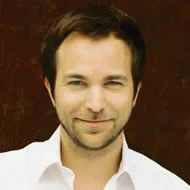
«Now and then I listen to my recordings from the past.»
The pianist Herbert Schuch has made a name for himself as one of the most interesting musicians of his generation, thanks to his dramaturgically well-thought-out concert programmes and CD recordings. In 2013 he received the ECHO Klassik for his recording of Viktor Ullmann's Piano Concerto and Beethoven's Piano Concerto No. 3 together with the WDR Sinfonieorchester under the direction of Olari Elts. As early as 2012, Herbert Schuch had been awarded an ECHO Klassik in the category "Chamber Music Recording of the Year" for his recording of Mozart's and Beethoven's quintets for piano and wind instruments.
Classicpoint.ch: You were born in Romania and moved to Germany after your first piano lessons in your hometown. Where is your home today? What still connects you to Romania?
My home is definitely Germany. Since I was born in Romania to a German family and German is my mother tongue, the moment of arriving in 1988 in Nuremberg, in this country which was in fact foreign to me, when I was eight years old, was something like coming home. At last everyone spoke the same language as I did! My family was not purely German, though. My cousins were brought up speaking Hungarian, as my uncle had married a Hungarian woman. My mother's maiden name was Draskovic, a Serbian name. So it was all multicultural, if you like. The Romanian state was relatively tolerant towards its minorities. For example, there was a German school, which my brother attended. This of course had historical reasons. Until the early 20th century, the population of the so-called Banat was predominantly German and Hungarian. These people then became Romanians virtually overnight, after this region was ceded to Romania following the First World War. The influence of the old Austro-Hungarian monarchy could still be felt linguistically, though. My grandmother still spoke of Paradeisern when she meant tomatoes... By the way, I only spoke Romanian in kindergarten and in the first two school years, but nothing of it has remained. The only connection to Romania I still have is my first piano teacher, Prof. Maria Bodo. She laid the foundation of my technique, and I really owe her a great deal.
All your teachers were over 50 years old. Did you select them deliberately?
No, not deliberately! Herr Kurt Hantsch, with whom I continued my lessons in Germany, more precisely in Rosenheim, was simply the best and strictest teacher in the area. He had heard Edwin Fischer. There is still hardly any room in his flat, as everything is filled with books, scores and thousands of CDs. Karl-Heinz Kämmerling in Salzburg was finally the first address my father managed to find for me in the region when I was 12. So I then studied with him in Salzburg alongside my grammar school and got a sense of how important the Central European repertoire is for us pianists! Together with Brendel, these were the teachers who shaped me the most. All three were born around 1930! I am really very happy that through these people I was able to take something from that epoch, so far in the past.
In recent years you have also worked with Alfred Brendel. Can you tell us something about that?
One can of course describe lessons with Alfred Brendel, but that will never convey the intensity that this coming together always had. Despite all the differences that naturally exist on points of detail, I have never met a musician who thinks, experiences and suffers music with every fibre of his soul and body the way he does. You will also search in vain for his famous humour in the lessons. They are serious, incredibly precise, and always in search of the right character in connection with sound, agogics and articulation. But I feel a little helpless now, because written down, all of this is just commonplaces. To truly learn what a lesson with Alfred Brendel is like, I would have to play something now and explain, through the sound, which mental processes arose in Brendel and then, over time, in me as well. If I am nevertheless to try to pick something out of the wealth of information, it is that Brendel as a pianist always tried not to be a "pianist", but to depict an orchestra, a string quartet or a singer on stage. This is indeed true of almost all German-Austrian music! From Bach to Schoenberg, the piano is simply an ingenious yet at the same time wretched medium for expressing thoughts directly. That is why as a pianist one must always think: how is this supposed to sound? Are there 4 or 80 people playing right now? This question never arises with Chopin. There it is always a pianist accompanying himself on the piano while singing.
In your CD and concert programmes you seek surprising combinations. How do you go about putting your programmes together, what is important to you in doing so, and how do you find these combinations?
It varies. The Schubert-Janáček cycle, in which I combine the great piano works of Schubert with the far too little known piano pieces of Janáček, and which I performed in six concerts in Salzburg, I owe to an inspiration in a dream. For my "invocation" programme, it was the call from Nike Wagner, who requested a piano evening for the Kunstfest in Weimar on the theme of "Invocation". So I simply began to put together music on this theme.
Schumann has always been one of my favourite composers. I put together my album "Sehnsuchtswalzer" in the Schumann anniversary year 2010 to celebrate his early cycles of dances and to reveal the secret connection between Carnaval Op. 9 and a waltz by Schubert. Many ideas arise in conversations with other musicians and artists. Creativity thrives on exchange!
When you won no fewer than three major competitions in one year, you attracted international attention. Did you enjoy taking part in competitions? What was your key to success? Did you play differently in a competition than in a concert?
My last competition was more than 10 years ago; that time seems endlessly distant. In any case, I thought back then that competitions were the only way for me to build a career. Of course, this has a great deal to do with my teacher Karl-Heinz Kämmerling, who more or less gently persuaded all his students to take part in competitions. I was somehow lucky. I quickly won several major competitions and of course enjoyed these successes. Apart from a certain sporting aspect, however, competitions above all taught me how important it is to be truly thoroughly prepared. I did take the sporting element as an incentive to engage with the pieces as well and as intensively as possible. I never played differently than in a concert, but after a few competitions that did not go so well, I came to the realisation that I would rather not play Schubert sonatas in competitions. The views of the jurors were too divergent, and presumably I was in no way equal to this music at that time either. But growing only comes with experience. This is better gained in concerts than in competitions.
You are still young. Looking back, where do you see your main developments?
I see a few major lines. On the one hand, the certainly very sheltered school years, in which I practised a lot and performed little in public. I went to school quite normally and took my Abitur. So it was all rather relaxed. Then the intensive study period in Salzburg with many unforgettable concert experiences! Outside the festival season there is a very exciting musical scene, including for new music. I heard a great deal there and made many discoveries. Lachenmann, Klaus Huber and Toshio Hosokawa were personally in Salzburg and presented their works. There was an unforgettable evening with Nikolaus Harnoncourt and the Hagen Quartet, at which a Mozart quartet was played and afterwards Harnoncourt worked on the music with the Hagen Quartet using the autograph.
Then came the phase in which I took part in competitions and afterwards a certain bewilderment – I had won the competitions, but how should my musical development continue? At that moment Alfred Brendel came into my life and showed me which things one can and must work on as a musician for one's entire life if it is to be a fulfilled musical life.
In November you made your debut with Valery Gergiev and the Mariinsky Orchestra in Munich. Did you choose Prokofiev's First Piano Concerto?
Valery Gergiev has performed all five Prokofiev concertos in Munich and wanted a German soloist for the first concerto. Naturally I was very pleased that he wanted me as soloist. Prokofiev is not really my repertoire as such. But I love this music passionately and deeply! It is so witty, so refreshingly different from the music I normally play! Prokofiev with the Mariinsky and Gergiev – this combination is like Christmas and Easter together! It was also an intense experience, and very interesting to see how he can create the whole atmosphere in the orchestra with just two or three details in rehearsals. By the way, I played Prokofiev's 8th Sonata at my Zurich debut in the Tonhalle many years ago. It is again a gigantic, profound work, one that you probably never finish with.
Where do you want to go, what are your goals?
With a question like this there are always two possible answers: where does the career go, or what happens to the musical development? Ideally both strands can be pursued at the same time. The fact that one plays with ever better orchestras does not, unfortunately, automatically mean that one becomes ever more profound as a musician! Sometimes the development is even contrary. I certainly want to avoid that! To balance both, I repeatedly need phases in which I can study a piece calmly. Chamber music is enormously important to me! Standing on stage with wonderful musicians and dear people and cultivating this form of musical communication makes me happy, and I want to do it as often as possible. And now and then I also listen to my recordings from earlier. It is highly interesting to see what has changed in my music over the years and what is still meant to change. One is never finished with music.
Interview by Florian Schär | Classicpoint.ch | 3.2.2016
© Photo: Felix Broede
More interviews
All interviews →


