

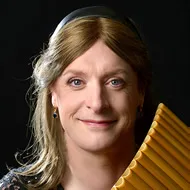
«In the classical music business there is far too much conformity, too many norms and a fear of anything that cannot be categorised.»
Hannah Schlubeck is regarded worldwide as one of the leading panpipe players and has made a name for herself especially in the field of interpreting classical music on the panpipes.
She was born in 1973 in Wuppertal as Matthias Schlubeck and has lived as Hannah Schlubeck since 2020, in harmony with her body and feelings.
She is the first musician in Germany to hold a university degree in panpipes. She began her studies in 1991 as a junior student with Prof. Manfredo Zimmermann at the Wuppertal University of Music, and completed them there in 1998 with the concert diploma.
Alongside her university studies, Schlubeck also received lessons from Romanian panpipe legends such as Damian Luca and Gheorghe Zamfir.
She had her first panpipe lesson at the age of 6 with Erich zur Eck and grew up with this rarely played instrument. Already at the age of twelve she was supported by the French panpipe player Jean-Claude Mara, and at the age of 15 she gave her first concerts.
In more than 30 years, the panpipe virtuoso has now given almost 2,000 concerts in churches and concert halls. Concert tours have taken her to European countries abroad, to the USA, to Latin America and to Australia.
You are the first graduate of a German university of music to take the concert diploma with panpipes as your principal subject. How has the course of study changed since then, and has the number of students increased?
First, I would like to point out at the outset that we are talking here about the panpipe in the form and tradition originating in Romania, which is also the one I play. Different panpipe forms have developed largely independently of one another over millennia on the continents of the world. Besides the Romanian panpipe, which became known mainly through the Romanian Gheorghe Zamfir in the 1970s, many people associate the panpipe with Latin American music and instruments that one encountered in a similar period in West European pedestrian zones. These two panpipe traditions are, however, different in construction, musical tradition and playing technique, even though there have been some crossovers since then.
Unfortunately, there is currently no possibility in Germany to study with panpipes as the principal subject. At the Institute of Music of the Osnabrück University of Applied Sciences there was a Bachelor's programme after 2010, in which, as a lecturer, I supervised a single student.
I see the problem in the almost non-existent basic work from childhood onwards. There are far too few teachers of panpipes, and very few music schools offer interested people the chance to learn the panpipes; there are almost no trained teachers. This creates a vicious circle, since in Germany there are only a few potential students as young talent at a sufficient level.
In addition, the music universities are mostly very attached to their "standard instrumentarium". The panpipe is not an orchestral instrument, so apparently there is no demand from that side either.
An often-cited argument is the lack of original literature for the panpipe. It is true that there are almost no original works for the panpipe from earlier periods, but in recent decades more and more original works have been composed.
I have made numerous attempts to bring the panpipe into the university. Unfortunately without success. Overall, the instrument still struggles with a poor image, ranging from street music to heartache-meditation twaddle and folklore dance. That the panpipe has undergone an enormous development since the 1980s is not noticed.
In the European neighbourhood the situation is now better. There, the potential of the panpipe has been recognised at a number of universities and conservatoires. For example, there are courses of study in the Netherlands and, of course, in Romania. In Austria, panpipe teachers were qualified through a postgraduate programme, which resulted in broader basic work at music schools there. In China, a great demand for the panpipe seems to be emerging at present. There lies great potential for training competent teachers.
In Switzerland, a mass movement in the 1980s and 1990s built up a very large base of thousands of people learning the panpipes. At about the same time as my studies, Switzerland also had several pioneering courses of study, which laid the foundation for outstanding pedagogical work with the panpipes. Today there are courses of study at several conservatoires there, outstanding teachers and even an association of professional panpipe players.
I hope that a course of study will be established in Germany in the future and that the panpipe will, in the medium term, also find its way into the curricula of music schools here.
You have made a name for yourself especially in the field of interpreting classical music on the panpipes. What is the situation regarding original classical music literature for panpipes?
The panpipe is one of the oldest instruments in the world and has a tradition stretching back thousands of years, from the simple pan signal pipe to the present-day version. What is fascinating about it is that the basic principle and simplicity of the instruments, which manage without any mechanism, have not changed. At the same time, in its basic principle the panpipe is the forerunner of all flute instruments and also of the great church organ. Compared with the panpipe, the so-called "early music instrumentarium" is very young.
Nevertheless, the panpipe always had a problem: it was almost always an instrument of the common people, an instrument of the pastoral setting, and it occurred mainly where suitable material for building the instruments was found in nature. The material then also determined the quality of the instruments.
Most composers of that time either did not know the panpipe at all or did not take the simple panpipes, often consisting of several tubes bound together, seriously.
In Mozart's The Magic Flute, one can recognise in the Papageno(PAN)flute what was considered capable of this instrument: just five ascending notes of a G major scale. However, precisely these five notes represent the only "original composition" from Mozart's time known to me.
From time to time, speculation also arises that a shepherd's flute mentioned by Telemann might have been a panpipe.
But for me the question is: why does it always come down to whether the panpipe has original literature from earlier periods? The panpipe has developed enormously, especially in recent decades, both in its playing technique and in the quality of the instruments, and there are ever more highly virtuosic performers on this instrument.
I am absolutely certain that a Bach, a Mozart or a Telemann would have integrated the panpipe, with its present-day possibilities, into their compositional universe.
The versatility of the panpipe offers so many possibilities. A Mozart flute concerto, a Telemann suite or even a double concerto open up new sonic dimensions. At the same time, I am fascinated by the sound combination of original-sound instrumentarium with the panpipe.
I hope that in the future composers will devote themselves more to this instrument: as a solo instrument, but also as a timbre in ensembles. By the way, a panpipe ensemble also offers very exciting sound worlds.
I believe the problem with the panpipe is still the underestimation of its many possibilities …
You were born in 1973 as Matthias Schlubeck in Wuppertal. In 2020 you took a big step and began your metamorphosis from Matthias to Hannah. How did you experience this transition, and how has it affected your music-making?
From my personal perspective, I have always been able to be more Hannah in my music than in all other areas of life. With this step, which I postponed for decades, I am not a completely different or new person. What represents the greatest change, however, is the freedom to simply be ME. There is no more hide-and-seek, and so making music feels very liberated.
But this liberation also needs its time, since for the greater part of my life I had to live and make music in a very controlled way, in a social role that did not suit me. Also, I was simply socialised "as a guy". Perhaps this perspective and position "between the worlds" is a kind of gift, since I am no longer pinned down and can combine my experiences as Matthias with my new experiences as Hannah.
The fear of the step towards metamorphosis, which I felt for so long, has certainly influenced me greatly, above all the looming possibility of no longer being allowed to present my music publicly, of no longer being accepted. After the initial euphoria of liberation, I see, despite much goodwill, major challenges already. This is certainly also because I am not prepared to let myself be pushed from one role into a new pigeonhole.
Recently, due to the developing situation in society and politics, a new fear of the future has arisen.
Whether disabled, queer, of another origin or simply in being different: pigeonholing and the increasingly rampant hatred are very dangerous.
By the way, I am of the opinion that especially in the classical music business there is far too much conformity, too many norms and a fear of anything that cannot be categorised, and that disabled people and certain groups of openly living queer people are far underrepresented. For this I wish us all more courage and acceptance!
In this sense, I totally stand out: panpipe player, severely disabled and trans* …
You were also one of the most successful swimmers of your time, set world records and won gold medals at the Paralympics. What does swimming mean to you?
As a child, swimming was above all rehabilitation sport for me, and as "fun swimming" it gave me a great deal of pleasure for a long time. At some point the moment came when I wanted to stop, but for the first time a time was taken and compared with competition times. As a result, I briefly landed in the competitive group and was entered for the first competitions. From that point on, I won every competition in my special discipline, breaststroke, and within a very short time I was catapulted all the way to the Paralympics. I took part three times and – very unsportingly – stopped after my first competition that I did not win at the Paralympics in Atlanta in 1996 (bronze).
Swimming has given me incredibly many unforgettable moments, and at a young age I was allowed to see a great deal of the world. Of course, it was a balm for my self-confidence as a disabled person to be so successful in this field. In school sport I always gave everything and took part, but naturally I was one of those who sat on the bench last when teams were picked. In swimming it was different – also at school.
Where do you see similarities between swimming and music?
On the one hand, swimming helped me build up a good physical constitution. Controlled breathing and a good lung capacity are essential in swimming as in playing the panpipes.
But also discipline and focus on important moments, and the sensible distribution of one's strength, play a major role for disabled people in all areas of life, not only in music.
You have no forearms – how did you come to play the panpipes?
I was very fortunate to be taught by a very dedicated teaching couple at a branch of the Bergische Musikschule, at the Musikzentrum Einern 13. After early music education, the other children began playing the recorder, which for me was naturally out of the question.
In the house of this branch, the teaching couple zur Eck had assembled a collection of musical instruments from all over the world spread across several rooms. It was always an event as a child to immerse oneself in this collection, in another world. With a great deal of time and patience we were repeatedly in this collection and tried out many instruments. A few possible ones remained. The various panpipes seemed made for me, and I got a sound out of them immediately.
Erich zur Eck, himself a recorder player, then agreed to always learn things in advance so that he could give me panpipe lessons. Later he accompanied me further on my way with the recorder.
At that time it was not at all easy to obtain high-quality teaching material, sheet music and also instruments. The whole environment helped with this. My mother, for example, translated a panpipe tutor by Gheorghe Zamfir, which was written in French, into German with a great deal of painstaking work.
Although the panpipe music published at that time, with its traditional Romanian music, fascinated me greatly, I always grew up in a "classical" environment. Especially at the beginning, recorder literature and early music in general shaped me greatly and remain my heart's music to this day. My professor at the Music University, Manfredo Zimmermann, a recorder and traverso player, is also a specialist in early music and historical performance practice.
It therefore still annoys me today, and I also find it unjust, that I encounter so much resistance when I want to play my "heart's music" in a professional setting too.
The panpipe is simply my instrument – and I love this instrument with all its possibilities. I will never accept being regarded as "not belonging".
Where do you get the strength to achieve so much despite your handicap?
From the very beginning I had a great deal of support from my family. The first years of my life were marked by countless traumatic hospital stays, operations and examinations. But I always knew that I was loved, and that in those years I had my family, above all my mother, as a firm rock in the storm. She was always there at important moments and supported, held and accompanied me. This also applies to this day, in the phase of my metamorphosis.
In sport it was my father who constantly accompanied me, who drove me to competitions after night journeys from concerts and performances, and who still today repeatedly steps in and helps at concerts.
Besides this, I always had the opportunity to try new things, to test myself, and I also had many supportive people outside the family.
I was the first disabled person allowed to attend a regular kindergarten and primary school. Also at grammar school, thanks to my parents' commitment, I played a pioneering role. Then there was finally also the willingness of the Music University and Prof. Manfredo Zimmermann, who, with a special permit, not only admitted panpipes as the principal subject but also accepted singing as a second subject, and indeed no compulsory harmony instrument.
This, together with many wonderful people, musicians and moments in my life, has made me strong, for which I am very grateful.
But there are also always situations in which prejudice, discrimination, rules and the pigeonholing of society become almost insurmountable obstacles. Life as a disabled person is mostly far more strenuous and draining. Unfortunately this is often not taken into account, and much assistance is refused unless one constantly fights for it.
It is so important that people with less backing and fewer opportunities also get chances. In practice this is often still not a matter of course today, even though diversity and inclusion are gladly advertised in society.
What are your goals and projects?
I would very much like to realise many ideas in the field of early music, but also to carry out exciting programmes and projects spanning a wide arc.
My greatest wish at present, however, is to receive support and relief for future projects and ideas, since so far I am still fighting alone in the increasingly complicated music world. Only then does the chance arise to devote myself again fully to new projects on a musical level, rather than constantly getting stuck in the exhausting and energy-draining organisational work. The risks of large projects often lie with me alone. Without fitting into pigeonholes, it is, for example, very difficult to find an agency.
Several new programmes are currently in preparation, which move in the field of early music, but a revival of Mozart's concertos is also on the agenda.
In February I will be a guest, together with my pianist Thorsten Schäffer, with the programme "Colourful PANflute" at, among others, the Laeiszhalle Hamburg and the Gewandhaus Leipzig. A wonderful opportunity to present the "colourful panpipe" with its possibilities across different musical styles – from Bach and Telemann through Donizetti, Schumann, Bartók and Eben to pieces of my own, improvisation, a little jazz and Romanian music.
I am also very much looking forward to a project in a completely different musical world. Together with the wonderful Hamburg klezmer ensemble Mischpoke, we are presenting a programme in the field of world music and klezmer. A very exciting project.
Do you have any other passions?
Music is naturally my greatest passion. Already towards the end of my school days, however, I was also very interested in sound engineering and computers. I have been able to integrate both into my professional life, and so, for example, I founded my own label and have produced most of my recordings myself.
A good balance is the physical exertion of working on my old water mill, in which I have lived for almost 15 years. There are always several major building projects here, which often have to be left lying for far too long. But the practical work offers a good change and time to make new plans in my head at the same time …
Interview by Florian Schär | Classicpoint.net | 01.01.2024
Photo: Bettina Osswald
More interviews
All interviews →


