

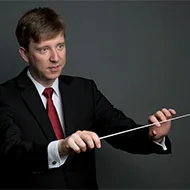
«Getting close to the spirit of Mozart»
Alongside engagements as a freelance oboist with various orchestras, Gotthard Odermatt also devotes himself to chamber music. He performs as an oboist in ensembles ranging from duos to octets and has so far played with various chamber music groups, such as the «Banda Classica». He also performs with the two chamber music formations he founded: the «Ensemble Armonico» and the «Krommer-Bläserensemble».
As a composer, Gotthard Odermatt first came to public attention in 2004 with his «Wind Octet in D major, Op. 15». A year later, it was also performed by the Zürcher Kammerorchester. In 2006 the «Wind Quintet in E major, Op. 16» followed, and in 2009 «Zeit und Stunde, Op. 17», for mixed choir and harp. In 2010 the label DECCA released a CD featuring Albrecht Mayer, principal oboist of the Berliner Philharmoniker, and the Academy of St. Martin in the Fields, on which, among other works, the first movement, «Eté», of the three-part work for solo oboe and orchestra «Trois Images pour hautbois et orchestre, Op. 18» was recorded. In 2012 further world premieres followed: at the Tonhalle Zürich, the «Concertino for Oboe d'amore and Strings, Op. 19», again with Albrecht Mayer as soloist, and in the Kammermusiksaal of the Berliner Philharmonie the «Fünf Miniaturen, Op. 20», for solo bassoon, with Stefan Schweigert, principal bassoonist of the Berliner Philharmoniker.
You studied the oboe yourself and mostly compose for wind instruments. Is it a decisive difference whether one plays an instrument oneself in order to compose, or does it ultimately play no major role, or is it even a hindrance in some respects?
If you can play the instrument you are writing for, that is naturally an advantage. You know its specific characteristics and can therefore highlight its strengths and take its difficulties into account. Especially in a solo work, one of my central aims when composing is to present the solo instrument in its most beautiful registers and timbres, that is, to write «for» the instrument and not «against» it.
Of course, it is not possible to master every instrument I compose for. But this does not need to be a composer's aspiration. Besides the oboe, the oboe d'amore and the cor anglais, I am fascinated by many other instruments. To better understand string and percussion instruments, I have taken lessons in violin and drums, and I maintain a constant and lively exchange with professional colleagues in order to keep learning. For harmonic understanding, a sense of polyphony, voice leading and other matters of part-writing, piano playing is probably the most important thing in composition. I taught myself the basics of the clarinet, bassoon and saxophone. With the saxophone, I even once played in a big band.
My main instrument, the oboe, is considered difficult to learn. I regard this as an advantage for composing. It makes me all the more sensitive to instrument-specific characteristics.
Do you compose more today than you play the oboe, or is it the other way round?
Especially now, during the Corona period, I had only a few performances, as did all freelance oboists. As a composer, I am receiving an increasing number of enquiries, which pleases me greatly and strengthens me in my compositional work.
You have already received several commissions from the Berliner Philharmoniker and from its musicians. How did that come about?
As a rule, a great many different factors play a role in receiving such enquiries. Alongside diligence, perseverance, the proverbial right moment and a bit of luck, cultivating personal contacts is also enormously important. If nobody knows that I compose, nobody will think of asking me for a composition. Once people know me, I get to prove myself anew with every work.
The contact with the oboist Albrecht Mayer, and thus also with the orchestra of the Berliner Philharmoniker, came about at the KKL Luzern. Albrecht was very taken with my compositions, which is why I have written numerous compositions for him. A friendship developed at the same time. Through the compositions for Albrecht Mayer, other members of the Berliner Philharmoniker also approached me, and works for other instruments have since come about.
You have recently written a new work on commission from Albrecht Mayer, the principal oboist of the Berliner Philharmoniker. How did this commission come about?
This current composition, which has been released by Deutsche Grammophon, is a special commission. Mozart left a fragment of an oboe concerto in F major, K. 293, which comprises only 50 bars; after that, the first 19 bars of the solo part have survived. The task was to complete the fragment in Mozart's style.
Albrecht Mayer had already recorded Robert Levin's version for Deutsche Grammophon in 2004, accompanied by the Mahler Chamber Orchestra under the direction of Claudio Abbado. Prompted by the wish to make the solo part more «oboistic», Mayer approached me some years ago with the request to complete this fragment. At first I had great respect for the task of finishing a work by Mozart in his style, but when he approached me again in connection with these CD recordings, I had already carried the idea within me long enough, and I decided to accept the commission.
What exactly was the commission? Did Albrecht Mayer have any influence on the compositional process?
The commission was to complete the first movement of the oboe concerto K. 293 in Mozart's style. After I had finished the composition, Albrecht Mayer proposed various variants, particularly for the oboe part, which I then incorporated into the composition. The whole experience he has gathered so far as an orchestral musician and soloist, especially with Mozart's music, impressed me greatly, and our collaboration became profound and immensely enriching.
After completing the first movement and recording it in Germany with the Deutsche Kammerphilharmonie Bremen, we both enjoyed the result so much that we are already thinking about a second and third movement. This would then give oboists another complete oboe concerto. These further movements would have to be composed from scratch. We have searched for fragments I could build on, but have not yet found any.
How would you describe the work?
As already described, it was an important concern for Albrecht Mayer that the solo part be tailored to the oboe. For the whole harmony, the structure, the proportions and the voice leading, I studied many scores by Mozart and took my bearings from his other instrumental concertos, with particular attention to his wind concertos. His chamber works, in particular the Oboe Quartet K. 370, also served me as a model and inspiration. With regard to range and technical possibilities, I oriented myself, both for the oboe and for the orchestral instruments, to the possibilities of the time. This applies, for example, to the natural horns. The movement is formally structured in the sense of the classical sonata-allegro form.
The typical elements of the Viennese Classical style are an important and useful foundation, but I consider it even more important to get, so to speak, close to the «spirit» of Mozart. To this end, I travelled to Vienna, among other reasons, to visit the composer's surviving places of work and to find inspiration. Composing in Mozart's style was electrifying for me, indeed even intoxicating, and I could almost physically feel how much joy the man Mozart must have had in composing. I wanted to let this joy flow into my composition as well.
What is important to you when composing?
When composing, it is important to me that I have enough time and quiet and that I can be entirely with myself. Then I can fully immerse myself in my music. It is especially pleasant when I manage to have dealt beforehand with as many current outstanding tasks as possible. I also like to go into nature to recharge my energy.
When you look at the current new compositions of other composers, what do you like and where do you have more difficulty?
That is not easy to answer. The stylistic range of compositions, particularly in today's time, is enormous, as is the number of works being composed. I find it exciting when composers venture along new paths and are able to realise convincing concepts. Personally, the most important thing for me is that the music touches the heart in some way. That is essential for me. If a composition has a purely intellectual approach, it mainly speaks to my head, and only "merely" to that. For me, the question of style is not the main concern, whether something comes across as "more modern" or "less modern".
What are your next projects?
At present I am composing a symphonic poem for large orchestra as well as a sonata for tuba and piano. A work for trio with oboe, bassoon and piano is being planned. Further works for Albrecht Mayer are in preparation, as are further chamber works.
What passions do you have besides music?
I enjoy sport and am a member of a table tennis club, like going into nature and love animals. I am also a science fiction fan. In my free time I enjoy visiting good restaurants, love good conversations and like to travel, although the latter too often takes place in connection with music.
Interview by Florian Schär | Classicpoint.net | 19.04.2021
More interviews
All interviews →


