

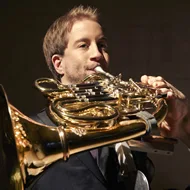
« At the moment everything is simply wonderful. »
"What I dreamt of as a little boy, I achieved long ago", beams Felix Klieser. Indeed, the career of the musician, born in 1991, reads impressively so far: first the youngest horn player of all time at the Göttingen music school, then at the age of 13 a junior student at the Hanover University of Music and Drama, horn player in the National Youth Orchestra and on tour with pop star Sting, "Life Award" laureate and federal winner of "Jugend musiziert". In 2013 his much-praised debut album "Reveries" appeared, with pianist Christof Keymer and works of the Romantic era; the following year brought the "Echo Klassik" as Young Artist of the Year, as well as the music prize of the Association of German Concert Agencies, endowed with 10,000 euros — "he stands at the start of a promising career", the jury predicted. Little wonder, then, that a book publisher took notice of him and offered to publish his autobiography. And so it happened: the book "Fußnoten – Ein Hornist ohne Arme erobert die Welt" ("Footnotes – A Horn Player Without Arms Conquers the World") by Felix Klieser has been available since summer 2014. It has since even been published in Japanese and Chinese.
Classicpoint.net: You were born without arms and had already chosen the horn at the age of four. Despite these adverse circumstances, you now count among the best horn players in the world, and you play with your feet better than most people do with their hands. Could you tell us a little about your beginnings?
Why I fell in love with the horn at the age of four, I honestly cannot say. The fact is that I wanted nothing else, although no one in my family is a musician, and in my immediate surroundings there was no great interest in music within the family. But I pestered everyone until I was sitting in front of a horn. Only then was I satisfied. Of course, every sensible horn teacher advises against starting such an instrument so early. The mere fact that baby teeth eventually fall out and new teeth grow in is basically a good reason to wait much longer before starting – not to mention the lack of lung capacity. But I must already have had a rather stubborn character back then, one with which no one could easily keep up. In any case, I know that it gave me a lot of pleasure as a child. I practised small melodies, and after about one and a half years I could actually play "Hänschen Klein" on the horn. It was a hobby, just as other children play football. No one would have thought that I would ever make it my profession. Although, of course, I did not practise every day at the beginning, it was always regular, and over time I got better. At some point I started taking part in competitions and even won them, all the way to the federal "Jugend musiziert" competition. Even though there were still people who gently mocked my enthusiasm, I increasingly realised that playing the horn made me happy.
Have you ever asked yourself whether you might not have become such a good horn player with hands? Because your ambition might have been smaller?
Many people always ask me how one can learn the horn with one's feet. I never asked myself that question; I simply did it, as with everything else in life. Where no teacher could help any further, I had to help myself. But that already gave me pleasure as a child, and today as an adult it is precisely what drives me: I love solving problems and working on techniques until they work. I don't think a character trait depends on whether one has arms, legs or fingers. I have always been very ambitious and wanted to understand things and make them work. I usually don't think about arms.
You play almost without using a stopping technique, since you have no right arm. Through years of experimenting you have worked on finding your sound, and you shape the different tone colours through minimal changes in tongue position and by enlarging the oral cavity. Are you still searching and discovering new sonic possibilities?
Finding the right sound was indeed the greatest challenge for me. I worked on it for many, many years. At first I sounded very high, almost like a trumpet. But I wanted to sound like everyone else, and that is what I had to work on. Honestly, I have been working on it for 20 years, and I am still far from the end. What the audience sees in the concert, that is, how I handle the horn and press the valves with my toes, I never had to train. That has always worked and is simply my natural way of doing things. But what the audience does not see, only hears, that is where I have worked hard.
You do not describe yourself as especially talented and are convinced that everything has to be earned through hard work. Do you also give lectures for companies or events on self-motivation and paths to success?
No, I have not done that yet. That is not one of my goals at all. I simply want to play the horn well, and I am always delighted when people come up to me after a concert and tell me how much they enjoyed the music.
Who are your favourite composers?
We horn players are very fortunate that many composers have written for our instrument. Richard Strauss, Ludwig van Beethoven, the brothers Michael and Joseph Haydn, Johannes Brahms, but also Reinhold Glière or Camille Saint-Saëns… and of course the great Wolfgang Amadeus Mozart. His four horn concertos are true masterpieces, and I enjoy playing them enormously in concert.
Which compositions do you have a special connection with?
I have just recorded Mozart's four horn concertos with the Camerata Salzburg. And all of it in the Mozart city of Salzburg, in the large hall of the Mozarteum… one cannot get more Mozart than that. Every morning I walked from the hotel past his birthplace – that does something to you. But it was even more enjoyable to delve into the background of the horn concertos. Mozart wrote them all for his good friend Joseph Leutgeb. Leutgeb was several years older than Mozart and had to go through a great deal to obtain these compositions. Mozart made him kneel by the stove for hours and threatened to tear up everything he had written so far should he dare to get up. Or he insulted him in the scores in the most extreme terms as a "donkey who should finally take a breath", as a "pig's tail who doesn't hit a single note", and so on. At one very difficult passage he even has the violins laugh at the horn players. And yet they were close friends. Such details say a great deal about what Mozart was probably like as a person and how he himself saw his music. All of this must feed into a recording, and with this knowledge, a soloist also builds a special relationship with a composer.
What does music mean to you in general, and why is music important for people?
That is a very difficult question to answer, because music means something different to everyone. I myself could not imagine a life without music, but of course I also see it through the professional lens. Others let music play all day in the background and only perceive it in passing. I could not do that.
Music has been part of our lives for several thousand years and exists in every civilisation. Musicians have always held special positions in society. Musicians were and are messengers of news, storytellers, the mirror of society, or simply entertainers – and I do not mean the latter in a disparaging way at all; I greatly admire truly good entertainers and always try to learn from them. Music can make people happy, but it can also stimulate thought. Sometimes music can even spark a revolution. Every era has its music, and it connects people within our society.
As a musician, where do you see your role in our society?
First of all, as a classical musician I do not think in political dimensions. I want to give listeners a pleasant evening and remind them of the beautiful things in life. I am always pleased when I see young people in the concert hall – perhaps even some who are learning an instrument themselves, preferably the horn, of course! I always talk with them, and now and then I can even give some advice. For this reason, by the way, I not only accepted a teaching post at the Münster University of Music, but I also get involved with the "Rhapsody in School" initiative and visit school classes to tell pupils about my instrument or my profession. It is important to me that we classical musicians are not regarded as an elitist bunch. Hopefully this will take away young people's inhibitions about going to a classical concert now and then, or even encourage them to learn an instrument themselves.
What are your wishes for the future?
At the moment everything is simply wonderful. I have many concerts, get to travel around the whole world and meet many interesting people. Amid all these happy successes, I always try to remind myself that I am not even 30 years old yet. I would like to pursue this profession for as long as people want to listen to me.
Do you have interests or passions besides the horn?
Unfortunately, the life of a professional musician leaves little time for other things. Either I practise, or I travel, or I play concerts. There is not really much room in between. That is why I am fortunate to enjoy practising passionately, to love travelling to new countries immensely, and to enjoy playing concerts most of all.
Interview by Florian Schär | Classicpoint.net | 1.6.2019
© Photo: Maike Helbig
More interviews
All interviews →


