

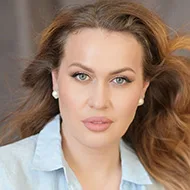
«The Zurich Opera House has a very special significance for me.»
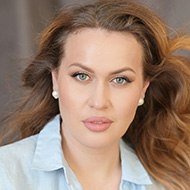
Elena Stikhina is an internationally acclaimed Russian opera singer (soprano) who has established herself in recent years as one of the outstanding voices of her field. She was born in Russia and received her musical training at the renowned St Petersburg Conservatory. She first attracted major attention as a member of the ensemble of the Mariinsky Theatre in St Petersburg, where she sang leading roles from the Italian and Russian repertoire.
Stikhina's international breakthroughs have included the Metropolitan Opera in New York, the Vienna State Opera, La Scala in Milan and the Bayreuth Festival. She is particularly valued for her powerful yet lyrical voice and her intense stage presence. Among her most important roles are Tosca (Puccini), Aida (Verdi), Senta in The Flying Dutchman and Elisabeth in Tannhäuser (Wagner).
With her musical expressiveness and technical precision, Elena Stikhina is now counted among the leading sopranos of her generation.
How has your understanding of "Tosca" or "Aida" changed over the years?
When you fall in love with opera for the first time, you surrender completely to it. You take everything in as one vast, grand whole. Then you begin to study a role, and suddenly you find yourself inside the character's mind and living within the libretto. But every time you return to a role for a new production, you discover something new. A different nuance in the music, a new tension between the characters, a truth you somehow overlooked before. With Aida, the first thing that overwhelms you is the spectacle. The great ensembles, the chorus, the sheer scale of it all. Only later does it become something much more intimate. A story about real people, their impossible choices, their grief. Tosca was a puzzle for me. For a long time the first act confused me. Why does it feel so different from everything that comes after? Why is the music so light? Then my teacher gave me the key. Treat it like an operetta. Playful and unguarded. Because the tragedy has not yet begun. That single insight changed everything.
Is there a role that you would say today you would have interpreted very differently five years ago?
Honestly, every single one of them. You can never sing the same opera in exactly the same way twice. Every performance is absolutely unique. When you keep returning to a role over the years, it grows along with you. Your own life changes, your perspective shifts, and the character changes precisely with it. I can't think of a single opera that I could perform today exactly as I did five years ago or as I will in five years. The role ages with you.
Which prejudices about dramatic voices do you keep encountering?
Only recently I came across a rather charming prejudice. People with dramatic voices apparently only enjoy listening to other dramatic voices. Completely wrong and, frankly, a little insulting to our taste! But the bigger myth is that dramatic voices are simply fully developed by the age of twenty. Yes, the potential must be there from the start. But a powerful voice very often matures over many years. It is really rare for a dramatic instrument to be stable and complete so early in life. And then there is the assumption that big voices need no technique. That singers like me simply stand there and let nature do all the work. That always makes me smile.
Does every stage really feel different, or is that a myth?
Far from being a myth. Every stage feels completely different, because every theatre has its own acoustics and its own atmosphere. The acoustics are the work of the architects. The atmosphere is something else entirely. It is created by the audience and by time, over decades, and it simply cannot be designed. It just accumulates.
Is there an opera house that has shaped you particularly deeply?
All theatres are special in their own way. But the Zurich Opera House has a very special significance for me. It was there that I sang Salome for the first time in Europe. The emotional pressure was immense. Singing a German opera in a German-speaking country is truly daunting. The pronunciation is merciless, and Salome also demands enormous physical movement. But all the hard work was worth it, and Zurich will always mean something special to me for that reason.
You are currently appearing as Amelia in "Un ballo in maschera" at the Zurich Opera. How much of Elena is there in Amelia?
Honestly, not very much. I rarely see myself in my characters. We are usually very different people. But during rehearsals I work hard on how my character thinks, on justifying each of her decisions, even those I find completely illogical. If I cannot understand her from the inside, I simply cannot embody her convincingly from the outside.
Many of your roles involve extreme emotional pressure. Do you take any of it home with you?
I have a personal mantra: when you leave the theatre, you leave the character behind. For me, separating work and private life is absolutely essential. The dressing-room door swings both ways.
Is there a character who has changed you personally?
Every role makes me think. Not necessarily about myself, but every one leaves traces. I would even say it is the other way round. Life leaves traces on my characters. A particular event or experience in your own life can completely overturn your understanding of a role, what you bring to it, and what you feel when you sing it. The character does not change you. You change the character.
Was there a performance where the audience's reaction was especially intense?
Yes, in 2017 I stepped in at the Paris Opera to replace Anna Netrebko in "Eugene Onegin". The protest against the change of cast was as loud as the ovations after the letter scene. At the final curtain the reception was extraordinary. It was, quite literally, a new chapter in my career.
If you had not become a singer, where would your path have led you?
We will never know. When you find your passion, truly find it, you can no longer imagine thinking about anything else. I am sure I would have found my place somewhere. But speculating about what that would have been? I really cannot.
Are there rituals before a performance that are important to you?
I love resting before a performance, sometimes even sleeping in the afternoon. But what is truly sacred are the last thirty minutes before the curtain. Warming up, listening inwards, finding the stillness. I need to be alone, without interruptions, without noise. Just me and the music that is about to sound.
What passions do you have outside of music?
Above all, my family. Time with them is irreplaceable. Cinema, long walks, nature and good food. Really very simple things. But after a week of Verdi, simple things are exactly what you need.
Interview by Florian Schär | Classicpoint.net | 01.06.2026
Image copyright: Daria Valetova
More interviews
All interviews →


