

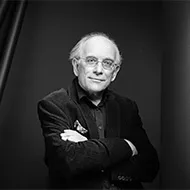
«Artistic work comes first.»

Born in Bonn, Dirk Joeres studied conducting and piano in Berlin, Cologne and London, and composition in Paris with Nadia Boulanger, the grande dame of musical modernism.
Dirk Joeres has also successfully devised new forms of presenting classical music. In 2008, for example, he initiated a new concert format at the home of the Sinfonia in Leverkusen: „KlassikSonntag!“. The press called it „a captivating offensive for classical music“ (Kölner Stadtanzeiger). The CD/DVD series „Beethoven Today“ and the series „Klassik im Kloster Steinfeld“ have also established Dirk Joeres as a „born music communicator“ (Westdeutscher Rundfunk).
Dirk Joeres’s CD recordings have received top ratings in the international press. The London-based Gramophone magazine awarded its ‚Critic’s Choice Award‘ for a Brahms recording with the Sinfonia; a Schumann CD with the RPO likewise received top reviews: „Exemplary ‚Rhenish‘ – a reference recording“ (Supersonic award, Pizzicato).
After your piano studies, you also studied composition with Nadia Boulanger. How did you experience the grande dame of musical modernism?
As very elderly and remarkably mentally agile. She represented a bridge to the past (after all, at the Paris Conservatoire she had studied with Gabriel Fauré!), while at the same time she was keenly interested in all developments in composition in the 20th century, her admiration for the music of Igor Stravinsky being a constant.
Do you still compose today, or do you have compositions planned?
During the Covid period, when concerts were of course not possible, I wrote several piano pieces. Incidentally, I believe every performer should at least master the basic rules of composition, for example be able to write a cadenza for a Mozart concerto. Doing it yourself also deepens your respect for the achievements of the great composers, and with it the realisation that without them, performers would be nothing at all.
What does music mean to you?
Here I can only agree with the wonderful words of Friedrich Nietzsche: „Without music, life would be a mistake“.
You later also established yourself as a conductor. How active are you still as a pianist today?
I often play in chamber music ensembles together with members of the Westdeutsche Sinfonia (most recently, for example, in the piano quintets by Schumann and Brahms), and occasionally as a soloist.
You are artistic director of the Westdeutsche Sinfonia and were principal guest conductor of the Royal Philharmonic Orchestra London. Tell us, what is important to you in your work as a conductor?
The responsibilities of a conductor are very varied, and of course artistic work comes first. But psychology also plays a major role: one of the most important tasks of the conductor is to motivate musicians, that is, to convey one's own identification with the music being performed. Only someone who is themselves „on fire“ for something can inspire others.
Were there formative experiences in your career as a pianist and conductor?
I believe the decisive influences ideally come before the start of one's professional life, if one is lucky enough to find good teachers. One can then build on early experiences in one's career.
You are the initiator of several formats. Could you tell us a little about the format «Dreiklang»?
„Dreiklang“ is an interdisciplinary format that brings together representatives of literature, philosophy and music in order to illuminate a theme from different perspectives. Past themes have included, for example, the Romantic era or the breakthrough into modernism at the beginning of the 20th century.
What is the idea behind the CD/DVD series Beethoven Today?
Beethoven's symphonies in particular run the risk of becoming mere cultural heritage that is only ever „consumed“. With the CD/DVD series, my aim is, on the one hand, to bring to people's awareness the message behind the notes; on the other hand, I want, above all with the help of Beethoven's sketches, to draw attention to the architecture, the „blueprint“ of the works. The goal is therefore active listening. For: whoever knows more, hears more.
You are said to have great communication talent. What would have become of you if you had not chosen music?
I would certainly have gone into something related in some way to language. And when I look today at how it is used in politics and the media, I have to conclude that language requires our special care and attention.
What hobbies and interests do you have besides music?
Literature and history.
Interview by Florian Schär | Classicpoint.net | 1 November 2022
Image copyright: Hagen Willsch
More interviews
All interviews →


