

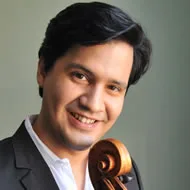
«My relationship with the music of Peru and Uruguay is excellent.»
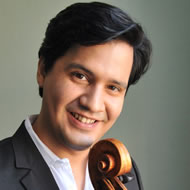
The German-born cellist of Peruvian-Uruguayan descent is among the most sought-after musicians on his instrument. Alongside his career as a soloist, he is a professor at the Stuttgart University of Music.
Classicpoint.ch: You were born in Germany, and your parents come from Peru and Uruguay. How is your musical relationship to your South American roots?
My relationship with the music of Peru and Uruguay is excellent. Since childhood I have regularly and enthusiastically listened to both Peruvian salsa music and Uruguayan tango music. In recent years I have also ventured onto the dance floor more often to learn both tango and salsa. Unfortunately I hardly have time for it, but I can only recommend it! It is worth mentioning that the world's most famous tango, "La Cumparsita", does not come from Argentina, as one might assume, but from the pen of the Uruguayan composer Matos Rodríguez.
Your parents are both professional musicians too. How much did they contribute to your having built your career?
My parents exposed me to classical music from my earliest childhood. I still remember very clearly how, at the age of six, I had to listen to "The Magic Flute" twice in a row and sang along enthusiastically with the large booklet of the LP.
When I then started playing the cello, my parents were a great support in daily practice, and my mother, a pianist, accompanied me from the very beginning. I never felt under pressure to become a professional musician, but there was one decisive condition. My parents wanted that, if I wanted to learn the cello, I should also do something for it every day, namely practise! If I failed to keep to this, the cello would be taken away from me again without further discussion. I had just turned seven. Naive and highly motivated, I agreed immediately. A few weeks later came the day when football mattered more to me than cello practice, especially as it was a sunny summer day and my school friends had spontaneously arranged to meet after school, me included. My parents now insisted on the agreed condition, and of course I had no desire to practise. They replied that they would now take the cello away from me, and, as stubborn as I was back then, I went offended to my room with the intention of going to football at once. But after the short walk to my room, I became aware that I did not want to lose the cello, so I sat down, practised my required amount and was then able to go to football contentedly. I often think back to this episode and I am very grateful to my parents. In this way I learned discipline and/or self-discipline at a very early age, without knowing what that word actually meant at the time. This was naturally enormously helpful for my development.
You were a pupil of Boris Pergamenschikow and later a guest professor at the Hanns Eisler School of Music in Berlin. How did the transition from student to teacher at the same institution go?
That was now ten years ago, and I did not find it to be a great transition. My longtime teacher and mentor, Prof. Boris Pergamenschikow, had supported me enormously during my studies, and it was always important to him to draw independent artists with their own opinions out of his students.
Even though it was cut short by his early death, teaching alongside him was a special time, far too brief, and we always had an active exchange of views. Even today, in every lesson I give, I think of him and take great care to pass on the principles he stood for to my students.
You now teach as a full-time professor at the Staatliche Hochschule für Musik und Darstellende Kunst in Stuttgart. In what ways do you differ from other cello professors?
Well, it lies in the nature of each person's uniqueness. That is why this question would be better put to my students or to participants in my masterclasses so far. :-)
Together with the painter Klaus-Peter Kirchner you developed the installation project "Raum für Pablo Casals" as a tribute to the great cellist. What exactly was it, and how did it come about?
When I won the 1st prize at the Casals Competition in Kronberg in 2000 and, as a result, was able to play Pablo Casals's famous Goffriller cello for two years, I familiarised myself closely with the various biographies of Pablo Casals. What struck me in particular was how strong a personality he was and how, in his time, he especially championed freedom of expression, democracy and brotherhood. Klaus-Peter Kirchner and I wanted to erect a musical and artistic monument to this, with an installation and a parallel live concert.
What interests do you have besides the cello and classical music?
Dancing tango and salsa, yoga, meditation, jogging, and a great fondness for football, both playing it and watching it.
What are your plans for the future in music?
At present I am busy researching intensively the great standard works of the cello repertoire by Bach, Beethoven and Brahms, and planning recordings of them in two to three years at the earliest.
This season I am engaged at a wide range of concert venues around the world, including the Konzerthaus Berlin, the Beethovenfest Bonn and, incidentally, also the Beethoven Festival in Warsaw, the Festival Casals de Puerto Rico and the Fort Worth Symphony Orchestra in Texas. At the same time I hold a professorship at the Stuttgart University of Music and regularly give masterclasses on various occasions. It is important to me to strike a good balance between my own performances and teaching.
Interview by Florian Schär | Classicpoint.ch | 2 December 2013
Photo: Neda Navaee
More interviews
All interviews →


